
 PREVIOUS : Emotion Domain
SITE : “Effects of Social Isolation on Mental Health”
The SOCIAL Domain refers to a category of human interactions with its own distinctive rules, expectations & behaviors for responding appropriately in social situations. It includes developing social skills such as collaboration, fair play, leadership & communication, that help us enjoy participating effectively with others.
It’s our ability to engage in social networks that promote overall well-being & optimal performance. Being socially healthy doesn’t mean having many intimate friends, a multitude of casual acquaintances, but rather knowing how to make & maintain contacts.
This domain helps to recognize that we aren’t alone – that we need to be attached, have support & a sense of teamwork. Knowing that we have someone to turn to makes any difficult / painful day much easier to deal with.
Any society can be defined by 3 significant dimensions :
AREAS : A workplace, organization, neighborhood, village, city, state, nation or state
TOPICS : Social domains are relevant to such fields in the social sciences as anthropology, linguistics, & sociology….
PARTICIPANTS : any social, political or religious group or community (family, school, sports teams, clubs….)
EXP : social media influencers, brand managers, content writers….
Optimal : Being able to recognize social cues & the effect of our behavior on others. Understanding & responding to the feelings & intentions of others, having good communication skills (listener & speaker), & the ability to repair or restore relationships.
EXP: We’re encouraged to be silent in a church, or mosque. But it’s normal to make lots of happy noise at a game or concert
Social Domain Theory (SDT) examines social thinking & behavior from a developmental perspective, in 3 categories : moral, conventional & psychological. It considers emotions & moral judgments as “reciprocal processes that cannot be disentangled”. Research has found that most people distinguish —
♦︎ conventional issues – about actions that are determined to be “right or wrong” by current social norms, standards or customs
FROM
♥︎ moral issues – about actions that have an impact on the welfare & rights of others, such as minimizing harm, fairness re. individual freedom, the distribution of resources….. (“Beginner’s Guide….)
CHILDHOOD
Brain research consistently indicates that the first 5 years of life are the critical time to form social skills. Problems in this domain are caused by a distorted or traumatizing “social engagement system” &/or learning difficulties. It makes such children have trouble picking up social cues, self-regulating around others, or understanding the effect of their behavior on others. 
Children who are chronically hypo- or hyper-aroused in social situations from excessive stress will more easily go into fight-or-flight, or freezes (from peer pressure, bullying, being excluded, meeting someone new….). They can react by being aggressive or withdrawn, which causes problems in several areas of life, especially learning, & then spills over into the other 4 domains.
ADULTS
Self-regulation is how well a person copes when stressed, & then is able to recover from the expended energy.
The 2 adult Social Domains are Romantic & Work relationships. Emotions & actions in these areas are organized in different ways, using different abilities.
Attachment research has shown that the key is not frequency nor intensity of social activity but knowing how to organize** one’s behavior in each. EXP : functioning at work requires different rules & skills than those needed when dealing with mates & children.
** Organize : how our brain arranges & structures incoming information in a meaningful way, which helps with efficient storage & retrieval of memories.
Social interaction is essential to all humans, but as people age, retire & /or are bereaved, they’re more at risk for withdrawing & a reduction in their social network, with harmful effects on both mental & physical health. Social isolation can be measured objectively, while loneliness is subjective. Research in the UK noted a link between loneliness & low levels of physical activity due to injury or illness, with an increase in risk behaviors such as smoking & alcohol abuse.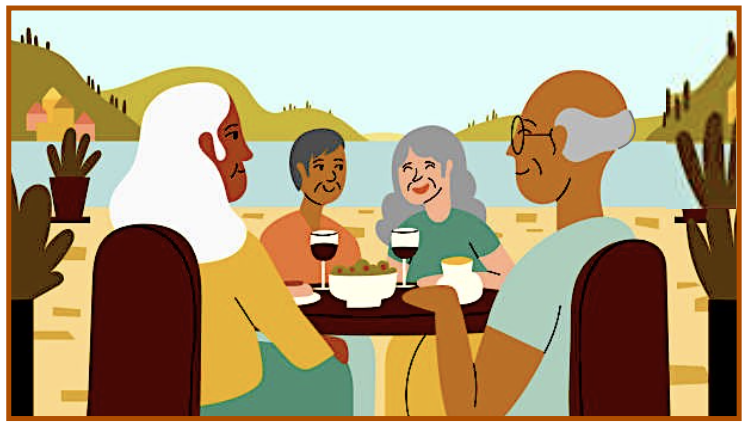
However, a 2005-6 US study found that – contrary to popular belief – older Americans are well-connected, having more contact with core confidants & involvement in their community. The association between age & closeness depends on how often they interact with network members. Social contact was found to be greater among women, African Americans, Hispanics, those with less education, & non-retirees. Also – with increasing age (60s —–> 80s), there seems to be greater weekly involvement in Religious, Neighborhood, & Volunteering groups.
«
«
NEXT : Prosocial Domain
 HEAL & GROW for ACoAs