
 PREVIOUS : Cognitive Domain
SITE : 5 STEPS to REGULATE our EMOTIONS
EMOTION (E) Domain (D) – often called “Affective” D.
Successful Emotion-Regulation (E-R) has many adaptive outcomes & connections, increasing our well-being, including better psychological health, social functioning, coping with stressful life events, as well as for school or job success.
The main focus of this domain is on the social-emotional development of the child – about their experience, self-expression, emotional management, & the ability to form positive, rewarding relationships with others. It involves the ideas, emotions & reactions that influence learning & behavior.
In this context, learning goals usually start with verbs such as appreciate, commit, demonstrate, express & respect.
This Domain tracks the growth of feelings & emotional responses throughout the educational experience. An ‘affective’ learning objective could be : “By the end of this course, participants will appreciate the importance of parental engagement & communication.”
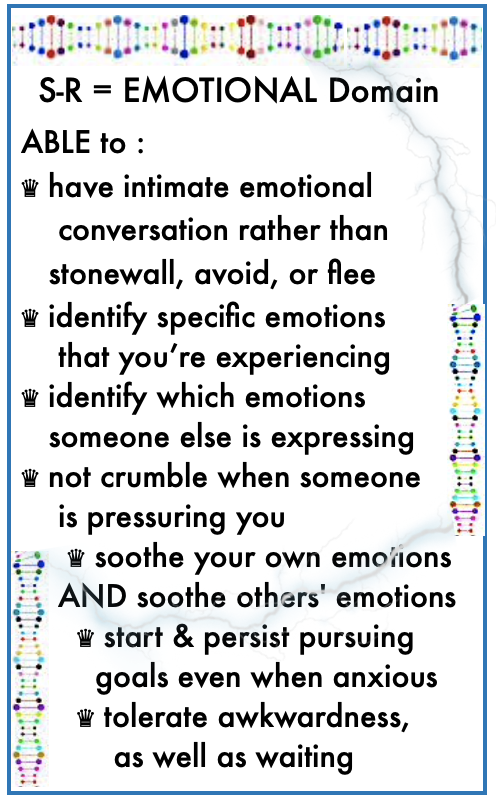 It’s about the whole range of activities, interactions & environments provided for children / students to gain beliefs, knowledge & tools.
It can also be evaluated during psychomotor activities, observing how students work together to master physical skills.
IN GENERAL the domain is about how we handle life-events emotionally, expressed in the form of appreciation, enthusiasm, drive, & values. Specifically, it’s how well we deal with the stress of intense emotions at both extremes —> very excited or very painful ones.
🔆 It’s about the physical energy & tension created by Es, not which one is experienced nor the event that might have triggered it.
It’s layered into a hierarchy, from simpler feelings & attitudes to the more complex – as the person gradually becomes more involved, committed & internally motivated. In this process, our emotions about a person, event or situation go from a general awareness of them -—> to eventually being incorporated into our ‘selfhood’, so they consistently guide or control our behavior. This helps us understand what our values are & how they’ve developed.
This hierarchy is sub-divided into :
1. RECEIVING stimuli – being aware of emotions & feelings, with the ability to have selective attention
🔰 Keywords (for content analysis) : ask, attention, courteous, dutiful, follows, gives, listens, & understands
EXP: Listen carefully to someone or a lecture, watch a movie, watch waves crash on the sand….
2. RESPONDING to stimuli – the listener’s active participation, as well as reacting to various people/ places/ things. (PPT)
🔰 Keywords – answer, assist, comply, discuss, greeting, help, gifts, narrating, shows, tags.
EXP: in a conversation or group discussion, give a presentation, comply with procedures, follow directions….. 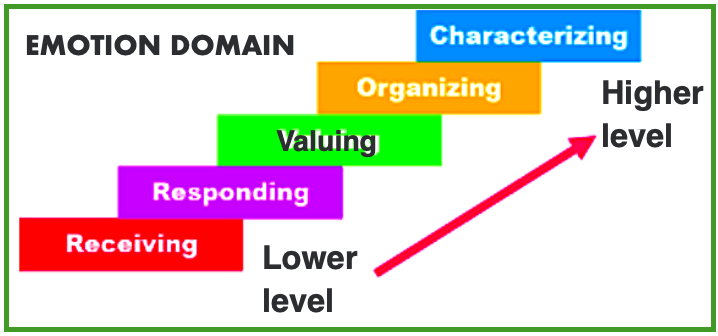
3. VALUING : the ability to see the worth we attach to something – “how important is it ?” (a particular object, experience, behavior or piece of info). Also, ways to express it clearly, from simple acceptance to the more complex state of commitment – such as from a desire for a work team to improve its skills —> to taking responsibly for its overall improvement.
🔰 Keywords : appreciate, cherish, demonstrate, initiate, invite, join, justify, propose, respect, share, treasure,
EXP : share ideas about increasing laborers’ salaries, propose ways to improve proficiency, inform leaders of possible project issues….
4. ORGANIZATION : ability to prioritize one value over another, by comparing, classifying, integrating & resolving conflicts between them. Also, forming a unique value system which determines ones priorities, guiding decisions & ways of acting toward others.
🔰 Keywords : compare, relate, synthesize.
EXP : a teen spending more time on her studies than with her boyfriend.
5. CHARACTERIZATION : the ability to internalize values and let them control the person’s behavior. Can work independently, or collaborate in group activities, & use objective methods to solve problems. Have goals which involve individual, social, and emotional patterns – which learners are able to adjust as required.
🔰 Keywords : act, discriminate, display, influence, modify, perform, qualify, question, revise, serve, solve, verify.
EXP : practice professional ethics, modify beliefs & change behavior based on new evidence, and value people beyond superficial features.
EXP : A man marries a woman for who she is rather than ‘just’ for her looks, job or income.
«
«
NEXT : SOCIAL Domain
 HEAL & GROW for ACoAs