

PREVIOUS : Self-regulation – Inhibition
SITEs :”Self-Regulation vs. Self-Control”
re. child’s brain
Self-Control (S-C) vs. Self-Regulation (S-R)
Self-regulation is about identifying & reducing the causes of mood, thought & behavior problems. It’s deliberately being in charge of what those T.E.As are, in ways that allow us to provide our needs & promote desires. It includes goal-setting, habit formation, emotional regulation and self-control.
Self-control (S-C) is always searching for hidden stressors. It’s the ability to resolve conflicts between our short-term desires & long-term goals. Stuart Shanker (2016) wrote : “Self-control inhibits strong impulses, but only a small part of S-R, & is more valuable in the long run.” EXP : I’m trying to lose weight, but I’d rather a burger than a salad …
Successful self-control means choosing to sacrifice a smaller immediate pleasure (binge watching TV) and instead – pursuing  an option that yields a larger but delayed reward (working on or finishing a project).
A S-R ‘failure‘ means ignoring the delayed reward in order to get immediate pleasure, which is called a ‘temptation’. So, does giving in to temptations really make us happy?
Researcher gave smart phones to a group of young people, & at random times asked them if they were currently experiencing a temptation.
If they said “yes”, they were to indicate whether they indulged or not, & how they felt about their choice. Although responders did get short-term pleasure from giving in, it didn’t increase their overall happiness. On the contrary – they felt less happy soon afterward.
However, not all decisions we make when choosing between immediate pleasures & long-term rewards cause inner conflict.
— For S-C inhibition to be triggered, we have to experience stress about the choice, such as “I really want cake BUT should pick salad”
— However, there will not be any conflict IF you don’t care about your health or you don’t like sweets. So you can freely pick either one.
DEVELOPMENT: The background to Self-control & Self Regulation is ancient, going back as the writings of Plato.
♥︎ S-R can also be traced to Hippocrates, whose work evolved into the 20th cent. science of Physiology, which looks at bodily  systems that keep the balance between energy output & restoration.
More recently much focus has been put on stress management & how S-R can help’
S-R is mainly about social interactions.
♠︎ S-C has traditionally been used by religious authorities & educators, who’ve worked on building character to strengthen ‘willpower’. This eventually developed into Behavioral Psychology, which looks for ways to contain the surface effects of imbalance, using age-old methods of punishment & reward to manage behavior.
S-C is only about individuals.
GOAL: Both styles aim to achieve “effortful control”- the ability to voluntarily focus one’s attention, which results in inhibiting or activating actions in response to their environment.
S-R is a way of reducing the amount of work needed to reach this “effortful control”, by keeping track of one’s impulses, worries & fixations – without being judgmental.
S-C instead encourages battling one’s ‘weaknesses’ to achieve “effortful control”, by judging oneself harshly, as well as being judged BY others (controlled by what others think of us).
When most people consider Self-control, we usually assume it means trying to force the brain to ignore or drown out uncomfortable or painful emotions. We take a deep breath, count to 10, or more often do something to distract ourself….. 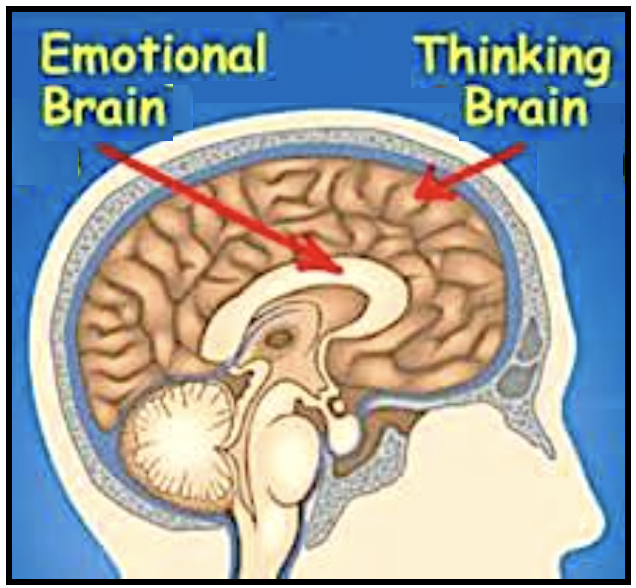
While such activities may temporarily help some, they’re basically flawed, since we’re expecting the prefrontal cortex to make decisions that will override the limbic system. But once we’re upset, the emotional brain has already taken control, so the rational part is at a big disadvantage.
That’s where Self-Regulation comes in. Simply trying to ‘push through’ emotions when they get triggered is setting oneself up for failure. To S-regulate we have to first identify the stressors & work to reduce or eliminate them.
INTERESTING: An international team of researchers (in 2013) identified that robust white matter connectivity between specific brain regions is key to fluid intelligence & thinking proactively (strong self-regulation).
Conversely, they found that poor white matter organization is linked to hyper-reactivity (too much S-C) and anxiety, from paying too much attention to irrelevant internal or external stimuli. (MORE….)
NEXT : Self-Regulation = Top-Down processing
 HEAL & GROW for ACoAs