
 PREVIOUS : Bottom-Up S-R
SITE: ‘Common S-R strategies for students‘
Self-regulation (S-R) creates identity in modern individualistic society. Children construct their values within their cultural & use to them when making decisions for taking actions. This resulting S-R is needed for human beings to prosper in the face of adversity.
4 components that propel self-regulation into action are:
❕ having standards of desirable behavior
❕ having the motivation to meet those standards
❕ monitoring situations and thoughts
❕executing willpower – internal strength to control urges
EXP : Monitoring and Willpower are cognitive mechanisms, willpower is the ability to resist temptations, & monitoring is one strategy to help with this resistance.
They 4 tools were designed to help students find their values & virtues in order to self-regulate so they can become the person they want to be. 
However, these skills are equally useful for adults, especially for anyone who didn’t learn good study habits in childhood.
Applying them consistently allow a person to :
• work independently & develop flexibility skills
• organize work assignments, complete expected task(s), review completed work, & continue to the next job
• experience success because they stick with challenging problems in order to find solutions.
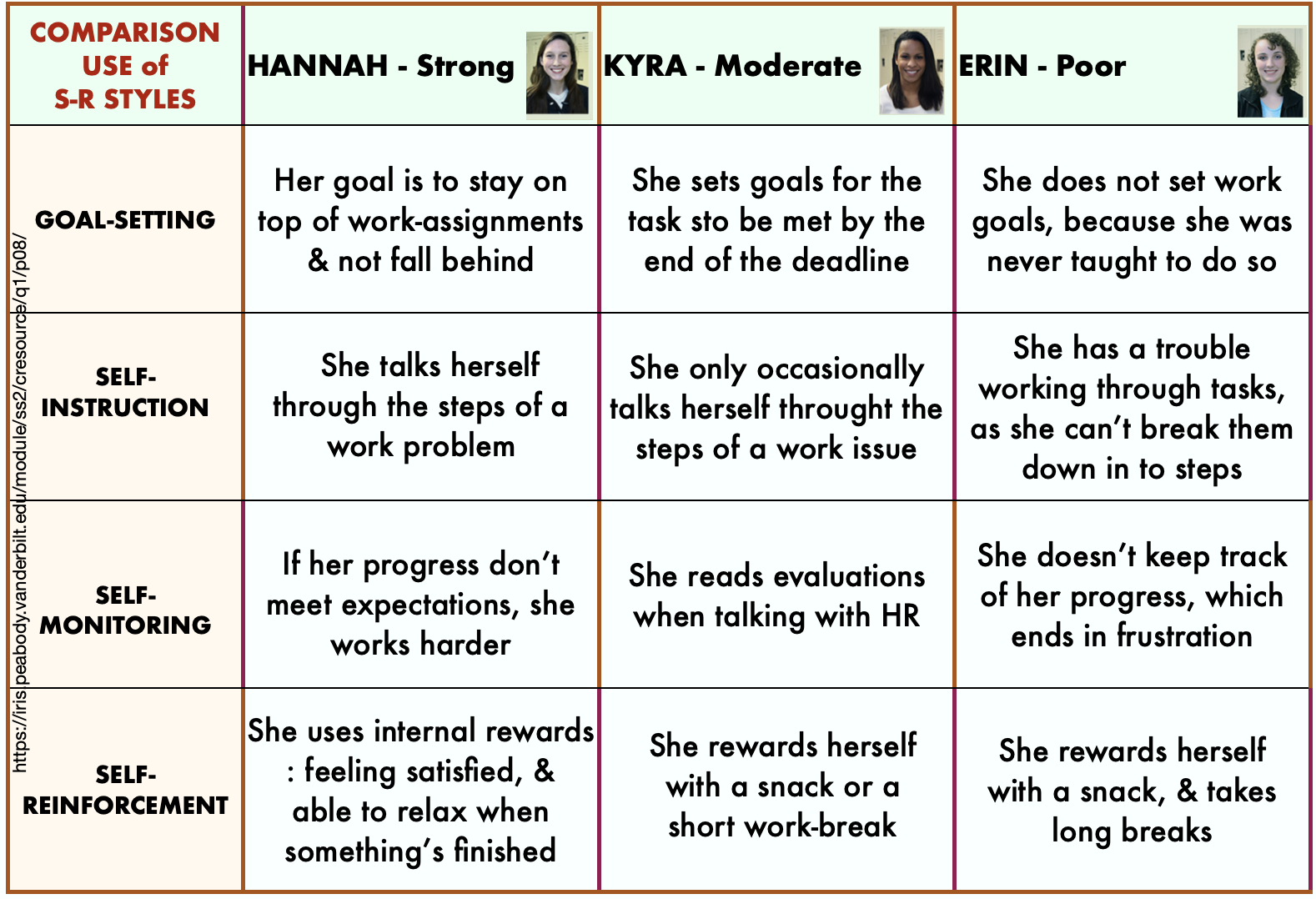
Def: Establishing achievable objectives for tasks or projects
It helps a person identify what they’re working toward, increasing attention, motivation & effort. For those who struggle with completing tasks on time, the best goals are those that can be accomplished fairly quickly (short-term).
When long-term goals are required, the person may need help creating a series of short-term action that add up.
📍Identify appropriate goals = not too easy or too hard, & ones that are specific enough to measure
📍Develop plans for meeting goals & monitoring progress
📍Implement the plans
📍Self-monitor progress toward meeting the goal
📍Revise the goals & actions as needed
 2. Self-instruction
Def: Talking oneself through a task or activity (self-talk).
A person can create encouraging or guiding statements for different types of situations, such as
WHEN :
⭐︎ Starting on or working through a task or problem
ASK : “What do I need to solve this problem? First, I need to….. I can use the formula d=t x r.…”
⭐︎ Coping with a difficult situation
ASK : “I forgot the outline is due Wednesday. Stay calm. If I do the research tonight, & finish the paper tomorrow night.”
⭐︎ Self-evaluating
ASK :“Did I understand what I just read? No, I didn’t so I need to reread the paragraph.”
⭐︎ Rewarding oneself
SAY “I was on the computer for several hours & did my best. I’m going to have a good meal, watch TV & cuddle with my mate.”
Def: Keeping track of one’s progress & recording the results. Though it doesn’t create new skills or knowledge, it does increase or decrease activity according to – how fast, how often or how long is needed to be successful. This strategy helps to:

📍stay focused on the task
📍increase awareness of ones behavior & attitude
📍provide more immediate feedback evaluated objectively
📍clearly show improvement over time
Def: Rewarding oneself after completing a task, especially when long & difficult. It produces a definite improvement in performance, & creates greater changes than eternally-imposed rewards. Payoffs & Rewards can be :
❣️Tangible (buy a new shirt / blouse, try a new restaurant)
❣️Social (a night out with friends, go to a show)
❣️Activity-related (read a favorite book, yoga, take a run…)
Other examples of S-R Behavior
🔅A cashier stays polite & calm when an angry customer is berating him for something he has no control over
🔅A child stops herself from throwing a tantrum when told she can’t have the toy she desperately wants
🔅A couple in a heated argument about something important to both of them – deciding to take some time to cool off before continuing their discussion instead of devolving into yelling & name-calling
🔅A student tempted to join his friends for a fun night out but instead decides to stay in to study for tomorrow’s exam
🔅A woman trying to lose weight meets a friend at a restaurant and sticks to the “healthy options” menu instead of ordering a favorite high-calorie dish.
NEXT : Biological Domaine
 HEAL & GROW for ACoAs