Attachment & Sexuality – PORN

PREVIOUS : Sexuality & Gender

SITE: “Why a Committed partner may watch porn”


PORNOGRAPHY  – DEF:
√ any sexually explicit image, material or texts directly, deliberately meant to sexually arouse the consumer
√ sexual material produced & distributed with the consent of all persons involved.

INSECURE attachment is associated with a more intense self-consciousness because of a poor body image.
This over-focus shows up as a person’s worry about how they look during physical activity & intimacy with a partner, concern about whether their body is fat or unattractive in some other way.
Self-consciousness during sex can be associated with painful emotions such as shame, anxiety, guilt…. minimizing physical enjoyment. To deal with this pain many people resort to regular pornography use.

According to attachment theory, porn use can bypass core attachment fears, providing insecure people with a false sense of intimacy & security.

The Avoidantly attached are less likely to be sexually intimate with a romantic partner, so pornography may provide a safe-zone to satisfy sexual needs without emotional connections.
Avoidant
s (& isolated Secures) make more use of porn as a fix for their loneliness, yet loneliness actually increases its online use.

The Anxiously attached can feel especially vulnerable during sexual activity because it taps into the depths of their neediness, the fear that their inner insecurities are being revealed, while intensifying the person’s longing to be secure but without the right to have that need met.

When being in a ‘real’ relationship feels emotionally dangerous, pornography can seem to be appealing, as it offers the ‘perks’ of sexual activity without having to deal with the stresses of face-to-face interactions with another person.

Studies verify they use porn to :
♦ try fulfilling unmet attachment needs, & reduce abandonment fears by repressing or replacing them with impersonal excitement
♦ reduce stress, regulate their emotional state & cope with difficult feeling such as sadness & loneliness, regardless of how false that sense is
♦ ‘manage‘ the fear that -their lack of trust in their partner- will be found out, which they feel would cause the lover to be hurt or angry & reject them as a result.

RESEARCH
A systematic review of literature showed strong association between porn use & negative sexual body image in both men and women. However,  pornography may have more of a negative impact on women IF they are Anxiously attached & currently in a romantic relationship. Since few people naturally have physical characteristics like those featured in sex-movies, female porn-watchers can end up feeling frustrated/bad about themself & even get cosmetic surgery as a result

A study conducted with 949 Israeli women revealed that looking at pornography to escape negative emotions significantly showed lower body image, rather than frequency of use.

In another study with 171 women, their body image was affected only by their partner’s porn-use, & only if they themself had absorbed unrealistic cultural beauty standards.
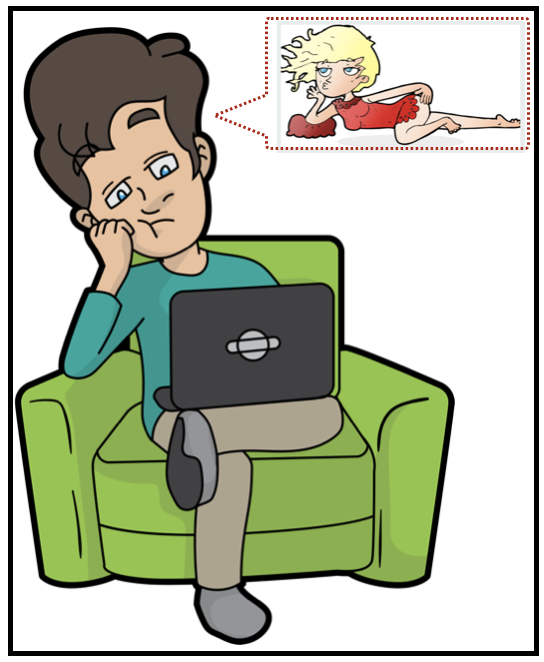
Pornography use can also harm a man’s body image — if they self-report as having an Anxious or Avoidant attachment in relation to significant others.
It’s been noted that frequent use can cause body-related mental distractions during sexual activity (fear-based obsessions), increasing performance anxiety & self-criticism.

GOOD & BAD PORN
According to recent statistics, 28,258 users are online watching adult movies every second. Since it’s impossible to eliminate the human need for sex, it’s impossible to eradicate the industry – ethical or unethical.  Another study in 2019 indicated that porn addiction occurs in 3–6% of adult movie viewers.

BAD  : Exploitation – porn watchers give little thought to how content was made. Larger porn hosting sites do not indication whether participants were willing or treated fairly.
An alarming number of reports from performers tell about being abused, & coerced by directors & co-stars. Even those who willingly enter the industry can suffer……

GOOD : Responsibly-made porn can be a helpful tool for those discovering their sexuality or wanting to explore sexual fantasies in safe ways. And can be to used to spice up a successful long-term relationship. This is possible without supporting the exploitation of sex workers.
Also, creators of fair-trade pornography are shifting the focus to women‘s needs & desires, dismantling outdated mainstream stereotypes.

NEXT : Sexuality & FOOD
Attachment & Sexuality – GENDER

PREVIOUS :  Dismissive Attachment

SITE: “How men confuse Sexual attraction with Emotional Connection


REVIEW
♥️ SECURE
attachment provides stability, satisfaction, self-disclosure, trust, support, & other intimate behaviors

♠️ Insecure attachment has negative outcomes, such as less frequent & less satisfying sex, & more negative emotions during sex

♦︎Anxious attachment causes with personal dissatisfaction, relationship conflict, obsessive-passionate ‘love’ but also a high breakup rate, being demanding of one’s partner, an inappropriate level of self-disclosure, holding dysfunctional beliefs (cognitive distortions), & extreme jealousy. 

♦︎ Avoidant or dismissing attachment is associated with a lower level of intimacy & self-disclosure, higher breakup rate, so a decreased likelihood of falling in love & remaining committed. Such people are attracted to partners with traits they themself have repressed or disowned.

🔴 Attachment & sexual dynamics is not the same in men & women, since they view sexuality somewhat differently.
♀︎ Women tend to have an emotional-interpersonal orientation to sexuality, associating sex with romantic involvement, & being nurturing in sexual situations.
‘Secure’ women have lower scores on socio-sexuality & less approval of casual sex, relative to women of other types.

♂︎ Men, by comparison, tend to have an individualistic-recreational orientation, so are more likely to link sex with physical gratification & want sexual variety.

Based on Attachment theory,
☁︎ Insecure relationships often have unhappy outcomes such as less frequent & less satisfying sex, & more painful emotions during & after sex. Although attachment insecurities take their toll on both men & women’s sex life, women usually pay a heavier price in terms of sexual functioning. 

ANXIOUSLY-PREOCCUPIED attached men & women cope differently with their fear when it comes to sex.
♣︎  Females have higher scores on unrestricted socio-sexuality tests, & are more accepting of sex in casual relationships than women with any other style. They may be tempted to cheat with other lovers for reassurance since having sex to ‘fix’ insecurity is unsuccessful.

NOTE : Both Preoccupied & Avoidant women can suffer from sexual dysfunctions, such as trouble lubricating, reaching orgasm &/or having painful intercourse, decreasing their overall sexual satisfaction.

This is not surprising since women’s sexual functioning is much more likely to be influenced by the kind of relationship they’re in, which for Insecures is likely to be disturbing & unhappy, & therefore more harmful to their sex life. ↗️ (Anxiety, Sexual Function & Genital Issues — for both men & women)

♥︎  Males may also worry too much about their attractiveness & performance, & their neediness makes it hard for a partner to feel loved by them.  The traditional male gender role as the sexual initiator makes them more vulnerable than women to experience rejection, leading more easily to depression, S-H & hopelessness. 

Being insecure about the love of their partner, & anxiety about potential loss –  intensifies their tendency to please the current partner. To reduce the likelihood of rejection, Anxious men will invest money & time in the ongoing relationship, rather than initiate sex with new partners.
They start having sex at an older age, & are less likely to approve of casual sex or to cheat, preventing them from using sex to bolster their self-worth.  As a result, they report having fewer sex partners. 

DISMISSIVE-AVOIDANT people seem to have a disconnect between sex & attachment, with trouble establishing & maintaining attachment bonds. This orientation is associated with a more permissive attitude toward sex — for men, but not in women. These men have higher scores on socio-sexuality & are more accepting of sex in casual relationships than any other attachment type.

Avoidants don’t like to show affection or respond to a partner’s needs. Sex, therefore, is more transactional** for women, without real emotional intimacy, serving personal needs such as stress-reduction. So they may engage in more one-night stands or affairs.
** “a non-marital, non-commercial sexual relationship (not prostitution), motivated by an implicit assumption that sex will be exchanged for material support or other benefits.”

Both avoidant men and women are emotionally disengaged from their partners. But this pattern is more marked for men, possibly because blindness to their partners’ wishes is part of gender role norms that encourage men to value sexual conquest rather than closeness, but this can be modified by the women’s nurturing tendencies.

NEXT : Sexuality & PORN

Attachment & Sexuality – AVOIDANT

PREVIOUS : Anxious-Preoccupied Attachment

SITEs:❃ “How to date someone with avoidant attachment
❃ “Avoidant attachment in relationships

INSECURE
1.
Anxious/ Preoccupied (A-Ps) Attachment Style

2a. AVOIDANT Attachment 
Adults with this style typically have a “deactivated” system, not wanting much physical nearness (acting distant) & avoid showing emotions (seem cold). This group would have experienced more neglect as kids than other styles, so intimacy became personally unsafe.

Their relationships are often unsatisfying, which they contribute to by sabotaging with inter-personal destructive behaviors. Their fear makes them less involved & less likely to fall in love, since they don’t believe in ‘happily ever after’. 

Avoidants are generally uncomfortable with sex, considering that it requires physical & psychological interaction – so are less likely to enjoy it, including passionate & affectionate foreplay.

Avoidants tend to have fewer long-term relationships, preferring short-term, emotion-free sex, or will abstain for long periods. Instead, they’ll use fantasy or pornography as a substitute for connection.

Intimate activity is driven by their ego  TO:
— gain high status or prestige with peers
— manipulate or control their partner
— reduce stress, as casual sex is most convenient.

When in a relationship, sex is not that important, & not used to express love or caring for their partner, which causes big problems if they have a Preoccupied lover who relies on sex to feel desired & loved. 

2b. Anxious-Avoidant Attachment
They have some things in common with the Preoccupied style, including :
— a deep fear rejection, equated with abandonment
— do not believe they’re worthy of love
— worried about their partner’s commitment to them
— can feel jealousy, though maybe not be as intensely.
BUT their way of coping can be very confusing for partners & for themself

This group is torn between not wanting to be abandoned (anxiety) & the terror of closeness (avoidance), wanting both autonomy & intimacy, but afraid to be vulnerable.
In the bedroom, this can show up as unpredictable or extreme behavior, since they find it hard to make sexual decisions that honor their desires -as well as- their boundaries.
They can end up guilt-ridden, failing to
figure out a way of having successful & satisfying partner-sex.
(↖️

Their attachment distress can lead to recurring cycles of compulsive sex, emotional withdrawal during sex, having sex that triggers or upsets them, pursuing poorly negotiated or high-risk sexual activity….. with lots of emotional highs & lows.

2c. Dismissive-avoidant Attachment
These people are more independent, self-sufficient, withdrawn & stoic. Rather than emphasizing the emotional aspects of sex, they see it as mainly physical, focusing on having orgasms or other personal goals (their sexual debut, the “thrill of the chase”… ) .

They don’t trust others so don’t communicate much, which is needed for good sex. Missing are things like negotiating consent, sharing likes & dislikes, exchanging fantasies, even flirting. Their discomfort with closeness can show up as erectile dysfunction, premature ejaculation, sexual compulsivity, infidelity &/or paying sex workers.

In a relationship, initiating sex may be TO:
— avoid an argument
— distract from an ‘issue’
— stop from continuing an uncomfortable discussion
— keep a relationship from going beyond casual, afraid to be clear & direct about what the really need & want.

When in distress, they emotionally retreat, shut down & withdraw, putting a strain on their sex life. In bed, they may be aloof & disengaged, or they may become highly skilled at pleasing their partner without being emotionally engaged. It’s not so much a lack of caring, as a protective mechanism against feeling “weak”.

NOTE : Dismissives may be romantic & charismatic until they develop strong feelings. They’ll come on strong, sweep a partner off their feet, initiating intense sexual experiences.

But if a romantic partner has sex with a Dismissive too early in the relationship, they can put up a psychological wall to compartmentalize emotions, separating sex from love, losing interest in the love ‘aspect’, because having sex relieved the tension that helped form the initial bond.

Even if they love someone, emotional closeness feels both unattainable & dangerous, so they may choose to leave a relationship before their partner has the chance to leave them, to keep their independence & avoid the risk of emotional pain outside their control.

NEXT : Sexuality – Gender differences

Attachment & Sexuality – PREOCCUPIED

PREVIOUS : Attachment & Sexuality – STYLES (#1)


REVIEW : INSECURE Attachment Styles
1.  P
eople with an Anxious/ Preoccupied (A-Ps) attachment style  (19% self-identified)  ARE:
❥ extreme desperate for nearness, connection & merging with the loved one
❥ constantly, intensely worried about how they’re ‘seen’ by others
very needy & clingy, have trouble being independent
❥ obsessed with the inevitability of being abandoned
❥ without PMES boundaries & not respecting their partner’s Bs

a. One double bind : On the one hand they have a very deep belief that no one will ever really be available nor interested in a long-term commitment – with  them.
At the same time they keep looking for the ideal soul-mate, getting attached way too soon, thinking they’re in love – at first sight. But since no-one lives up to their fantasy ideal, they’re constantly disappointed, so no current partner can ever be their ‘true love’.

The best the unrecovered A-Preoccupied person can do is to use sex as a manipulation, to :
⎈ pull the mate into some form of connection they don’t feel the rest of the time
⎈ feel nurtured, the ‘ultimate’ bond of merging bodies
⎈ get reassurance they’re attractive & desirable, although no amount of sex will convince them they really are

b. Another double bind – without self-definition & self-esteem, A-Ps are desperate to be loved & wanted, but only focus on the needs & desires or demands of the partner, while ignoring what truly suits themself, denying their own emotions, longings & dreams. They assume that all their caring & self-sacrifice will be reciprocated, but this rarely happens.

TO manage anxiety, they live in fantasy as a substitute of emotional intimacy. Constant worry about their partner’s feelings & the state of the relationship diminishes sexual enjoyment.
The dubious up-side of people-pleasing is that they’re too likely to accept or overlook the partner’s faults, often to their detriment. Over time, one result is that A-Ps end up feeling under-appreciated, misunderstood, & generally unsatisfied with the way they are being loved.

Because of an intense fear of rejection, they can easily be emotionally labile (rapid, often exaggerated mood changes). Even the most minor or unrealistic sign of unavailability from the partner will lead to distrust & extreme jealousy with anger outburst, which can spill over into their sex life.

Yet in spite of their negative attitude about being desirable in general & sexual activity in particular, A-Ps have more sexual partners (compared to the other styles), & tend to be unfaithful.  They blame themself for never being satisfied, & keep looking for that magical fix.

Ironically, partners of Anxious-Preoccupied lovers can be thrilled by the constant flow of attention & affection, whose eagerness to please can make them passionate & attentive participants.
However, they can also be emotionally dramatic, overwhelming the other person with neediness, which puts them off. The message is “We have to share everything & do everything together, or I’ll die”

Their hidden motivation for having sex is to manage attachment anxiety, looking for symbiosis to stave off the threat of being alone. And when A-Ps are sexually dissatisfied or in pain, they may :
⌲ constantly complaint but not work on alternates or solutions
⌲ talk about it exhaustively, over-analyzing the issues, & blaming their partner
⌲ bring up the problems as indirect, passive-aggression comments
⌲ downplay the problem’s importance, OR
⌲ never mentioning any of it, suffering in silence.

Unhealed Anxious-Preoccupieds create constant instability in a relationship. But having frequent &/or passionate sex may be used as a way to compensate for emotional disconnection. Sex becomes a test of relationship-strength rather than an expression of mutual love & enjoyment.

SUGGESTIONS to a Secure mate of an A-P
🔅Always be in a safe space, & be sure your partner is ready & willing
🔅 If your partner initiate sex, ask if that’s what they actually want, or just need to be cuddled, & stroked
🔅Tell them they’re beautiful / handsome, desirable….

🔅 Encourage them to stay aware of what triggers anxious thoughts – before, during & after sex
🔅Take time to bring them to orgasm. A-Ps don’t expect you to meet their sexual needs, so flip their expectation.
When getting acquainted, before sex ask what they like, what makes them feel good….
Once you know each other, always gently check in – no one feels the same (physically or emotionally) every day.

NEXT : Attachment & Sexuality – Avoidant

Attachment & Sexuality – INSECURE

PREVIOUS : Attachment & Sexuality, SeCUrE

SITE : 10 signs I’m the problem in my relationship from feeling insecure


Sex mitigates** insecure attachment
(**makes less severe)
With its primal longing, sex brings out the best & worst in relationships. Swinging from the highs of passion to the lows of rejection, sex is often an opportunity to explore both the sexual & emotional patterns that need healing.
Yet most of us find it very hard to talk about this topic, especially outside the bedroom. Not surprising, silence & withholding are the key features of bad sex. Instead of connecting, too many partners end up frustrated & lonely.

WHEN A couple’s emotional pattern is in trouble, there are predictable behaviors from each partner, whose self-defeating ‘protective’ defenses reinforce each other.

♠️ Congruent** interplay (**internally consistent). Sexual intimacy is affected by a person’s attachment style, so each partner will choose to either move away <—- or toward -—> the other, in the form of interlocking defenses.
EXP:  A female emotional pursuer (Preoccupied) is also likely to chase her (Avoidant) partner sexually, triggering them to withdraw emotionally & sexually, preferring to watch tv, drink &/or masturbate with porn.
Typically,
🔸The pursuer reacts to even a slight disconnect, their attachment style being hyper-activated by pushing for attention, closeness, interaction & reassurance.They believe that pushing is necessary to feel safe

🔹The withdrawer uses a de-activating strategy – pulling away to avoid escalation, trying to protect the relationship by keeping things calm. They believe that not engaging is necessary to feel safe. But the opposite happens.

The pursuer feel rejected & will react with anger & criticism, getting emotionally & verbally louder, trying to get thru to —-> the withdrawer, who then gets anxious, feeling suffocated, controlled, accused of not being enough & wrong for pulling away – a total failure – & so shuts down even more.  

The withdrawer‘s retreat adds to the message that the pursuer’s needs are too much, intensifying the endless negative cycle. As the pain piles up, the costs to the relationship are grave, with increased distance, mistrust, reactivity & decreased closeness, trust, & safety.

Crossover interplay is the most common relationship game (SWYMD , pg 36) in heterosexual couples seen in therapy. Eventually, with endless frustration for both people, the previous pattern gets reversed. The emotional pursuer switches roles in the sexual pattern to become the withdrawer, & the withdrawer becomes the pursuer.

EXP : Now the male partner finds some security in having sex, motivated by both closeness & pleasure, even though his overall emotional protective strategy is still withdrawal – but camouflaged.
And the female partner wants emotional connection, but in reaction to continually feeling abandoned – will down-regulate** her sexual needs with de-activating strategies  (**minimizing the intensity of emotions, weakening behavioral & facial responses).

With so much push-pull mis-attunement, the negative sexual pattern keeps looping, so that —-
🔸the sexual withdrawer starts using reactive strategies :
☹︎ is constantly preoccupation with sexual thoughts
☹︎ efforts to connect become manipulative, even coercive
☹︎ is hyper-vigilance about their partner’s signals of desire or rejection
☹︎ obsessively worry about their personal attractiveness
AND
🔹 the sexual pursuer starts using minimizing strategies :
☻ dismisses or makes fun of partner’s sexual hints/ requests
☻ inhibits their sexual desire, ignoring their own sexual needs
☻represses sexual thoughts, memories & fantasies
☻ suppresses arousal & orgasm when having sex

EXP of sexual confusion is seen in the Disorganized style, a combination of ambivalent & avoidant behaviors. Sex can be a minefield – people in their group are often submissive, taking on a passive role, & sometimes giving up their dignity in the bedroom.

The good news is that – over time – developing healthy sexual passion can help heal insecure emotional attachment.  If both people are willing & psychologically capable (not BPD, NPD….), sex counseling can help them identify & agree to undo the negative pattern of defensiveness. More importantly, replace those with positive, loving responsiveness to each other.

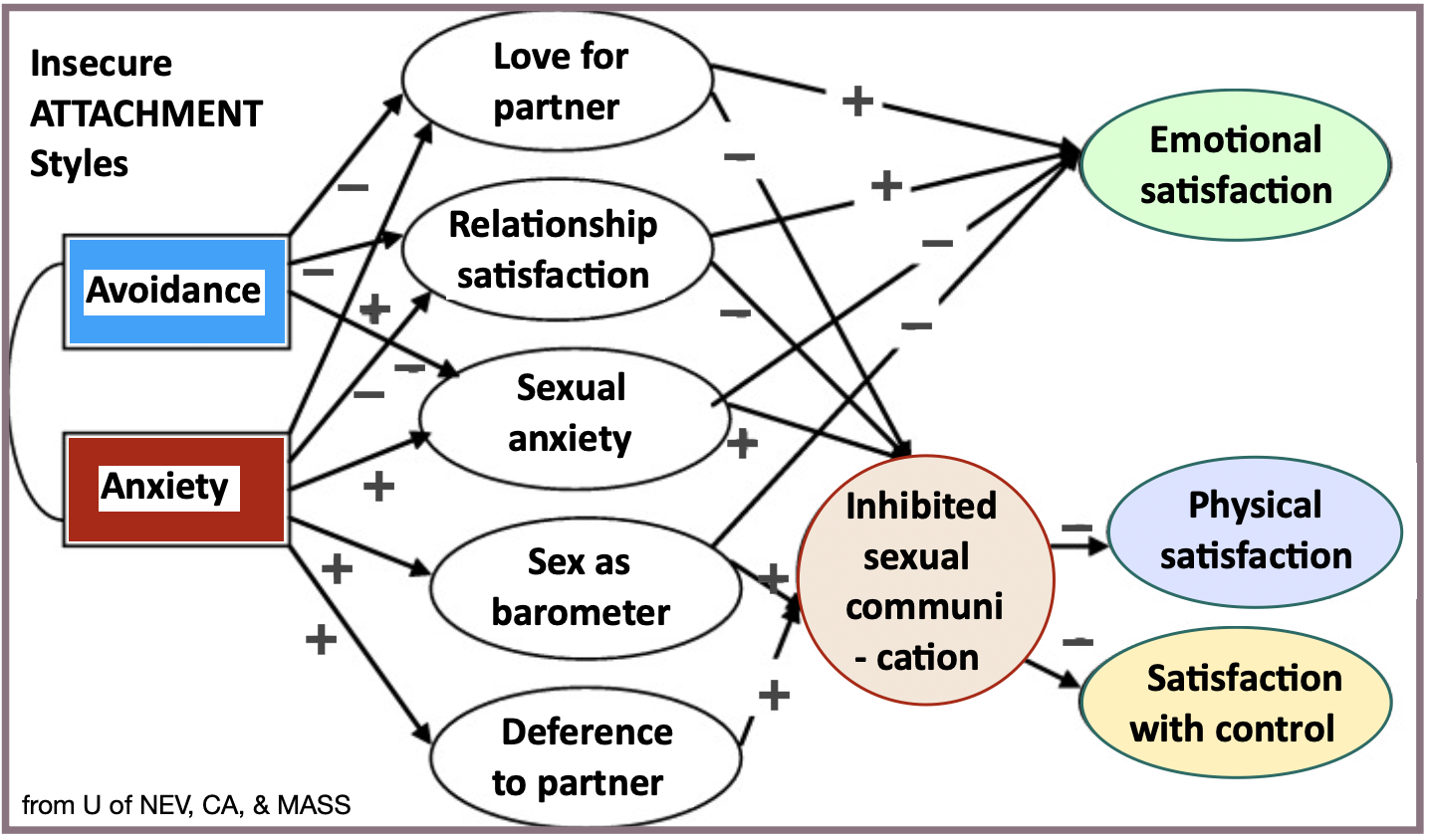
(⬇️ CHART  : ‘”I can’t get no satisfaction” – a study connecting attachment style to sexual communication & sexual satisfaction. HYPOTHESIS : Inhibited communication was expected to be modified by attachment-related tendencies to defer to partners’ needs, concern with implications of sexual choices, general anxiety regarding sex, & feelings for one’s partner (white circles).
«

«
NEXT : Attachment & Sexuality – SECURE

Attachment & Sexuality – SECURE

PREVIOUS : Sexuality (c)

SITE :


Sex is part of a positive pattern of attachment

SECURELY attached people are able to regulate their emotions & recognize that their needs are valid & worth investing in.

They also can read other people’s intentions well, to tell if they’re emotionally & physically safe as a sexual partner.
Yet – even if there is a mutual attraction, & the conclusion is that the other person is ‘kosher’, Secures are able & willing to delay gratification, having clear boundaries.

The purpose is to get to know the potential sex-partner first,   to be sure their 1st impressions were right, & form a connection on a mental & emotional level, not just physical.
Then – because secures have good self-esteem, they’re able to communicate their sexual needs with honest & respectful conversations.

Secure Sex – This is when a couple feels safer with each other, less afraid of rejection or disconnection. When outside the bedroom they know their partner will show up & be there, accept them & have their back, ways of expressing **intimacy,

With emotional security, partners help defend each other from threat (a safe harbor). They respect their differences and the need for separateness (not experienced as a form of rejection). They’re happy to encourage each other to express their individual purpose, work, or calling in life (a secure base ).

**Intimacy, known as-partner engagement, is usually thought of as deep, meaningful love making – pillow talk, eye gazing, intense kissing, sensual touching….
But it’s much more than just romantic closeness. To be true intimacy  —> it has to start with each person being emotionally vulnerable & transparent, in context, which does not imply sexual activity. so can be in a close friendships, when mentoring, and of course with ones parents & children.

Secure sex is physically & emotionally satisfying , so constant newness (positions or partners) is/are not needed nor demanded to be content.
At the same time – knowing that their partner is accessible, responsive & engaged, the freer they are to enjoy sexual experiences. The couple feels safe to play, safe to ask for what they want, & safe to enjoy just being sexual with each other without the need for constant reassurance.  

Being able to read & understand each other during sex is part of arousal. This guarantees Synchrony Sex – at least most of the time – where love & connection combine joyfully with physical pleasure.

This emotional attachment is one of the things that makes the human brain so special. It’s how we develop trust to build relationships, so we can experience safety as well as pleasure. We’re wired to connect, to mirror each other’s desires, and to act on the signals we subconsciously send to & receive from each other.
That’s why it’s said that sex starts with brain activity. But your partner (probably) can’t read your mind, that’s why it’s important to keep an open dialogue about your sex life &.ask for what you want in bed .

TRUST and sexual pleasure go hand in hand. Whether you’re having sex with a committed partner, a fun fling, or somewhere in between, there’s no doubt that the dynamic between you two plays a huge role in how much you’re getting from your sex life.   

When you have a deep level of trust with someone, you can be at ease with your partner, so there’s a different level of relaxation that also adds to enjoyment. But trust isn’t an instant thing. It takes time to build it up to the level that’s needed to experience the kind of pleasure that you’d like to.

And we can’t ignore the reality – that in heterosexual relationships women orgasm less than men – called the Pleasure Gap.  (Audio book)
The female body usually needs a feeling of fundamental trust & safety to fully open & relax.
And while sex isn’t all about orgasms, they sure are nice. Not only do they feel great, but it’s a lot easier to get there when you have a lot of trust in the person you’re having sex with.
Deep trust in relationships builds organically, but it can also be cultivated through conscious action.  (How to build trust)

NEXT : Attachment & Sexuality, #2