
 PREVIOUS :
Attachment Dysfunctions (#2)
NOTE: According to the DSM-5, RAD & DSED are two childhood socially disabling attachment disorders – resulting from childhood trauma,. RAD is not a form of Disorganized attachment, which is caused by confusing caregiver mistreatment & can lead to oppositional defiant disorder (ODD).
The critical period for damaged development is in the first 6 months of life, up to age 5, but there is growing evidence that RAD & DSED symptoms may persist into adolescence & early adulthood.
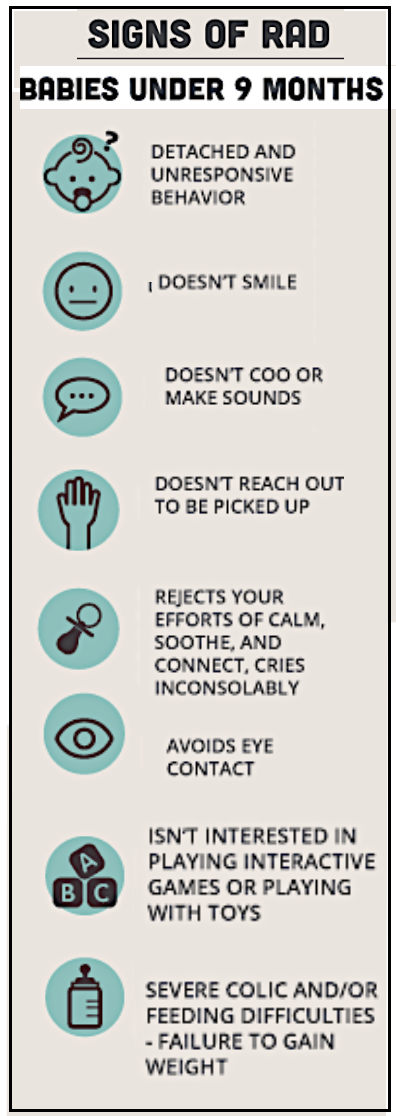 ♠️ RAD = Reactive Attachment Disorder
RAD is considered a rare (1-2%) & lifelong condition that results from non-attachment in very early childhood – caused by insufficient care, such as social neglect, a deprived or limited opportunity to form stable attachments to caregivers.
RAD children may have experienced a a traumatic birth, sudden separation from mother or continual PMES abuse. Most grew up in shelters, orphanages, foster homes, a war zone…. receiving little 1-on-1 attention.
Since these children didn’t have the opportunity to experience comfort from others, they don’t usually feel pleasurable emotions, but more likely are irritable & unhappy even during normal activities with adults. Tend not to be interested in playing interactive games in groups.
As young children they’re prone to tantrums or uncontrollable crying, & spend time alone trying to comfort themself (rocking, head butting, thumb sucking….).
Other symptoms – THEY :
► seem to have an under-developed conscience – stealing, lying, often disobedient, & don’t express guilt or remorse after behaving badly
► may have abnormal speech patterns & persist in asking nonsense questions or have unusual arguments with others
► can be preoccupied with fire, blood or gore, & be cruel to animals or siblings (More…. extensive lists)
♣️ DSED = Disinhibited Social Engagement Disorder
This disorder is another face of damaged Attachment, rather than a behavioral problem – from various forms of neglect, most prominently Emotional.
It’s described as the child’s inappropriate, overfamiliar & indiscriminate social interactions with strangers, preoccupied with getting their attention despite the presence of their family/parents.
Common ground with RAD & DSED is that both groups find it very hard to form emotionally meaningful bonds with anyone, although acting from opposite extremes, which makes it hard to have nurturing long-term relationships.
While similar abnormal upbringing will produce either inhibited (RAD) or disinhibited (DSED) styles, studies suggested that abuse & neglect was far more prominent & severe in cases of DSED.
Not all these children were raised outside the family. Many grew up with parents who were severely narcissistic, mentally ill, alcoholic, obsessive-compulsive, too preoccupied with their mate, covertly suicidal….
It left a gaping emotional hole that desperately needs to be filled – anyway possible – & these children use their persona of being very friendly & outgoing as ‘bait’.
DSED children act in abnormal ways – for their age. They :
◆ often wander away from mom in social settings out of not feeling bonded to her, loneliness, social curiosity ….
◆ will hold hands, hug or sit on the lap of a new person without an invitation
◆ can easily leave with a stranger, even without being seduced or manipulated
Signs of DSED in young children can show up as trouble thinking rationally (living in fantasy, dissociated, smiling when describing painful events….), & in adolescence as poor social skills.
♦️ Obvious DSED behaviors may or may not persist into adulthood, but even if those ‘calms down’, there can be residual patterns, such as over-disclosure, idealizing desired friends & lovers, weak boundaries…...
«
«
LINK between Attachment Types & Childhood TRAUMA
Study by Atilgan Erozkan, Mugla Sıtkı Kocman U, Turkey
Results provide more verification of typical developmental disturbances seen from research in other parts of the world (US, Italy, UK, Poland, Australia ….)
🔻 Secure attachment is inhibited by growing up with physical, emotional & sexual abuse, along with physical & emotional neglect.
🔻 Fearful, Preoccupied & Dismissing attachment styles are predictable results from harmful parenting.
FROM a Study in Texas
To assess childhood mistreatment found in a community sample of 676 active drug users, Medrano, Hatch, Zule, and Desmond (2002) found that :
— 53% of women and 23% of men were sexually abused
— 53% of women and 43% of men were physically abused
— 58% of women and 39% of men were emotionally abused
— 52% of women and 50% of men were physically neglected
— 65% of women and 52% of men were emotionally neglected.

NEXT : PREOCCUPIED Style (#1)
 HEAL & GROW for ACoAs