
 PREVIOUS: Parent-Child Attachment – #1b
REMINDER Based on the “Strange Situation”
🔹AVOIDANT child – distracted by the environment & doesn’t want mother when she comes back <—-> becomes DISMISSING adult – who doesn’t open up emotionally to partner, & prefers to be on their own
🔸 AMBIVALENT (resistant) child – who doesn’t interact with the environment much, & is very upset when mother leaves
<—-> becomes PREOCCUPIED adult – always afraid of rejection, obsessive about needing closeness
«
♥️ ATTUNEMENT vs DELAY in the Early Years
In his work with mothers & infants, John Bowlby challenged the idea of a ‘perfect mother’. While a mother needs to be emotionally available to her infant, with two-way communication being built up —–> an equally important part of her role is to allow the infant to experience tolerable frustrations.
This can lead to a healthy development of independence & sense of Self. Bowlby said that a mother was not doing the best for her child if her aim was to immediately alleviate all distress, discomfort & frustration. (Winnicott, 1965).
♥️ MOTHER – CHILD interactions 
«
♥️ INDEPENDENCE through SCAFFOLDING
For a slightly older child = when an age-appropriate task gets tough, he/she will pleadingly ask you the parent / caretaker, melting your heart in a second – moving you to do the task for them.
No matter what prompted you to do that, the result is – the child’s independence is hampered.
The best way to handle the situation is through scaffolding. Provide just enough support for the child to complete the task on their own.
GIVE clear directions, reduce confusion, understand “zone of proximal development”**, and encourage the child to finish.
Soon they’ll develop the pleasure of doing the activity, not just focusing on results.
** “…. the space between what a learner can do without assistance & what they can do with adult guidance or in collaboration with more capable peers”
This lays the foundation for strong social & emotional skills that will serve them for the rest of life. An independently functioning child is also more stable in groups, interacting well with peers – because of a high level of confidence.
«
♥️ DISTURBATION of Attachment
«
♥️ GOOD vs BAD PARENT

«
♥️ Maternal COMMENTS
A UK study was made to test the links between attuned & non-attuned comments made by mothers – to see the effect on their infants’ mental states. In a study of 206 mothers with their infants, these two types of comments showed marked differences on attachment security. (York U. Meins et al., 2012,  ).
).
RESULTS :
☀︎ attuned comments = secure infant attachment
☀︎non-attuned comments = less secure attachment.
And a very high proportions of non-attuned expressions predict Resistant attachment, more than Avoidant.
«
♥️ Infant Attachment and SECURE BASE Provision
The Secure Base model is drawn from attachment theory, adapted to include an additional element, ‘family membership’, for children who are separated from their birth families. It provides a way for the infant to learn about a caregiver’s availability to serve as a secure base — both when it needs comforting AND when it’s focused on exploring
(See Att. Dysfunctions #3 post)
«
The 5 dimensions of caregiving ⬆️ are each associated with a corresponding developmental benefit for the child. When the dimensions overlap & combine they create a secure base.
EXP: A caregiver playing with a child in a focused, child-led way will be doing so with Sensitivity & Acceptance —> as well as demonstrating availability & promoting co-operation.
Both Sensitivity & Secure Base Provision (SBP) look at how caregivers perceive, interpret & appropriately respond to infant signals, Also, in both important infant signals occur at each end of the attachment-exploration continuum.
But SBP looks only at certain key infant signals & specific caregiver responses. It also focuses much less on prompt responses and more on crying resolution – the ratio of infant crying episodes that end in chest-to-chest soothing until the infant is fully calmed, regardless of promptness. (MORE…..explanation)
«
♥️ OBJECT RELATIONS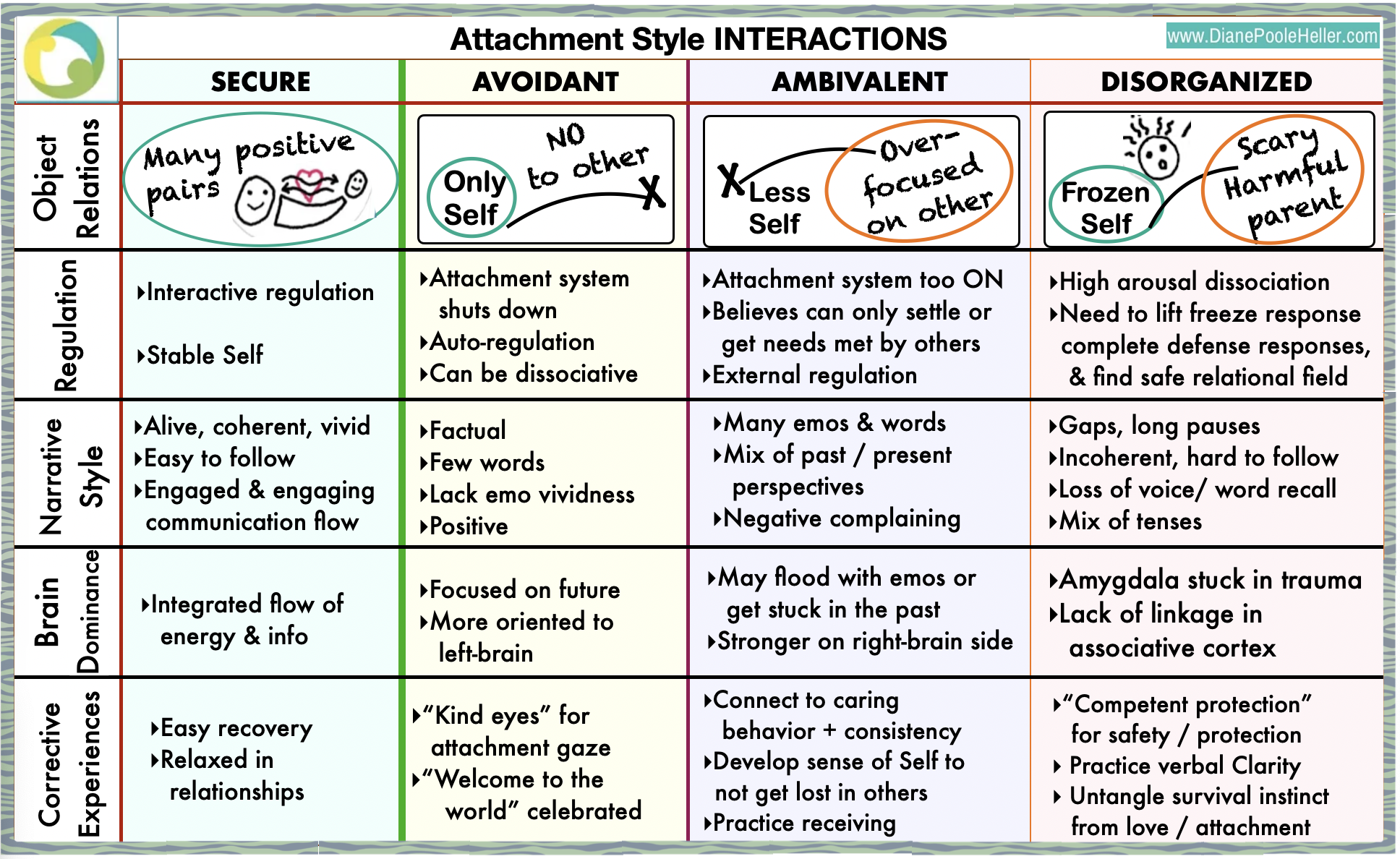
«
♥️ CHANGING Parent-Child Relationship
 In a large national study of Canadian families, interviews revealed that typically warm relationships between parents & preschoolers changed (diminished) as children became older. (Statistics Canada, 1999)
«
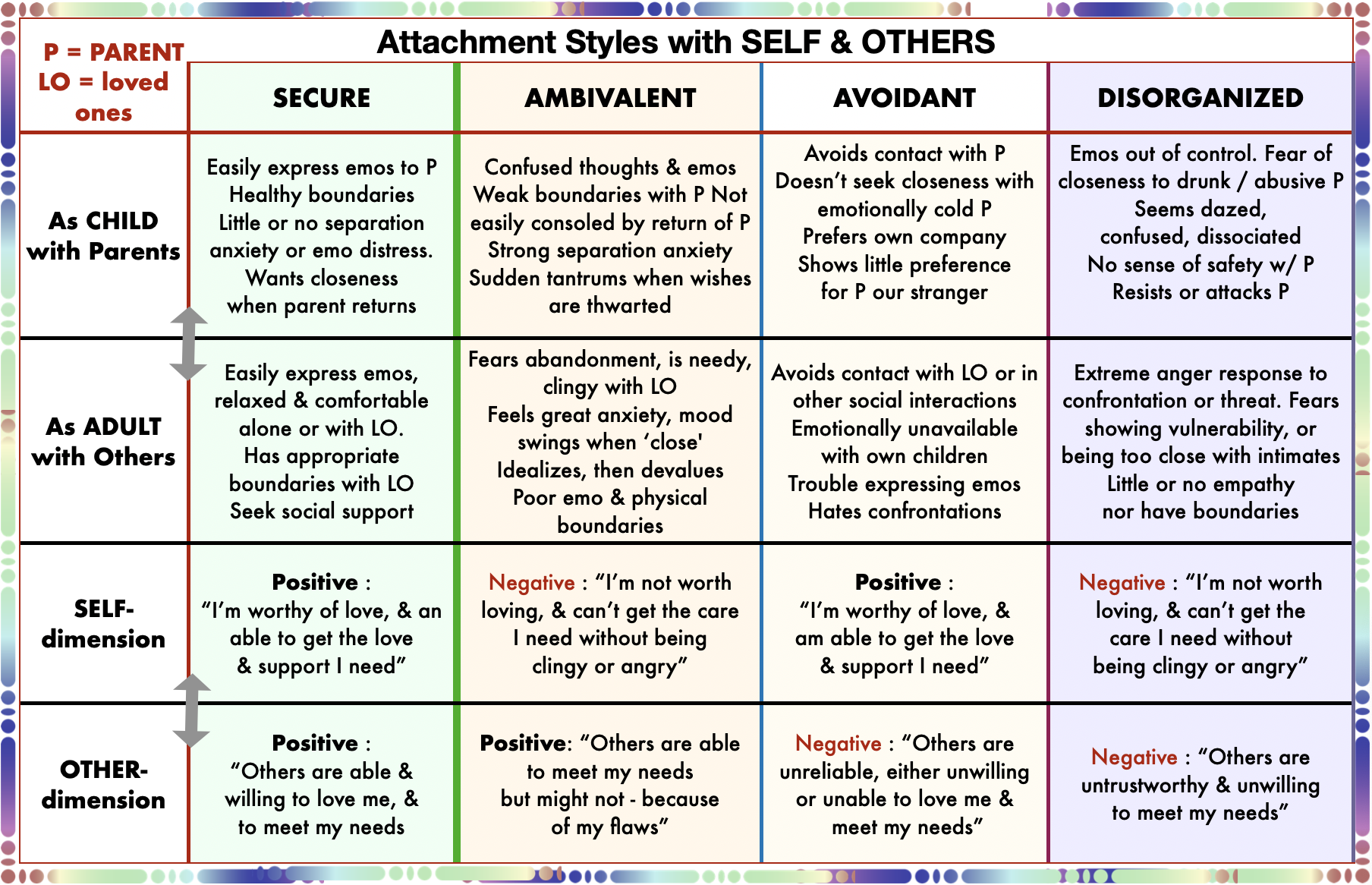
♥️ INTER-RELATING
«
NEXT : Healthy-er PARENTS
 HEAL & GROW for ACoAs