Self-Regulation – STUDENTS √

PREVIOUS : Self-Reg for CHILDREN

SITE : “Components of Self-Regulation” – re. Students w/ EXPs.

REVIEW :  Self-Regulation is a ‘SOFT’ skill, made up of personal characteristics that give s person the ability to regulate one’s reactions. This helps them interact successfully with others. Failure to do so leads to conflict or estrangement. 

S-R forms the conditions that allows the person to guide their thinking & activities. It greatly helps a person to be self-motivating, & be able to use inborn mental abilities for academic skills. 

It’s linked with meta-cognition – (“thinking about thinking”) the awareness of one’s mental strengths & weaknesses (how their mind works & what they know).  SKILLS :▫️declarative knowledge (about oneself as a learner – factors that influence their performance)
▫️procedural knowledge (about strategies & procedures)
▫️conditional knowledge (why & when to use a particular strategy).

STRATEGIES of meta-cognition :  • Set goals
• Have good time management
• Keep an academic / learning journal
• Plan learning activities //      • Do task-analyst of problems
• Ask questions before, during & after reading relevant material

Self-regulated Students do these tasks especially well
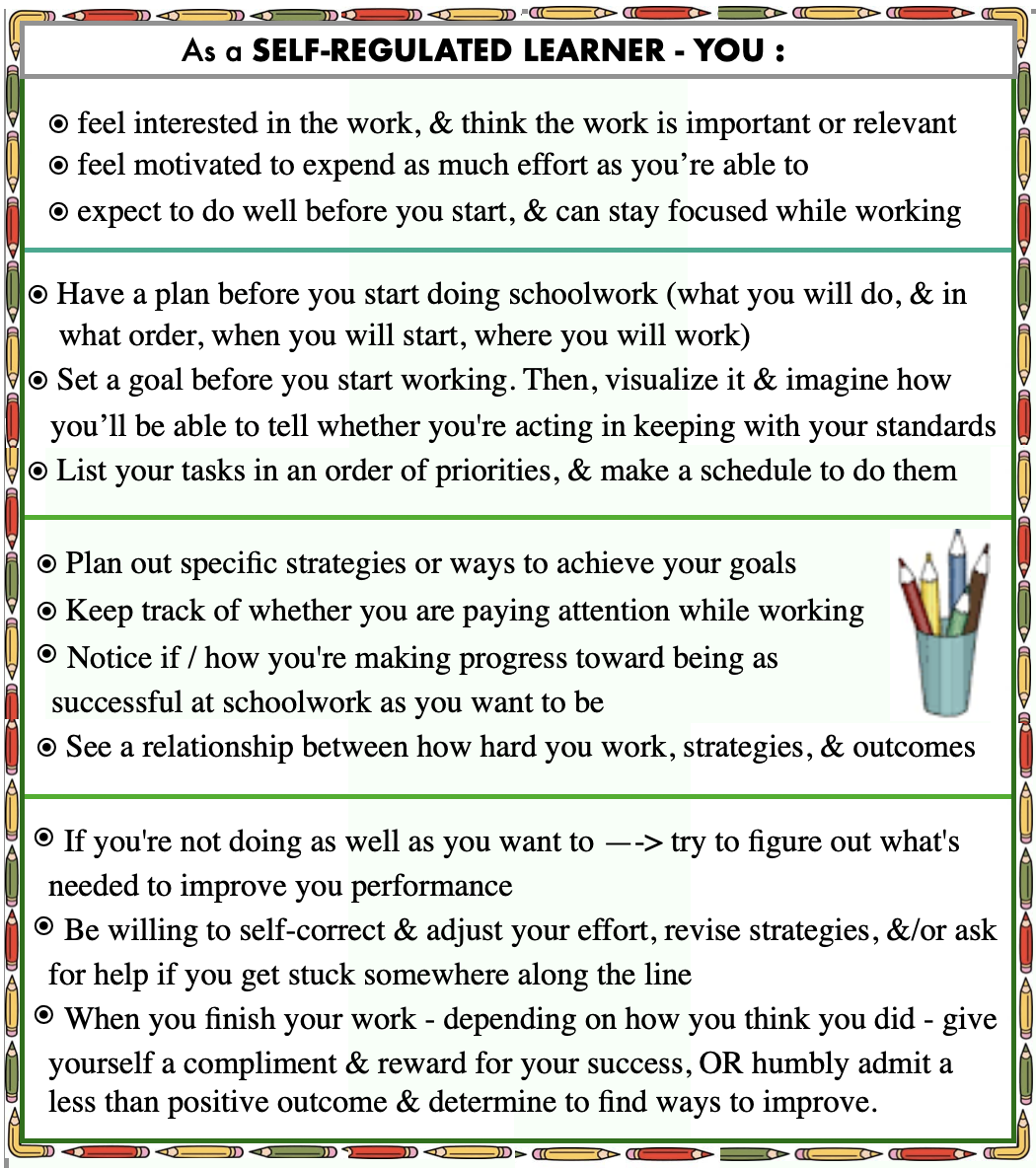
S-R learning is not an innate ability, but rather a skill set that can be developed to help students direct themselves through the learning process. This allows students to become less reactive, & more proactive in their studies. THEY CAN :

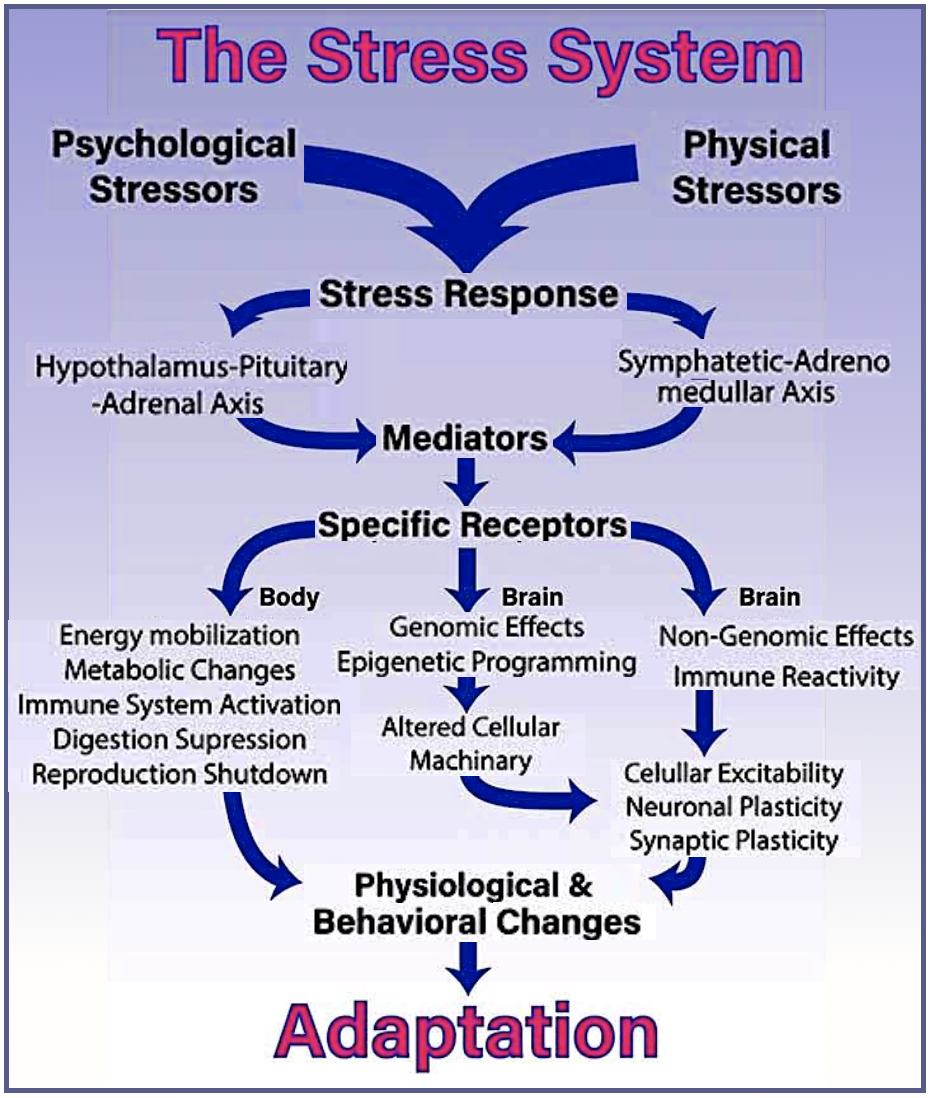
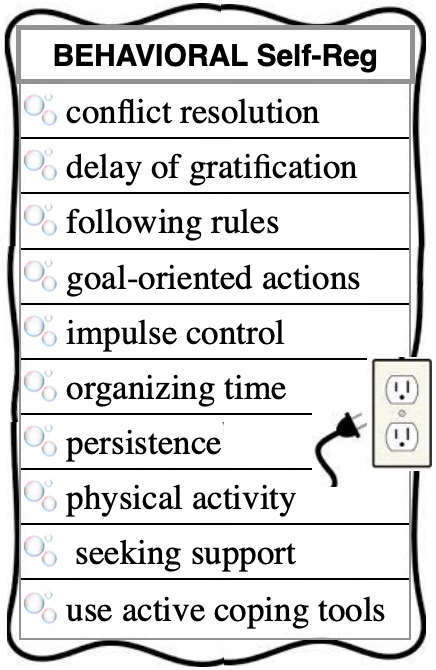
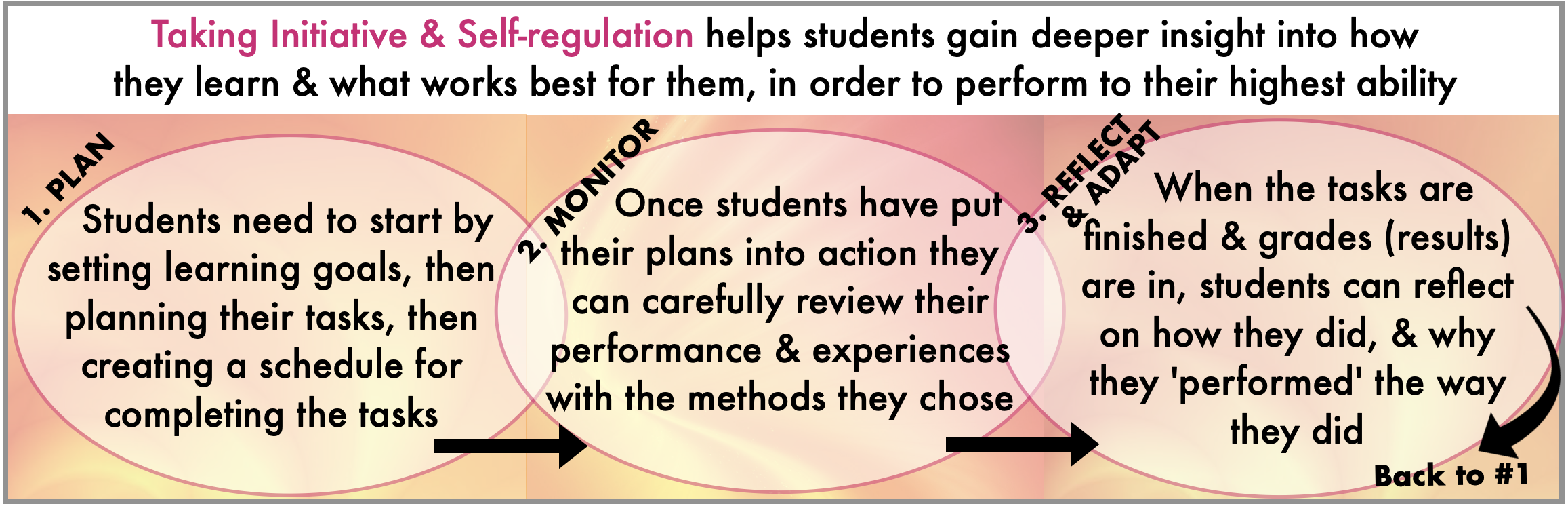
1. Plan: Systematically use meta-cognitive, motivational & behavioral strategies (chart ⬆️) . Set sub-goals, such as thinking about when & where to study, or choosing approaches for a given assignment, exam or assessment format.

2. Monitor: Reflect on how effective certain locations or strategies are when studying, think about what to do when obstacles arise, & determine how good one’s understanding of the content is. They respond positively to feedback about how they’re doing academically

3. Evaluate: Self-perceptions of academic accomplishments – think about both the outcome of the assignment & teacher assessment, & the effectiveness of the strategies used. ☀︎ They attribute performance to their effort & strategies rather than to external influences.
Ways students can monitor progress : 🔸Checklists (EXPs)
🔸Self-monitoring sheet (EXPs) //  🔸Self-monitoring log (EXPs)
«

«
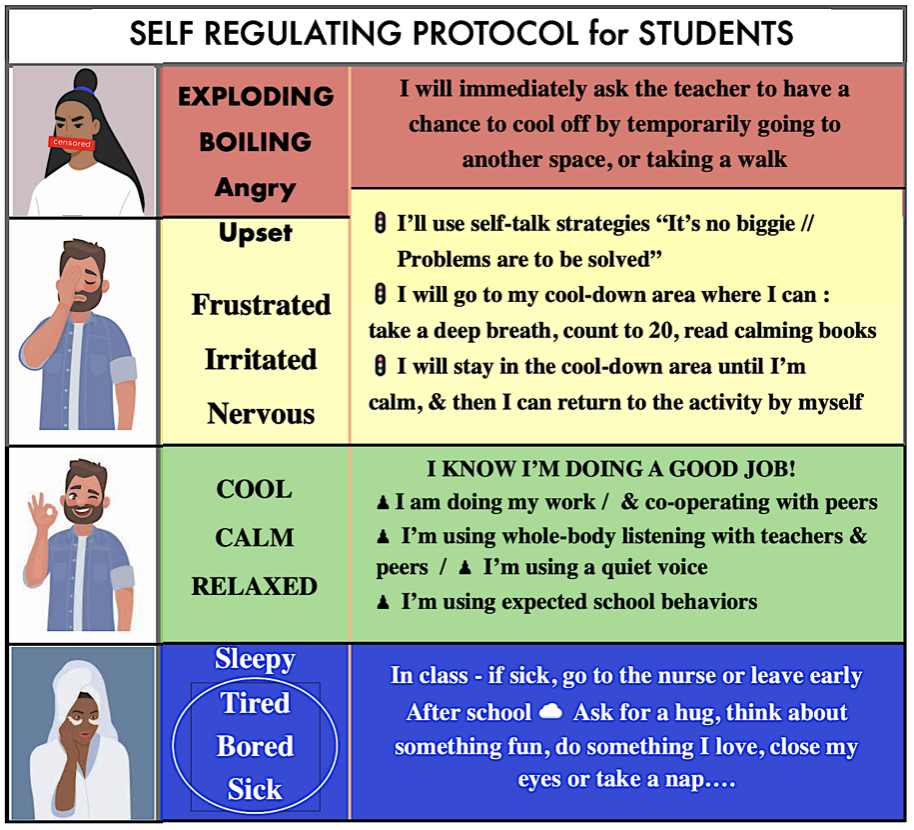
▶︎ Each child is different, which includes children with complex disabilities such as ADHD or Autism, who have trouble self-regulating. Children should be encouraged to self-regulate in their own way, responding to different self-regulation strategies based on their personality, developmental stage & mental capacity.

TEACHERS – of younger students:
✪ Offer the child the chance to take a break from the current activity, environment or being around others
✪ Ask them about their emotions, & validate what they say they’re feeling
✪ Provide & take them through a calming or distracting activity, such as reading their favorite story
✪ Offer an object they find comforting or relaxing, such as a favorite toy, book or blanket
✪ Give them the chance to release their energy if they need to, such as running around in the yard.
«

«
▶︎  If a reactive child can calm down, the following strategies can help them reflect on what has just happened, & build self-regulation skills for the next time they’re ‘triggered’ :
✪ Describe what positive self-regulation responses are / look like
✪ Role-play or encourage the child to practice alternative positive responses
✪ Recognize & acknowledge when the child self-regulates & uses positive responses
✪ Brainstorm with the child what strategies work for them, and what they can do in the next challenging situation.

NEXT : Self-reg for ADULTS, #1
Self-Regulation – CHILDREN √

PREVIOUS : S-R =

SITE : How to crete a safe environment 


⬅️ The 5 Domains


SELF-REGULATE (S-R) in “CONTEXT-CHART ” ⬇️
showing the range of factors that influence if & how well a child / youth can S-R in any given situation. Although the concentric circles begin with the most internal factors & extend outward, each layer will interact with & influence the others.

a. BIOLOGY : The most internal factors include the child’s genetics, physicality & temperament – contributing to individual differences in S-R ability
b. SKILLS : The talents & abilities the child / youth has developed over time, which can serve as areas for interventions, when needed
c. MOTIVATION : The child’s reason to S-R, either from external sources (via rewards or consequences), OR from internal goals & values (intrinsically motivated).

d. CAREGIVER SUPPORT- (from parents, teachers, mentors) which strengthens the  child’s S-R skills, buffering them from distressing experiences in the larger environment.
e. ENVIRONMENT : the overall context also influence the child’s ability to S-R, including demands or stressors placed on it, as well as any external resources available.

EXP : Environment will affect a child’s biology by shaping brain circuitry, while their biology or temperament can influence how a caregiver /parent interacts with the child.

Research suggests that a young child’s self-regulatory (S-R) activities are a better measure of future academic achievement than IQ scores.
EXP: A child unable to self-regulate at age 4 will likely have trouble following teacher directions at age 6.
«

«
SELF-Regulation attars to develop in the toddler & preschool years, & continues into adulthood.

🔆 Babies might suck fingers for comfort, may look away from their caregivers if they need a break from attention or are getting tired. But they can’t actually S-R, so it’s important to comfort them & help them calm down when they’re unsettled.

🔆 Toddlers can only wait a short time for food & amusement. So they may snatch toys from other children if it’s something they really want. Tantrums can happen when they’re overwhelmed by strong emotions.

🔆 Preschoolers start to know how to play with other children & understand what’s expected of them. EXP : they may make an effort to talk softly when at the movies.

🔆 School-agers improve at controlling their own wants & needs, being able to imagine other people’s point of view, & see both sides of a situation. EXP : they may be able to disagree with other children without arguing.

🔆 Pre-teens & teens are better at planning, sticking to hard tasks, behaving in socially appropriate ways, & considering how their actions affects other people. EXP: they may think about the parent’s perspective when negotiating curfew.

ADULTS can help children learn self-regulation
Young children who naturally feel things intensely find it harder to self-regulate, compare to those who are more easygoing, as well as older children & teens who have developed the capacity to S-R.

📍 It’s important to match adult expectations of the child’s behavior TO their age & stage of development. This helps them avoid the frustration of not understanding or having the skills to do what’s being asked of them

📍 Parents can apply calming-down strategies for toddlers, calming down steps for preschoolers, school-age childrensteps for pre-teens & teenagers
📍 Adults can encourage the child’s ability to identify, understand & manage emotions.

📍Parents need to Plan for challenging situations when younger children might find it hard to behave well.
EXP : “The store we’re going to has lots of things that can break. It’s OK to look, but please don’t touch”. Give your child a gentle reminder when entering, “Remember – just looking, OK?”

📍 Adults can model self-regulation for child. EXP: “I’d better stop gardening now so I can get you to ____ on time”. Or ‘That was really tough to deal with, but I managed it”.
📍 Involve pre-teens & teens in problem-solving and negotiating difficult situations. EXP :  “I’m working all weekend, so I know it’ll be boring for you. Let’s figure out how you can make the most of the time while you wait”.
📍 Praise child when they show self-regulation & manage a tricky situation well. EXP: “You were great at waiting your turn’ OR “I liked the way you were calm when Sam teased you”.

NEXT : S-R & Students

Self-Regulation : CO-REGULATION √

PREVIOUS : Pro-social Domain

SITE : LIST of
Blogs & Practice Resources 

CAREGIVER = usually the mother, but may be a substitute.

DEF : Co-regulation (Co -reg) is how children develop the ability to soothe & manage scary emotions or painful sensations – through a healthy attachment to nurturing & reliable primary caregivers.

Basically – it’s when a loving adult is able to figure out what a child in emotional distress needs during a stressful incident – that will calm the child or help it calm itself.
EXP :  A warm, gentle presence & tone of voice, verbally acknowledging distress, acting in ways that soften the upset, & in a structured environment providing emotional & physical safety

Our biology is wired for connection. The autonomic nervous system (ANS) plays a crucial role in co-regulation, making it possible to tune in to others’ emotional states, & vice versa. It’s a continual interactive growth process formed by healthy experiences that lead to well-being – rewriting the story of trauma into one of resilience. It expands our capacity to handle intense & complex feelings, especially shame & grief.

CHILDHOOD : Co-reg is called “caregiver-guided dyadic regulation”, a critical precursor to emotional self-regulation. The most effective way for an infant to cope with distress is to look for help from a caregiver. Sensitive, reliable responses from the mother can show the infant that emotional distress IS manageable, either with her direct comfort, or developed during consistent interactions with her.

Early co-reg is initiated & maintained by the parent, who makes the effort to soothe the child’s emotional distress. ** To be successful, the adult’s responses have to be adjusted to closely fit the infant reactions when stressed, which will encourage it to behave in way that suit its personality. Over time the co-reg becomes more even & more indirect, as children develop their own ways to emotionally self-regulate.

The adults are still willing & available to help with distress when needed, but not over-involved. As the child grows, healthy parents give them space to manage their own style, add suggestions for co-reg improvement, & eventually may have abstract talks about a variety of emotional experiences & appropriate responses.

Emotions are often contagious, whether a person is upset or calm. So before a parent or trusted adult can help a child, they need to understand & own their own emotional limitations & resilience . Recognizing how they’re feeling & being able to actively regulate their own emotions at difficult moments – will allow children to copy those self-comforting skills.

Benefits : Co-regulation teaches kids inner & outer tools to handle stress. Through warm, responsive interactions, caregivers help young people learn better ways to manage their emotions during inevitable upsets & challenges of life. This incorporates all the Executive Functions needed to express the True Self.

ADULTHOOD – DEF : “A bi-directional linkage of oscillating emotional channels between partners, which contributes to emotional stability for both”.
▶︎ ie : the mutual exchange of comfort, support & understanding, a process of interactions with a trusted  “other” which help regulate our emotional & physiological states.

Here the strength of co-regulation is based on categories of attachment – those early experiences with family that become internalized, which guide a person’s expectations of & behaviors in future close relationships.
Some differences from the childhood process:
1. adult co-reg is a form of reciprocity between partners, so that the responsibility to regulate each other is more or less equal
2. it’s more likely to include physical measurements, based on reward systems (oxytocin, opioids), strongly activated by sexual contact
3. it’s a continuous, dynamic process as each participant repeatedly regulates the feelings & behavior of the other – not an exchange of limited or occasional experiences.

Generally – it’s the interactive process by which caring adults :
(1) maintain warm supportive relationships
(2) promote self-reg through coaching, modeling & feedback
(3) develop supportive environments. Co-reg works best when these processes are matchedto individuals or groups by age, fit their values & goals, & are flexible according to the demands of a situation.

EXP : ✥ Romantic relationships : partners supporting each other emotionally through joy, stress & ‘mormal’ challenges – to encourage a deeper understanding & connection
✥ Friendships : sharing experiences, offering empathy & supporting each other through life’s ups & down
✥ Work : colleagues supporting each other emotionally to reduce work-related stress, by acknowledging feelings, collaborating on projects, or celebrating successes.

NEXT : Self-regulation & Children

Self-Regulation : PRO-SOCIAL Domain √

PREVIOUS :
S-Reg — SOCIAL DOMAIN


PROSOCIAL
behavior shows a person’s sense of justice/injustice in society, which promotes empathy, acceptance & friendship.

DEF: General – Prosocial actions benefit others, such as being cooperative, sharing, helping, & caring. In adulthood :
☆ Emotional empathy relates to the feeling-response that comes from recognizing another person’s need
☆ Cognitive empathy is when someone can see things from another person’s
perspective, imagining what they think & feel.
When that happens the empathizer’s neurological activity-pattern is similar to when we experience the same situation, almost as if it were our own.

The Big Five Theory (OCEAN) specifies broad traits :  Openness / Intellect, Conscientiousness, Extraversion, Agreeableness,  Neuroticism.
❖ Conscientiousness & Agreeableness are linked to prosocial responses.

The Prosocial Domain supports self-regulation across all domains
The basic elements of understanding others’ needs & intentions, a general interest in joint activities, empathic concern & caring behavior – emerge during the 1st & 2nd years of life.
It includes the ability to cope with other people’s distress, having a sense of justice/injustice, & the ability to co-regulate with others, & sometimes putting other’s needs & interests ahead of one’s own. In this category – the focus is on connecting, as in the Social domain, & stressors are also experienced in relation to others.

Children – Theories & evidence indicates that pro-sociality in children develops from a combination of genetic inheritance, emotional & social-cognitive development, and the guidance of parents & teachers who model & reinforce the learning of social & moral norms.

EXP : If a child falls on the playground – other students would notice it, stay calm, maybe identify with their pain, & do something to help.

Their prosocial functioning depends in part on a child’s ability to control their behavior. In developmental psychology, self-reg is considered from 2 broad frameworks :’effortful control’ and ‘executive function‘, having 2 important components in common  :
✴︎ Attentional control – the ability to mentally hold information that’s relevant to completing a task, & to focus without getting distracted
✴︎ Inhibitory control – the ability to suppress a dominant or impulsive response, which includes resisting temptations & waiting one’s turn.

EXP : re. helping others, a child must be able to identify what another person is trying to do, & hold that goal in mind (attention), while also disengaging what they’re currently doing (inhibition), & then follow thru with an action that will help the other person achieve their goal (attention).

Adults – Women engaged in prosocial behaviors more often than men. Other predictors are : community cohesion & grit (perseverance & passion for achieving long-term goals.)

Research re. self-control & life-satisfaction found that people with high levels of self-control have the tendency to engage in more prosocial behavior, which can translate to higher life satisfaction. (More…..)
The prosocial attitude of empathizing with another – with its emotional underpinning – is an important precursor to generosity or self-sacrifice.

💝 Altruistic : Any voluntary action motivated by goodwill & concern for others’ needs, even at one’s own expense. 4 categories : to uphold a moral principle, to benefit oneself, another person, or a group.

🤍 Anonymous : doing something for others without being recognized, so those who receive help don’t know who provided it.
❤️ Compliant : involves helping others when they ask for help (rather than spontaneously).
💚 Emotional : a tendency to respond with sympathy & higher levels of morality – when providing help to another person who is in a highly emotional situation.
💘 Dire : helping in a crisis or emergency, which naturally are emotionally charged circumstances
💟 Public : performing helpful acts in front of others, because they’re not afraid of being watched.

OLDER adults –  Generativity : contributing to the next generation is important for one’s well-being throughout middle & late life. EXP : Parenting & work are common ways, as is Prosocial behavior.

Researched in Western societies during COVID – found 2 opposite prosocial responses. Generally, their prosocial behavior increased, being more in-group focused than younger adults when choosing who to help, & made larger donations to national rather than international charities. (See maps…..)
However, some studies of older adults found heightened anti-prosocial reactions, including a greater focus on their own emotions, increased negative stereotyping of ‘out-groups’ & less support for foreign aid.  (More….)
«

«

«
NEXT : Co-regulation

Self-Regulation : SOCIAL Domain √

PREVIOUS : Emotion Domain

SITE : “Effects of Social Isolation on Mental Health”


The SOCIAL D
omain refers to a category of human interactions with its own distinctive rules, expectations & behaviors for responding appropriately in social situations.  It includes developing social skills such as collaboration, fair play, leadership & communication, that help us enjoy participating effectively with others.

It’s our ability to engage in social networks that promote overall well-being & optimal performance. Being socially healthy doesn’t mean having many intimate friends, a multitude of casual acquaintances, but rather knowing how to make & maintain contacts.

This domain helps to recognize that we aren’t alone – that we need to be attached, have support & a sense of teamwork.  Knowing that we have someone to turn to makes any difficult / painful day much easier to deal with.
Any society can be defined by 3 significant dimensions :
AREAS : A workplace, organization, neighborhood, village, city, state, nation or state
TOPICS : Social domains are relevant to such fields in the social sciences as anthropology, linguistics, & sociology….

PARTICIPANTS : any social, political or religious group or community (family, school, sports teams, clubs….)
EXP : social media influencers, brand managers, content writers….

Optimal :  Being able to recognize social cues & the effect of our behavior on others. Understanding & responding to the feelings & intentions of others, having good communication skills (listener & speaker), & the ability to repair or restore relationships.
EXP:  We’re encouraged to be silent in a church, or mosque. But it’s normal to make lots of happy noise at a game or concert

Social Domain Theory (SDT) examines social thinking & behavior from a developmental perspective, in 3 categories : moral, conventional & psychological. It considers emotions & moral judgments as “reciprocal processes that cannot be disentangled”. Research has found that most people distinguish —
♦︎ conventional issues – about actions that are determined to be “right or wrong” by current social norms, standards or customs
FROM
♥︎ moral issues – about actions that have an impact on the welfare & rights of others, such as minimizing harm, fairness re. individual freedom, the distribution of resources….. (“Beginner’s Guide….)

CHILDHOOD
Brain research consistently indicates that the first 5 years of life are the critical time to form social skills. Problems in this domain are caused by a distorted or traumatizing “social engagement system” &/or learning difficulties. It makes such children have trouble picking up social cues, self-regulating around others, or understanding the effect of their behavior on others.

Children who are chronically hypo- or hyper-aroused in social situations from excessive stress will more easily go into fight-or-flight, or freezes (from peer pressure, bullying, being excluded, meeting someone new….). They can react by being aggressive or withdrawn, which causes problems in several areas of life, especially learning, & then spills over into the other 4 domains.

ADULTS
Self-regulation is how well a person copes when stressed, & then is able to recover from the expended energy.
The 2 adult Social Domains are Romantic & Work relationships. Emotions & actions in these areas are organized in different ways, using different abilities.
Attachment
research has shown that the key is not frequency nor intensity of social activity but knowing how to organize** one’s behavior in each. EXP : functioning at work requires different rules & skills than those needed when dealing with mates & children.

** Organize : how our brain arranges & structures incoming information in a meaningful way, which helps with efficient storage & retrieval of memories.

Social interaction is essential to all humans, but as people age, retire & /or are bereaved, they’re more at risk for withdrawing & a reduction in their social network, with harmful effects on both mental & physical health. Social isolation can be measured objectively, while loneliness is subjective. Research in the UK noted a link between loneliness & low levels of physical activity due to injury or illness, with an increase in risk behaviors such as smoking & alcohol abuse.

However, a 2005-6 US study found that – contrary to popular belief – older Americans are well-connected, having more contact with core confidants & involvement in their community. The association between age & closeness depends on how often they interact with network members. Social contact was found to be greater among women, African Americans, Hispanics, those with less education, & non-retirees. Also – with increasing age (60s —–> 80s), there seems to be greater weekly involvement in Religious, Neighborhood, & Volunteering groups.
«

«
NEXT : Prosocial Domain

Self-Regulation : EMOTIONAL Domain √

PREVIOUS : Cognitive Domain

SITE : 5 STEPS to REGULATE our EMOTIONS


EMOTION (E) Domain (D) – often called “Affective” D.
Successful Emotion-Regulation (E-R) has many adaptive outcomes & connections, increasing our well-being, including better psychological health, social functioning, coping with stressful life events, as well as for school or job success.

The main focus of this domain is on the social-emotional development of the child – about their experience, self-expression,  emotional management, & the ability to form positive, rewarding relationships with others. It involves the ideas, emotions & reactions that influence learning & behavior.

In this context, learning goals usually start with verbs such as appreciate, commit, demonstrate, express & respect.
This Domain tracks the growth of feelings & emotional responses throughout the educational experience. An ‘affective’ learning objective could be : “By the end of this course, participants will appreciate the importance of parental engagement & communication.”

It’s about the whole range of activities, interactions & environments provided for children / students to gain beliefs, knowledge & tools.
It can also be evaluated during psychomotor activities, observing how students work together to master physical skills.

IN GENERAL the domain is about how we handle life-events emotionally, expressed in the form of appreciation, enthusiasm, drive, & values.  Specifically, it’s how well we deal with the stress of intense emotions at both extremes —> very excited or very painful ones.
🔆 It’s about the physical energy & tension created by Es, not which one is experienced nor the event that might have triggered it.

It’s layered into a hierarchy, from simpler feelings & attitudes to the more complex – as the person gradually becomes more involved, committed & internally motivated. In this process, our emotions about a person, event or situation go from a general awareness of them -—> to eventually being incorporated into our ‘selfhood’, so they consistently guide or control our behavior. This helps us understand what our values are & how they’ve developed.

This hierarchy is sub-divided into :
1. RECEIVING stimuli –
being aware of emotions & feelings, with the ability to have selective attention
🔰 Keywords (for content analysis) : ask, attention, courteous, dutiful, follows, gives, listens, & understands
EXP: Listen carefully to someone or a lecture, watch a movie, watch waves crash on the sand….

2.
RESPONDING to stimuli – the listener’s active participation, as well as reacting to various people/ places/ things. (PPT)
🔰 Keywords – answer, assist, comply, discuss, greeting, help, gifts, narrating, shows, tags.
EXP: in a conversation or group discussion, give a presentation, comply with procedures, follow directions…..

3. VALUING : the ability to see the worth we attach to something – “how important is it ?” (a particular object, experience, behavior or piece of info). Also, ways to express it clearly, from simple acceptance to the more complex state of commitment – such as from a desire for a work team to improve its skills —> to taking responsibly for its overall improvement.

🔰 Keywords : appreciate, cherish, demonstrate, initiate, invite, join, justify, propose, respect, share, treasure,
EXP : share ideas about increasing laborers’ salaries, propose ways to improve proficiency, inform leaders of possible project issues….

4. ORGANIZATION ability to prioritize one value over another,  by comparing, classifying, integrating & resolving conflicts between them. Also, forming a unique value system which determines ones priorities, guiding decisions & ways of acting toward others.
🔰 Keywords : compare, relate, synthesize.
EXP : a teen spending more time on her studies than with her boyfriend.

5. CHARACTERIZATION : the ability to internalize values and let them control the person’s behavior. Can work independently, or collaborate in group activities, & use objective methods to solve problems. Have goals which involve individual, social, and emotional patterns – which learners are able to adjust as required. 

🔰 Keywords : act, discriminate, display, influence, modify, perform, qualify, question, revise, serve, solve, verify.
EXP : practice professional ethics, modify beliefs & change behavior based on new evidence, and value people beyond superficial features.
EXP : A man marries a woman for who she is rather than ‘just’ for her looks, job or income.
 «


«
NEXT : SOCIAL Domain

Self-Regulation : COGNITIVE Domain √

PREVIOUS : Biological Domain

ACoA website : ⛰ Negative “Decision Making Styles” – 2 charts
🪴”Problem Solving & Decision Making” – 5 charts
◉ POSTs : LIST of “To think” alternative words (scroll down)


2. COGNITIVE (mental / thinking)
“Cognition” refers to any mental process involved in gaining knowledge : attention, perception, memory & problem-solving. The domain is also about verbal & written communication.

Self-Regulation in this domain is concerned with the basis of these processes – the so-called Roots of Attention, which involve the body as much as the mind. S-R should not be confused with mental ability or academic performance skill. Instead, it is a self-directed inner process & set of actions used by learner to transform their mental abilities into practical skills.

Having positive mental control is a critical requirement needed to stop oneself from doing & saying self-defeating or abusive things in response to environmental & internal demands.
 Roy Baumeister et.al listed S-R’s mental availability as: 
a.
knowledge – needed to exert self-control
b.
strength – requiring willpower, so is a limited resource
c.
a skill – built up over time & can not be diminished

High-order mental processes such as decision making require flexible mental control. This adaptability provides the resources to modify planned responses as needed, & reacts appropriately to ever-changing information from external events & internal goals (Duque et al. 2017).

With any new skill, learning goes through 4 basic stages :
1: Unconscious INcompetence
We’re not aware of lacking skill in some area
2: Conscious INcompetence
We’re now aware that we don’t know something, perhaps causing a feeling of weakness & inadequacy, which our ego wants to avoid. What’s required is the determination to follow through to the goal, with self-compassion, hard work & discipline (cultivating the will).

3: Conscious Competence
A commitment to consistent practice of new info & skills – with devotion, patience & kindness toward oneself. It requires the ability to manage one’s time & effort while moving through boring plateaus & long periods of hard work.
Observing our progress builds confidence, & reviewing where we once were allows us to marvel at improvements. We still need to focus intently on learning, but growth is undeniable.

4: UNconscious Competence

The real ‘magic’ happens at this final stage of transformation. From total darkness, awkwardness, discomfort & frustration experienced in stages 1 & 2, through herculean efforts of consistent practice in stage 3, emerges a new level of ‘being’.

To perform a skill effortlessly no longer requires conscious focus. Automatic responses allow us to be in an absorbed mental state, as “in the zone / in the flow.” We see this in great athletes, musicians, orators, & anyone on the path of self-mastery.

S-R LEARNING occurs BY:
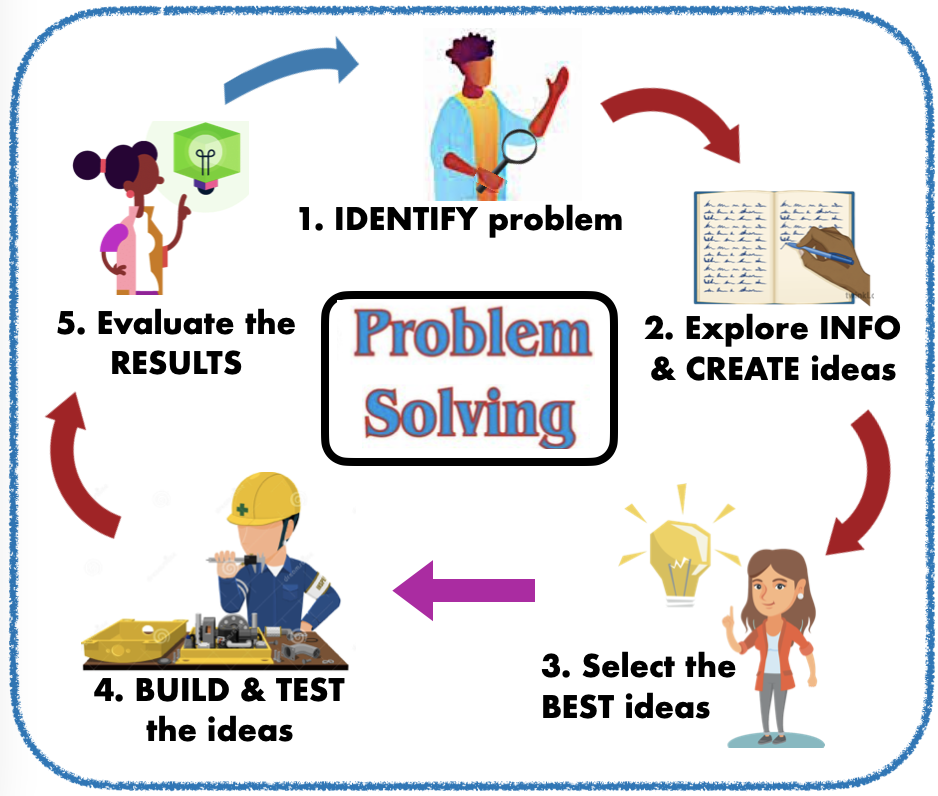
1. Planning
: think through your task, set goals, outline strategies to tackle it, &/or create a schedule for the task
2. Monitoring: put the plans into action. Closely monitor performance & experiences from the chosen methods
3. Reflection: When finished & results are in, review on how well you did (➕/➖), & why you performed the way you did (see S-R post Self-Reflection)

Components of S-R learning
💎 Cognition = skills & habits needed to encode, memorize & recall info, as well as to think critically & problem-solve
💎 Meta-cognition = ability to stand back, take a birds-eye view of yourself in a situation, & observe how you problem-solve (negative versions -3 posts)
Also : using self-monitoring & self-evaluation skills (“How did I do, or how am I doing ?”). Knowledge IS:
▫️declarative – what influences your performance
▫️procedural  – about learning strategies & tactics
▫️conditional – why & when to use a particular strategy

💎 Motivation  = beliefs & attitudes that affect the use & development of both cognitive & meta-cognitive skills, by understand & monitoring then both
▫️self-efficacy – degree of confidence that one can perform a task or accomplish a goal
▫️epistemological beliefs  – about the origin & nature of knowledge

⚙️ The Cognitive domain includes the stress of processing various kinds of information, maintaining attention, dealing with time pressures, & the demands on our working memory.
Sustained concentration of any kind can take a high energy drain on a person’s autonomic nervous system (ANS). So someone uncomfortable for any reason in a learning situation will have to work harder to concentrate than someone who’s calm & alert. And problems self-regulating in any of the other domains can seriously limit their ability to focus on a mental task.
«


«
NEXT
: Emotional Domain

Self-Regulation : BIOLOGICAL Domain √

biologic domainPREVIOUS : Bottom-Up 

SITE : “Domains & Strategies for Self-Regulation” re. students


Self-Regulation
includes being aware of the people-places-things in our daily life (PPT) that upset us & how they impact our ability to develop ways to cope. Dr. Stuart Shanker identified 5 areas of behavior as reactions to stressors :

Biological physical factors : general health & sensory issues
Cognitive: attention, concentration, perseverance, thinking
Emotion: re. strong & uncomfortable feelings
Social: social interaction, relationships, friends
Prosocial: our empathy, moral judgments & behavior, effects of other people’s stress

Why look at these areas ?
☆ Stress in one domain can cause or worsen stress in another
☆ It helps us see beyond the most obvious stressors
⭐︎ See children’s (& our own stress) more holistically
☆ Opens our eyes to more possibilities for reducing stress

Pupil dilation predicts self-regulation success across domains, in response to emotionally relevant stimuli, with excellent test–retest reliability. Core aspects of daily life include being able to experience different emotional states & if necessary, adaptively regulate our reactions. The eyes are one way to measure this.
The Sympathetic System controls pupil dilation in response to emotional arousal, & the Parasympathetic controls constriction in response to brightness changes.

➡️  CHART : Results of self-regulation tasks & behavior = Each block shows the emotion reappraisal success of testing. Black solid line indicates group average & the white box its standard error. Each grey dot – in the center – is the average ratings for one participant.

RESEARCH conclusion: Pupil dilation is a proxy used to infer the person’s central arousal state. The difference between – reappraising tests & viewing of emotional stimuli – predicted the degree participants were able to balance their feelings to make them more neutral. Results were tied to each person’s level of regulation-related arousal, itemized by pupil dilation, & independent of the estimated effects of task difficulty. (MORE….)
1.  BIOLOGICAL Domain
This category involves general physical health = sleep, nutrition, exercise, & various ways to consciously maintain energy, as well as the role our nervous system plays in regulating energy levels.

It’s grounded in ‘Arousal Regulation’, which is the energized state of readiness to perform any action. This is made up of competing forces between Activation vs. Fight-or-Flight responses of the Sympathetic Nervous System’s (SNS), and the inhibition, feed-&-breed ** responses of the Para-sympathetic Nervous System.

** Involuntary activities that occur when the body is at rest, especially after eating, including : sexual arousal, salivation, lacrimation (tears), urination, digestion, and defecation.

How much activation or recovery is needed for any particular task will vary for each child & adult, situation by situation.
As the Loving Parent ego state in Recovery, it’s important to recognize states of arousal in oneself, so we can adjust emotions through up-regulating (energizing) or down-regulating (calming) our behavior & activities, to maintain optimal equilibrium.  See: “Sensory Diet for Adults“.
«

« Biological influences on S-R
Molecular genetics & Behavioral research have shown a definite genetic component to Self-Regulation. Most brain regions are inherited regulatory structures, such as the dorsal prefrontal cortex, orbital frontal cortex, superior parietal cortex & temporal lobe.
These studies suggest that some differences in children’s abilities to self-regulate are related to individual distinctions in their genetics. Naturally, there are other factors & influences such as environment, therefore self-regulation can be modified & is responsive to intervention.

4 Neural Mechanisms used to deal with stress, in descending order, are:
(1) social engagement
(2) fight-or-flight  (3) freeze
(4) dissociation.
If one strategy is inadequate to deal with the present stress, the brain’s ranking procedure for responding to threat will shift to the next option. The most beneficial is ‘social engagement’.

Biological stressors contribute to the quality of our day & our overall physical condition.  EXP : if you’re sick, or didn’t sleep well – it makes sense why you can’t concentrate on a report you have to write.
T
he brain-body has to respond to & recover from a current (or cumulative) stressor which depletes our energy.

Other energy zappers not always considered to cause a physical imbalance : daylight-savings time changes, dense written text with too little white space in presentations or books, smog in the air, strong smells, sudden weather changes…..
«

«
NEXT : Cognitive Domain

SONG : “THIS is ME”

PREVIOUS : Self-Reg – Emotional DYSREG .

⬅️ Travis George
23 yr old Welsh singer

NOTE : Self-Regulation Posts CONTINUE NEXT.

The SONGTHIS IS ME” is from The Greatest Showman, in the 2017 movie about P.T. Barnum who started his traveling circus show featuring unusual animals & ‘odd’ people, in 1870. Performed by Keala Settle, as Lettie Lutz, a bearded lady.

This song is about strength in the face of criticism. The singer confirms her individuality & self-acceptance. One of the most moving non-movie versions is by Travis George, a 2023 semi-finalist on BGT.

❇️ This song could be used as an anthem for all ACoAs!
We can reinterpret some words to apply to our life.

❣️”THEY” – can be our drunk, crazy, narcissistic family. Also abusive schoolmates, partners, bosses….

❣️”SCARS” & “BRUISED” – are the marks on one’s skin from beatings, accidents or self-injury. But it can also mean internal marks received from emotional abuse. Another possibility is anyone bullied for marching through life to the beat of a “different drummer”

❣️”BROKEN PARTS” – ACoAs : Wounded Child, healthy Child, negative Introject, healthy Adult & missing LOVING Inner parent. To form a whole inner family, some have to be ‘revised’ & others need much attention & healing.  Remember : We are ‘Damaged not defective’.

❣️”NO ONE WILL LOVE US” – is all the awful, painful reality that we were neglected, abused & abandoned by the very people who should have cherished & cared for us

❣️”US” – can be all of us Children of addicts & narcissists who identify as wounded but not defeated – working separately & in groups to heal & grow

❣️”ASHAMED” – is of course our own Self-Hate, as well as having absorbed constant shaming from family members & peers. One mother often said to her young daughter “Look ashamed !” even when the child wasn’t doing anything wrong

❣️”HIDE AWAY” – many ACoAs isolate as a way of trying to protect themself from being mistreated by the world the way we were by our parents. It can also look OK on the outside but hide internally by shutting down emotionally,  being dissociated, living in our head, disconnected from our body

❣️”A PLACE FOR US”- be part of Recovery & spiritual healing groups. But broader than that – a place in the world for our talents & for our empathy toward others like ourselves

❣️’GLORIOUS”- validating the True Self – our natural gifts, intelligence, fierce determination to overcome obstacles, creativity…..we were born with.

LYRICS
… I am not a stranger to the dark“Hide away, ” they say“‘Cause we don’t want your broken parts”I’ve learned to be ashamed of all my scars“Run away, ” they say“No one’ll love you as you are”

… But I won’t let them break me down to dustI know that there’s a place for usFor we are glorious

… When the sharpest words wanna cut me downI’m gonna send a flood, gonna drown ’em outI am brave, I am bruised   I am who I’m meant to be, this is meLook out ’cause here I comeAnd I’m marching on to the beat I drumI’m not scared to be seenI make no apologies, this is me

Oh-oh… Another round of bullets hits my skinWell, fire away ’cause today, I won’t let the shame sink inWe are bursting through the barricades andReaching for the sun (we are warriors)Yeah, that’s what we’ve become (yeah, that’s what we’ve become)

… I won’t let them break me down to dustI know that there’s a place for usFor we are glorious

… When the sharpest words wanna cut me down I’m gonna send a flood, gonna drown ’em outI am brave, I am bruisedI am who I’m meant to be, this is meLook out ’cause here I comeAnd I’m marching on to the beat I drumI’m not scared to be seenI make no apologies, this is me

Oh-oh-oh…. This is me

… and I know that I deserve your loveThere’s nothing I’m not worthy ofWhen the sharpest words wanna cut me downI’m gonna send a flood, gonna drown ’em outThis is brave, this is bruisedThis is who I’m meant to be, this is me

… Look out ’cause here I come And I’m marching on to the beat I drum I’m not scared to be seenI make no apologies, this is me

… Whenever the words wanna cut me downI’ll send a flood to drown ’em out I’m gonna send a flood Gonna drown them ’em out Oh, Oh…. This is me

♦️ As recovering adults we can teach our WIC (wounded Inner Child) to take courage, & triumph over all the old hurts.

NEXT : Self-Regulation -BIOLOGICAL Domain

Self-Regulation : EQ LEADERS √

PREVIOUS :
Self-Reg &
E-I QUOTIENT

SITEs :
▶︎ “50 tips for improving your emotional intelligence
◀︎ The Rise of Emotional Intelligence: Why EQ is Essential for Modern Leadership”


EQ  = Emotional Intelligence QUOTIENT


High EQ Leaders, Communicators, Healers
=
THEY :
♦️ Self-regulate
Their EQ skills benefit them in both business & social situations, allowing them to stay calm, keep a clear head & focus on the issues at hand. They rarely get overly emotional – without temper tantrums or hysterical outbursts, & don’t make impulsive, careless decisions. They can manage delaying gratification, accepting that waiting for what they want may bring better results.

♦️ Want to be a good, moral person
“Moral identity,” is an aspect of EQ, wanting to see oneself as ethical & caring. They work at building up this aspect of themself (regardless of how they’ve acted in past moral situations)

♦️ Love changes
They are emotionally flexible & constantly adapting, since they know that fear of change is paralyzing, a major threat to happiness & success. They look for positive changes lurking just around the corner, & form a plan of action when those do show up.

THEY ARE :
♦️ Curious 
A deep sense of wonder & curiosity makes them delightful to be around. They don’t judge, but explore possibilities with an open mind, asking questions & are available to new solutions.

♦️ Empathic
They’re able to understand other people’s points of view, even without a lot of firsthand experience to draw from. Those who can  feel empathy for their co-workers can respond in more constructive ways, even anticipating teammates’, subordinates’, or manager’s needs.

♦️ Focused on Positives
While not ignoring the bad news, they consciously decided to not waste time & energy on problems. Rather, they find what’s positive in a situation & look for solutions, focusing on what’s possible, & what’s in their control.

♦️ a Great Leader
Most successful leaders have a high E-I coefficient. They like to lead by example, aware that it’s not enough to delegate to get things done properly – if they’re not willing to “walk the walk”. They are very talented, have a good work ethic & are ambitious.

♦️ Highly motivated
They’re able to focus, stay on-task & are better at handling stress. This comes from being more self-managed & less impulsive – not overtaken by emotions, nor ignoring them. Also, they can use emotions as a guide foo make good decisions, rather than just on an intellectual basis.

♦️ Not easily offended
With a firm grasp of who they are, it’s hard to get very upset when others say or do something annoying or abusive. Being self-confident & open-minded, they also tend to have a rather thick skin. While drawing the line between humor & humiliation, they don’t always take themself so seriously, & can even take some ribbing from others.

♦️ Respected by others
 Managers are widely respected by their bosses, peers, and employees. They like people and are savvy enough to know what makes them tick. Their ability to quickly build rapport and trust with those on whom they depend seems almost second nature. Power wars, backbiting, and duplicity are not their style.

♦️ Responsible
They take responsibility for their own life, & don’t rush to blame others when something goes wrong. understanding that current circumstances are a result of decisions they’ve taken so far. They identify what can be done differently the next time, & develop a plan to implement those changes.

♦️ Self-aware
They know their advantages & accept weaknesses, & analyze how to work most effectively within this framework

♦️ Socially Aware
They can read non-verbal communication & social cues, tuning into other people’s emotions & attitudes. This helps them see the inter-personal interactions in groups or larger organizations

♦️ Able to stand pressure & fight it
They don’t freak out easily, so others look to them for reassurance when things get crazy. In a bad situation, they’re the strong shoulder to cry on, the source of light to look toward, the beacon of hope, the rock. EQ leaders embrace this position fully. If they sometimes lose your cool they don’t obsess over it, just dust themself off & move forward.

(Modified from  Salman C.  TÜV Rheinland Middle East)

NEXT :