Noticing LIES (Part 2)

PREVIOUS : Intro, #1

SITE: The Cost of a Lie


SELF -REGULATION means to monitor & control one’s thoughts, emotions & actions, according to personal standards & goals.  Competitiveness, moral identity, & guilt-proneness affect the interpretation of a situation, & therefore a person’s willingness to modify their behavior, based on their values. What effect self-control has on lying depends on the :
1) easiness to make use of the opportunity to lie
2) amount of time available to decide to lie.

WHY it’s HARD to spot a lie
🔸 Parental
influence
They teach us to not identify their lies. Hiding their misbehavior, family scandals & shame, illegal activities, or the need for sexual privacy – can be reasons for misleading children about what they’re doing, when they’re doing it & why. So we learn to deny or ignore our perceptions..

🔸 They remind us of ourselves
Social psychology tells us that people define themselves in terms of social groupings. Similarities make us feel comfortable. The ones we feel a part of are considered the In-group, & any that exclude us is an Out-group (us vs. them). And we disbelieve people who act ‘inappropriately’ according to how we would act & by our group’s standards.

We assume we know what In-group people are like – they’re good, just like us!  So we’re much more likely to trust the deceivers we have a lot in common with – regardless of how little they may deserve it.
EXP : It can be hard to accept that a trusted colleague in business is doing something underhanded, so we believe their lies until they become undeniable, but by then the damage is done.

🔸 We want to be misled
We’d rather not ‘out’ liars, because we have a stake in not knowing unpleasant truths. Being trusting rather than suspicious generally enriches life, in spite of possible consequences & costs. To always be cynical & assume the worst of others is not only hard on the doubter, but undermines their chance of developing & maintain intimacy in mating, friendships & work relationships

🔸 Social Manners
We’re brought up to be polite in all interactions – to not be too direct, not ask sensitive question & not try to get personal information by manipulation. Giving the false message (“I’m fine”) is often more socially advantageous than the truth (“I’m miserable”). 

Also, when it comes to detecting liars, we’re socialized to focus on the wrong thing . EXP : people who are physically attractive or of high social status are assumed to be ‘good’ – we automatically assign favorable traits to them, believing them to be more likable, competent, & honest than unattractive or lower status persons. 

🔸 Truth Bias
This term refers to the fact that we assume most of what we say to each other is truthful. Research indicates that people find it easier  to judge a statement as true rather than false.  Lying, though universal, & done to some degree, but still considered the aberration. Beyond the truth bias, calling or labeling someone a liar is serious business – even when absolutely accurate – & can get the accuser fired, attacked or even killed.

NOTE : Unfortunately, many adults (especially family) are unwilling to believe a child who reports being sexually assaulted by another adult, assuming they must be lying. Yet there are many examples of mothers who instead will accept the lies told by boyfriends, husbands & siblings rather than believing the victim.

🔸 Lacking Facts
Over a lifetime, we rarely deal with pathological liars, so if we’re unfortunate enough to encounter one, we’ll be hampered & overwhelmed by a high base rate of inadequate info. In that case, the base rate of lying is more than 75% (“percentage of a population that has a characteristic being measured”), making it harder to be alert to the subtle clues of deceit.
EXP: all the highly skilled phone & internet scammers who are believed.

🔸Misreading Body Language
We’re encouraged by folk-wisdom to focus on signs of nervousness or anxiety as proof of dishonesty. These are measured by increased heart rate, respiration & blood pressure, the basis of polygraph testing. Actually, research shows that these signs may indicate emotional anxiety, not necessarily of lying.

NEXT : Psychology of Lying

Noticing LIES (Part 1)

PREVIOUS : Attachment & Spirituality, #4

◀︎ CHART explained


DEF : Lies are ‘deliberate attempts to mislead, without prior notification – vs –
Truth,
which is a ‘sincere attempt to provide accurate information.’

NORMAL : Humans are generally very poor lie detectors. In the original study of Truth Wizards, only 50 people out of 20,000 people were clever at lie detection. Another study found that people in a lab setting could only accurately catch when someone’s lying – 54% of the time.

We don’t automatically assume we can tell if a stranger is lying, but we mistakenly believe it’s easy to know if someone close to us is,  yet we can barely tell if our own partner is lying to us. Actually, our conscious thinking often interferes with gut awareness. Instead of relying on instinct, people focus on stereotyped behaviors associated with lying, such as fidgeting & lack of eye contact.

However, depending too much on ambivalent markers makes it hard to separate truth from falsehood. In fact, there are no universal, surefire signs that prove someone’s lying. All those indicators that researchers point to are just clues that may or may not ‘prove’ that a person is being dishonest.

Researchers at UCLA analyzed 60 studies on deception to develop recommendations & training for law enforcement. The results published in the American Journal of Forensic Psychiatry noted that, although catching deception is not automatic, quality training can improve a person’s ability.

A study reported in the Journal of Forensic Research found that “truth” is multi-dimensional, & that false statements differ from it in both quantity & quality of information presented. Catching lies is hard because it requires more mental (cognitive) work. Being able to accurately ‘hear’ lies can be improved by using verbal-content-analysis, which identifies characteristics of truthfulness & deception.

🧡 Figuring out that a communication is true only involves 1 step, since the brain’s automatic reaction to incoming information is to assume it’s correct.
Speak truth, listen > believe.

🩶 Instead, falsehood is a 2-step process, because creating it requires suppressing the pre-potent (automatic) “truth response”. Once deciding to lie (1), mental inhibition/ self-control is then needed to prevent the truth from slipping out (2).

This may explain why it can take the ‘average liar‘ longer to respond when questioned. (“Lying relies on the truth“)
76% of participants said they applied the simple rule of saying the opposite of the truth, so the closer a liar sticks to the truth, the harder it is to detect deception. (More….)

This 2-step process suggests why the listener may also take longer to catch on – because they are forced to look deeper, rejecting the surface meaning of a suspect statement, & figuring out that it’s not just incorrect but is actually meant to mislead or deceive.
KEY solution : Because spotting lies is not intuitive, paying attention to someone’s body movements, verbal patterns & behavioral signs can help to expose them. (Future posts)
✅ Whether it’s someone you know well or are newly attracted to a potential friend, lover, teacher…., observe them over time, noticing their baseline behavior. What’s normal for them – when they’re not stressed or triggered ?

EXP : What if you notice when you’re talking to someone – that they rarely look straight at you  but instead look elsewhere?
It can mean that they have a physical problem, may be a visual thinker (up & left), or may ‘just’ have low self-esteem, but are not a liar !

✅ Once you know someone’s baseline functioning, you can compare their behaviors with a repeating pattern of reactions when they are stressed, which will help to evaluate their credibility in a given situation.

NOTE : Be careful to not jump to conclusion when evaluating. Go by what you already know about this person. Some ‘proofs-of-lying’ may instead be signs of intense fear &/or shame, or a disability.
ASK yourself : How does my body feel – before, during & after interacting with this person? Anxious or relaxed. The most important tool is to consider previous experiences combined with gut institution.

Attachment & SPIRITUALITY (#4)

PREVIOUS : SPIRITUALITY (#3)

BOOK : “Attachment in Religion and Spirituality, a Wider View” ∼ Pehr Granqvist


Attachment, CHURCH & COUNTRIES
from Betsy Stalcup, founder & Exec.Director of Healing Center International (UK)

1. Secure  – For Baby to be securely attachment, Mother needs to be attuned to them. For a child’s healthy development, she is “good enough” if she’s available at least 50% of the time.

Securely attached people are confident & hopeful. They’re not anxious, so don’t avoid intimacy, & experience a wide range of emotions, enjoying safety & shalom (peace).

To represent this, Betsy chose Denmark, often dubbed “the happiest country in the world.”  EXP: New moms have a full year of maternity leave – unlike the U.S., one of only 7 countries in the world that doesn’t have this service!

SO – What kinds of churches exemplify a Secure attachment? Those that include both sides of the brain, that draw people to God through reason & words, as well as emotions & beauty – drawing by love, not fear. Their connection is based on who God says He is (in the Bible), rather than how our family & ‘religion’ treated us.

2. Distracted : Babies feel great when connecting with Mom.  But she only she attention when she’s in the mood for interaction, & other times ignores baby’s inter-personal needs. So, Baby vigilantly watches mom to make sure they doesn’t miss out on the crumbs when she makes herself available. As a result, Baby’s attachment light is always on.

These become adults who are clingy, overly dependent, filled with anxiety. They tend to experience emotions at the extremes, & are often labeled drama kings or queens.
A ‘Distracted’ worship style might be loud, intense, even charismatic. Reason & logic would not be as important as a LOVE relationship with God. Even so, it can be stormy, because nothing is ever enough.
EXP : Italy, land of passion where even talking is emphatic, pronouncing every syllable: Bru-sche-tta! Piz-zeh-ria! 

3. Dismissiveavoidant – Babies develop this attachment style when there is little or no interaction with Mom.  She’s not sensitive to Baby’s emotional or social cues, so its attachment light gets turned off. Since this relationship is not a source of joy, the child concludes it’s better to go it alone & find some thing else to attach to – not people.

Betsy chose England, home of the stiff-upper-lip, where historically the upper class sends their children off to boarding schools.
Dismissive adults tend to undervalue emotions & peoeel, so they’re more likely to choose churches that focus on reason & logic, on religious principles rather than spiritual connections. USA culture often considers Dismissives as “strong”. but actually, they long for intimacy without knowing how to achieve it.

4. The disorganized style is complicated (80% of abused children, most often in the inner cities). In this case Mom is mis-attuned to Baby. She’s not reliable – sometimes there, other times oblivious. She may be an active addict, mentally ill, have unprocessed trauma, or be a Disorganized herself.  So – Baby’s attachment light comes on erratically. The result is a confused, angry, lost adult.

Betsy chose Russia, where “drinking is pervasive & socially acceptable….” & the people are aggressive. Then perhaps so is their Deity. Any church that preaches “fire & brimstone” or portrays God as an angry punisher tend to draw this type. Their relationship with Higher Power is stormy, bonded by fear & anger, not love.

❤️‍🩹 Betsy asks : How can we help those with insecure attachments?
ANS: Encourage everyone to develop a Spiritual attachment, which has to be a 2-way conversation :
⏫️ From us – it’s talking to God in prayer, daily praising Him for who He is, as well as bringing all our joys, sorrows & requests.
⏬️ From heaven – it’s letting God talk to us, mainly by reading what He tells us about Himself in the Holy Scriptures – Omnipotent, Omniscient, Omni-present, Just & Loving.

We needed lots of time with Mom, but most of us were deprived of that as kids, although for some, we got to be with her more often as adults.
Even if she could never fill that longing, now we can form a Secure attachment to the Lord, by daily spending time with Jesus. We’ll find out how glad He is to be with us, & how lovingly attentive He is to our needs. His presence is healing.

NEXT :

Attachment & SPIRITUALITY (#3)

PREVIOUS :  Spirituality (#2)


CONNECTEDNESS : Psychologists & religious leaders trace many personal problems to a lack of adequate parent-child attachment, pointing to broken connectedness & historical dislocation as sources of psychopathology.

Problems in relating to others can & will occur. Disconnections are part of any relationship that is not mutually empowering or mutually empathic. But Humans were not designed to be Disconnected. Yet our scientifically-oriented culture has deliberately cut us off from staying attached to our Creator God, & therefore from our innermost needs, & from each other. Society is ill with fear, confusion & rage inside, while on the outside we  still hold on to the fiction that “we are in control’

Christian psychologist Larry Crabb‘s book about Connecting (audio) suggested that it could be formed by empowering the good in each other – that which is of / in line with God’s beneficial rules for living. Crabb realized that it is a more effective counseling approach than many traditional psychotherapeutic styles.

Jean Baker Miller (Wellesley) names some bad things about Disconnection:
☀︎ Disempowerment, causing diminished
☀︎ Diminished sense of self-worth
☀︎ Isolation & relationship avoidance
☀︎ Mental Confusion

Some good things about having Connections :
♥︎ Increases sense of worth – by being seen & heard by others with empathy
♥︎ Desire for more suitable connections, & the joy that adds to our life
♥︎ Increased knowledge & clarity about our own & other’s thoughts & feelings
♥︎ Empowered to act for ourself – on our own – with increased energy & productivity

ATTENDING ‘Church’ & Family Relationships
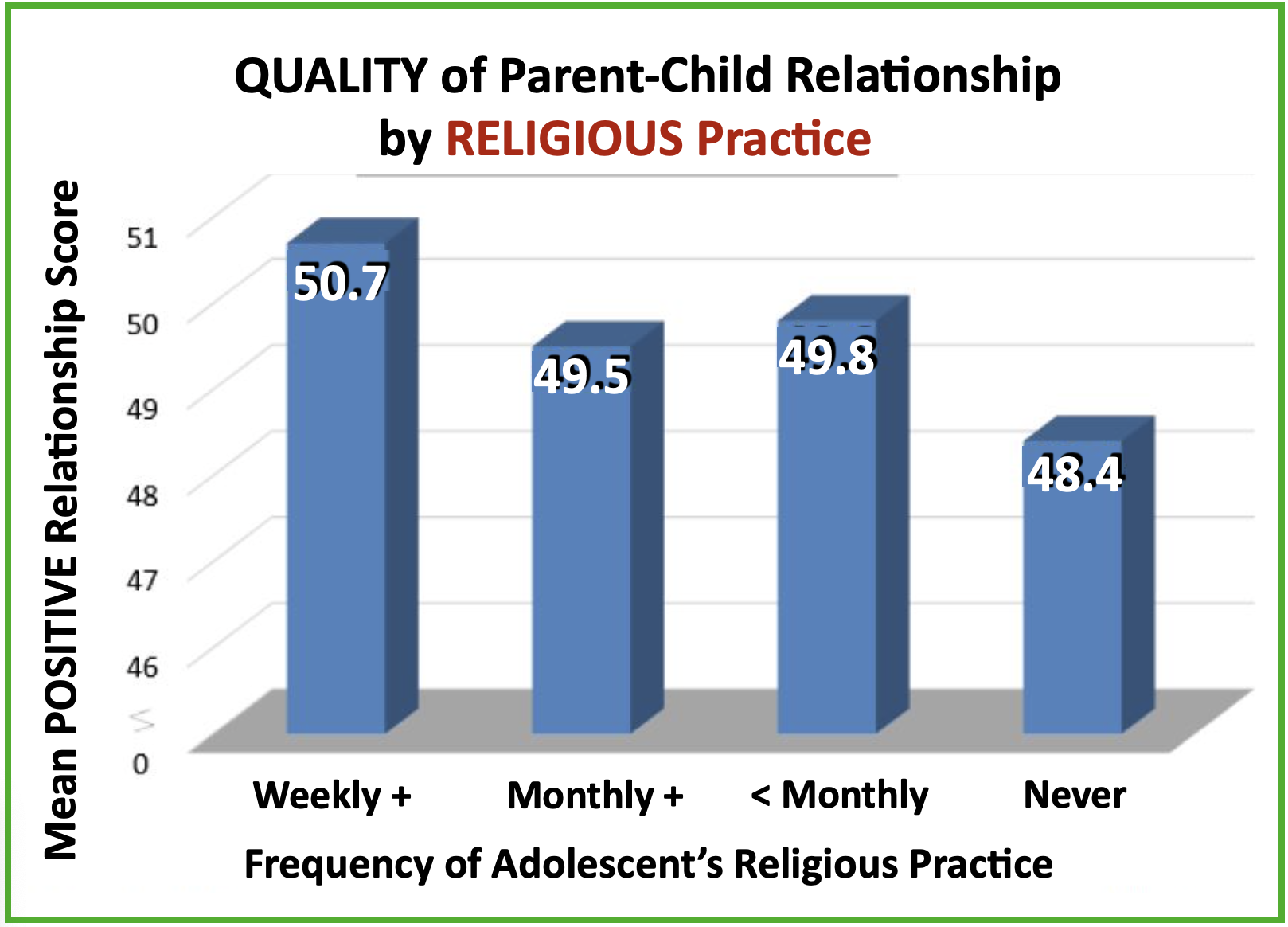
From :  MAPING AMERICA : A survey made in 2003, consisting of parents of 102,353 children & teens in all 50 states and D.C. Data was taken from the National Survey of Children’s Health.
PPR-= Positive Parental Relationship (scale)

The survey noted that the stresses of marital conflict or separation + the strains of maintaining a household + rearing children as a single parent —> often interfered with interacting with children in a calm, positive, yet firm way.

On the other hand, when parents & children were involved in a religious community, other families in that environment provided emotional support & practical assistance to the stressed ones, making it easier for parents to raise their children well. Being a members of a religious community also helped reinforce the moral & spiritual lessons that parents wanted their children to absorb.

a. Family Structure: Children who lived with both biological parents or two adoptive parents scored higher on the PPR scale than children who lived in a different grouping, such as with their father alone, with grandparents or foster parents.
➤ In between were those who lived with one biological parent, a stepparent or with a single mother

b. Religious Practice: Children who attended religious services at least weekly scored higher on the PPR scale than those who never attended 
➤ In between were children who worshipped 1-3x a month, & those who attended less than once a month

c. Combined – Family Structure & Religious Practice : Children who worshipped frequently & lived with both biological parents or with two adoptive parents had a higher score than those who worshipped less than monthly & lived in single-parent or a reconstituted family
➤ In between were those who lived in intact families but worshipped less than monthly, & those who lived in non-intact families who worshipped at least monthly

OTHER Studies corroborated these findings.
º Single parents “are more likely to yell” at their children, while conservative Protestant parents were less likely to do so
º Fathers in intact families devoted more time to their children & most of their social time consisted of religious activities

CONCLUSION : Combining Religious attendance, Spiritual interest & Intact families are the building blocks of healthy parent-child relationships.

♦️ 2023 UPDATE : Christian Identity & religious affiliation has markedly changes in the last 30 years.  While the positive influence of religious participation on the family is still valid ⬆️ , the practice has greatly diminished. The PEW Research Center looked at these changes, (2022), asking “What is your present religion, if any?”.

Theories about why the dis-affiliation has sped up since the ’90s :
— as societal conditions improve & scientific advances allow people to live longer with fewer worries about meeting basic needs, they have less need for religion to cope with insecurity
— the US’s association of Christianity with conservative politics has driven many liberals away from the faith
declining trust in religious institutions, clergy scandals, rising rates of religious intermarriage, smaller families….
⬇️ Stats are for 1973 to 2017. (MORE….)
«

«
NEXT : SPIRITUALITY (#4)

Attachment & SPIRITUALITY (#2)

PREVIOUS :  Spirituality (#1)

BOOKs :
ATTACHED to GOD” ∼
 Krispin Mayfield, with review
▸ :”GOD ATTACHMENT “∼ Dr.Tim Clinton &  Joshua Straub


A CHRISTIAN Perspective
“Attachment Theory & Your Relationship with God”, by
Dr. Bonnie Poon Zahl , a UK psychologist studying people’s religious & spiritual experiences in terms of natural psychological processes – the thoughts, emotions & behaviors that form the warp & weft of human life.

To do this she uses an important & well-respected concept about human relationships : Attachment Theory, which explains how people experience & respond to separation & distress within —–> the context of core, close relationships from very early in their life.

Attachment is part of what it means to be human – beings who are created by God to be part of His eternal family. So how attachment styles affect human connections can also describe our relationship with God & the ways we talk about our faith.

RECAP : Our most intense emotions are triggered during the “formation, maintenance, disruption & renewal” of attachments. Separation brings up feelings of loss, sadness & grief, and sometimes anger — while reunion causes joy & closeness for some, but more mixed emotions for others.

Since Baby is born without the ability to regulate emotions, Mom needs to bond with infant, & then she can regulate the ++ & — emotions of them both, by face-to-face communication, looking into baby’s eyes, & smiling.
These early experiences play a crucial role in our sense of Self = in relation to those people who matter the most.

re. RELIGION
Bonnie explains : ‘As a Christian & a psychologist, I’m struck by the clear parallels between the attachment theory of separation & reunion and the Christian narrative of alienation from God because of sin, the suffering it causes, & reunion by God’s grace through Jesus’ death & resurrection.”

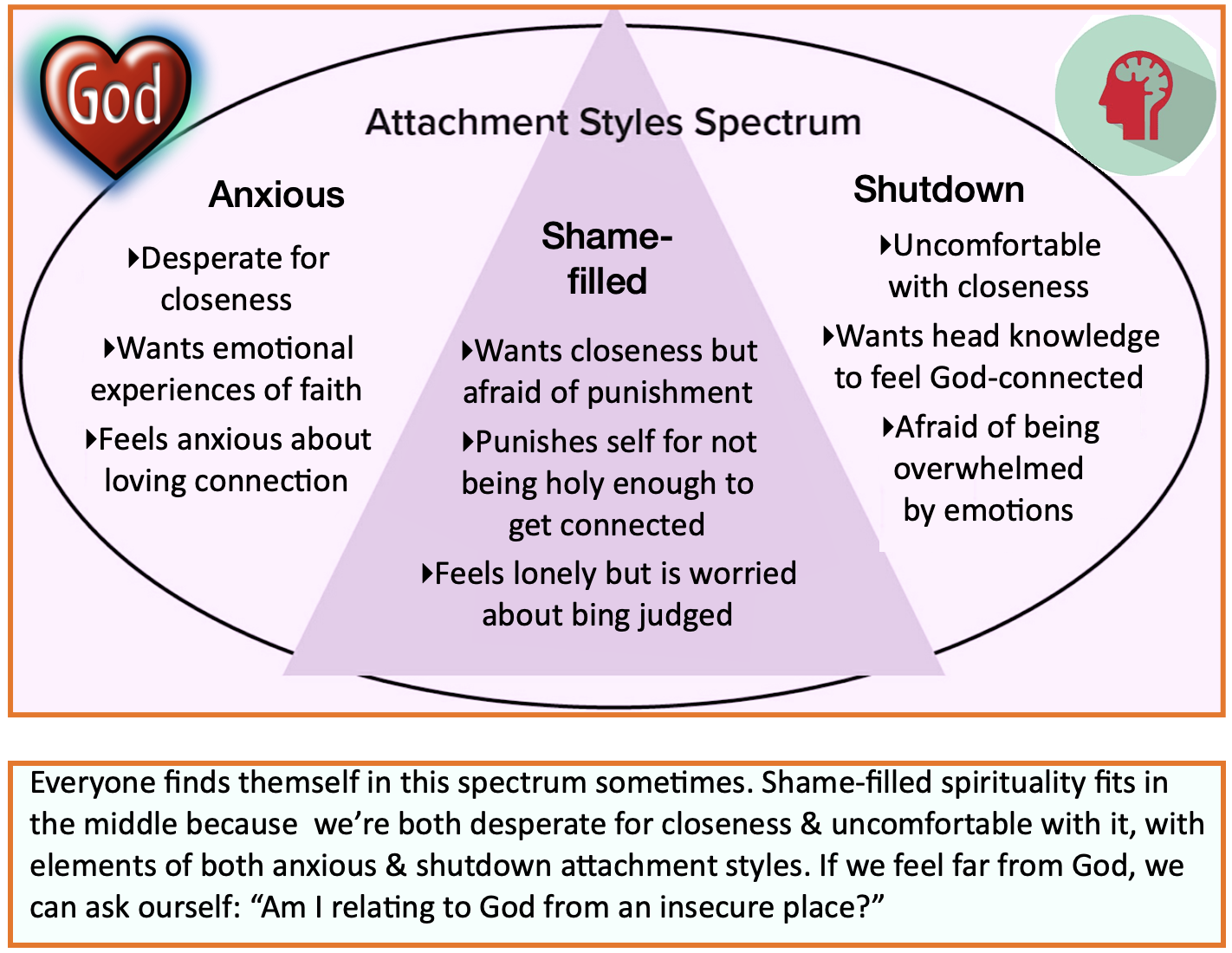
Attachment patterns developed in childhood provide one lens that helps us see how people relate to God when things go wrong in our life. Research confirms the tendency to consider God as an attachment figure, so we experience Him in different ways :

🔆 securely, the connection with God is stable & integrated throughout the ups & downs of life
〽️ anxiety about abandonment (FoA) – always worried about losing God’s loved, & trying to be perfect to avoid His anger
〽️ avoidance of intimacy (FoC) – don’t feel His presence or love, so don’t want to depend too much on God, even when distressed.

Many Christians do turn to God to restore a lost sense of security.  But when some Christians experience Him as distant, unresponsive or absent, they feel depressed or bitter. Anger at God is a common reaction to unanswered prayer, especially if there’s a strong need & they’re very disappointed when God doesn’t respond the way they hoped.

For the Insecurely attached, long-term anger at God can turn into doubting their relationship with Him.
Not getting what they asked for, many of this type misunderstand & misinterpret the reasons (EXP : God is mad at me….), or go as far as doubting God’s goodness, even losing faith altogether. (EXP: Mother Teresa : 50 yrs of feeling abandoned by God – scroll  to “The Onset)

In any case, God meets us as we are, whatever the attachment style.
🔻 On the human side, the Incarnation proved that God himself fully understands us because He took on the same kind of body & mind as us, & had the same kind of relationships with family many of us have had.

EXP: Jesus’ siblings didn’t believe in Him (until after His resurrection). And once, when Jesus was mobbed in a house where He was teaching & healing people —-> his mother & brothers came to get Him, convinced He was crazy! (Mark 3:20)

🔺 On the spiritual side, the Bible presents God as the perfect Father & caregiver, but how we take that in will at least partly depend on how we were raised. Wise Christians turn to God to restore a lost sense of security. 

The Psalmist describes God as “our refuge & strength, a very present help in trouble” (Ps 46:1).
St. Paul wrote that “neither death nor life, nor angels nor rulers, nor things present nor things to come, nor powers, nor height nor depth, nor anything else in all creation —> will be able to separate us from the love of God in Christ Jesus our Lord” (Rm 8:38).
Truly amazing – & a wonderful promise!

NEXT: SPIRITUALITY (#3)

Attachment & SPIRITUALITY (#1)

PREVIOUS :  Attachment & Animals

SITE : “How To Trust God In Hard Times + 7 Bible Verses To Pray


John Bradshaw, ACA therapist, TV lecturer, (in the 1990s) & author of many important books…. reminded us that “Up to the age of 7 children deify their Parents. After that they parentalize their Deity”. 

Unfortunately, for many people who grew up in a narcissistic &/or alcoholic family – their only reference for a Higher Power – are abusive, drunk & neglectful parent(s). In ACoAs 12step meetings, we are minded that “God is not an alcoholic parent!”.  Instead, we read in God’s own Words that He is attached to us!
♥︎ “I have loved you with an everlasting love” Jeremiah 31:3
♥︎ ” ‘I will never leave you
nor forsake you’ “(Hebrews 13:6),
♥︎ “The Lord is near to the brokenhearted & saves the crushed in spirit.” (Psalms 34:18).

As ACoAs, few of us had many positive attachment choices growing up – perhaps an attentive relative or older sibling, a friend’s kind mother, a sensitive babysitter or teacher….. but for most – there was no beneficial influence in our early years.
«
«
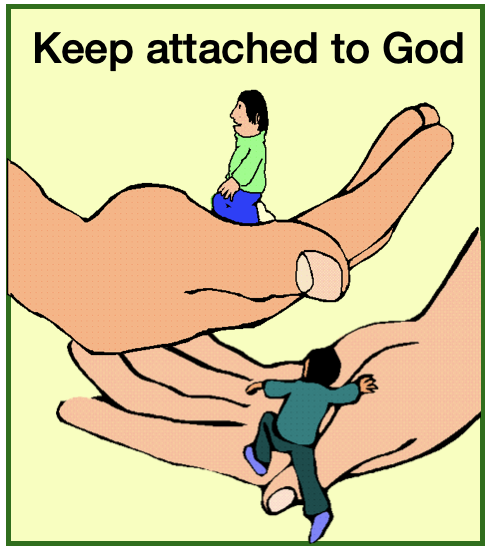
We didn’t have a choice then  but now we do. NOW, as part of our life-long Recovery, we can allow ourself to form attachments to safe people around us. Along with that we can develop an attachment to Yahweh, the loving Creator, learning that we can trust in His love, care & provision.

Without that – given our background – the world is a scary place, just like our original home, & we’ll find unhealthy PPT (people places, things) to fill the ‘hole-in-the-soul”, such as food, sex, drugs, control, rescuing….

Re, HOPE
Children from a severely dysfunctional home end up with a deeply rooted sense of hopelessness : “nothing ever changes, nothing good will ever happen, & nothing good is available for me.” When a secure attachment base is lacking, people lose confidence in the possibility of achieving what’s important to them. They shy away from others & from problems in relationships. 

Developing HOPE is an essential part of Recovery.
DEF:  a way of thinking, composed of having :
(1) meaningful goals for the future
(2) the ability to identify procedures to make those goals work
(3) the motivation & energy to implement those procedures 
High levels of hope is related to much better performance & achievement in all areas of life, at any age.

Research shows that parents instill hope in their children when they are a “secure base” that allow children to :
— confidently explore their environments
AND who provide safe havens so children can
retreat to be consoled when frightened by stressful events.

Just as secure attachment to parents instills hope in children ——> secure attachment to God & healthy groups can foster hope in adults – especially when life seems dark. It minimizes loneliness, encourages positive emotions & higher levels of optimism. 

Developing trust in a loving all-powerful God  – exactly because He is not like our original family – provides a sense of safety, predictability & reassurance throughout life. These blessings might explain why researchers have found that a secure attachment to God yields positive mental health benefits, It allows us to think, feel & act in ways that makes life better & easier.
(Modified from – Hal Shorey Ph.D., The Freedom to Change)

A REVIEW of 17 studies by the Psychiatry Dept. at U. of Saskatchewan, Canada (2013) looked at “The Relationship between Attachment style & Spiritual Beliefs”

In this context, God is considered a Heavenly parent, & religious beliefs fostering hope as past of psychiatric treatment. Higher levels of spiritual awareness & practice were independently associated with better psychological well-being, providing emotional comfort, self-regulation, & meaning.

The attachment-religion link comes from 2 hypotheses:
— Correspondent : attachment will be stable across different relationships (secure in one predicts secure in others)
— Compensation : a relationship with God makes up for deficient caregiving bonds, by substitution.
Some FINDINGS:
☆ The mental picture of how survey respondents  connected to Mother was similar to the ‘see’ their connection to God
☆ People with Secure, sensitive parents – had strong religious beliefs
☆ Those with insensitive parents used religion to compensate
☆ Disorganizeds tended to have a sudden religious conversion, or a pull toward New Age ‘Spirituality’.

Unwritten Assumption :  God was more often used as crutch &/or tranquilizer, rather than having a genuine inter-relationship with Him as our Creator & Savior.

NEXT : Spirituality (#2)

Attachment & ANIMALS – Too Attached? (#6)

PREVIOUS :
Pets & 
Eating Disorders

SITE : “Types of Pets, Pros and Cons” w/ pics

TYPES of PETS (lg variety)


REVIEW
: People with secure attachment have that deep-down confidence that ‘the other person’ loves them & can be depended on. The anxious-style people experience separation anxiety when their partner is not with them. Avoidant people prefer being independent, having learned that their parent or mate will not be there for them, so avoidance has become a protection against feeling abandonment pain.

But — CAN WE BE TOO attached?
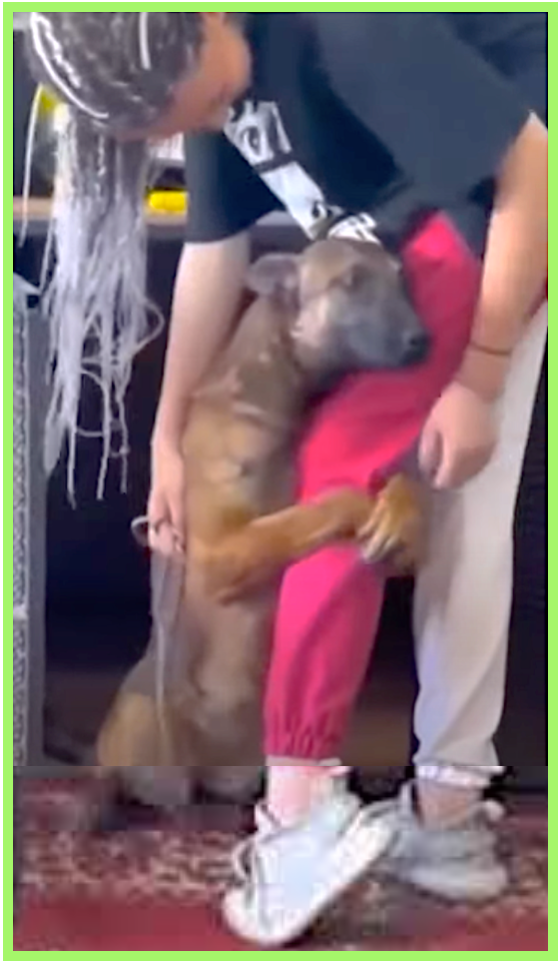
Being emotionally attached to your pet is completely natural. It’s easy to feel affection for our pets because they give us unconditional love & companionship, making us feel secure – & we rely on them for that. We want to be close to them, especially when going through tough times.
Song E. (2016) says : “Sometimes I even feel like my dog can sense when I’m not feeling well, & he comes over to comfort me. It’s amazing how strong a bond we can create with our pets.”

However, our attachment to pets is unreasonable & unhealthy when we expect our pets to take the place of another person, because of our own inability or unwillingness to form functional relationships with other human beings. To evaluate how healthy and reasonable, one’s bond with a pet(s) is,
ASK:
😽 How much do you let the pet interfere with your life ?
– Has your relationship with the pet negatively affected your relationship with a spouse, other close friends or relatives?
– Do you turn down invitations if the pet is not included?
– Do you relate to the pet instead of with family & friends?
– Does the pet occupy your thoughts more than most other matters?
– Do you feel like you can’t live without this animal ?

It can also have a negative effect on us as owners & caregivers if we have trouble differentiate ourself from our pets – becoming symbiotic.  Preventing or correcting this requires owners to have a level of mental health which includes implementing appropriate boundaries for both human & pet. 

For many people, the intensity of our attachment to pets comes from a strong tendency to anthropomorphize beloved animals**,which is when Insecure-style owners unrealistically apply human characteristics to their pets.
**Anthropomorphize = oversimplify or overvalue (give too much credit to) any non-human being, & in this case – assume animals have the same mental motives & physical capacities as people.
EXP : Saying that dogs are “people pleasers”, implying their behavior is psychologically unhealthy. Such assumptions are widespread in adults of all cultures that have been investigated.

We know they rely on us too, not just for food & shelter but also affection, attention & protection. (⬅️ Rescued !) However, if we allow them to become “too attached” to us it can have a negative impacts on their well-being, based on unrealistic expectations about their needs.

Can your dog be hyper-attached?
Does your dog constantly follow you around the house? Get very agitated when you leave, asks for a lot of attention, or even jump on you to express fear? And when you come back, does it over-greet you & have trouble calming down? You may wonder ‘Is my dog too attached to me’?

Some studies suggest that the owner’s avoidance attachment style may play a role in separation-anxiety in their dog. Based on human studies, one may extrapolate that since these owners don’t provide a consistent secure base for the animal which is needed, it learns the owner is not a source of comfort & safety.
These dogs are less able to cope on their own & show different behaviors when left alone. So an over-excited & over-attention-seeking pet may be showing abandonment fear, rather than hyper-attachment.

On the other hand — another study showed that following owners around the house was a very common behavior in all dogs, including ones without separation anxiety. And lots of excitement & activity before the owner was about to leave the home – or when returning – did not indicate worry, just normal dog behavior. This is more easily understood if the owner themself is secure. 

NEXT : Attachment, & Spirituality, #1

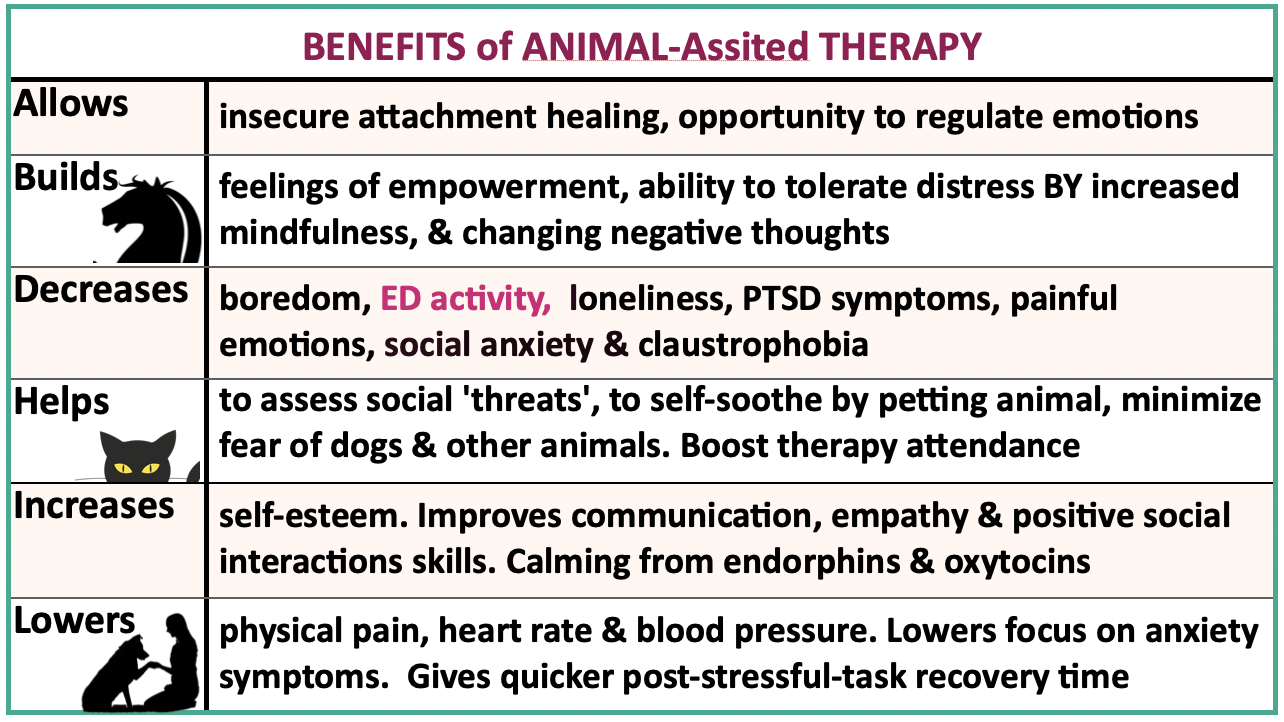
Attachment, Pet Therapy & EDs (#5)

PREVIOUS : Attachment & CATS

SITE : “Best Service Dog Breeds for Anxiety”


Animal-assisted therapy (AAT) is a goal-directed addition of an animal as an integral part of the clinical treatment process.  It’s guided by a professional health or human service provider with the skill & expertise about the health applications of human-animal interactions.

EXP : Studies show that having a canine companion is linked to lower blood pressure, reduced cholesterol, & decreased triglyceride levels, which contribute to better overall cardio-vascular health & fewer heart attacks. Also, dog owners who do have heart attacks have better post-op survival rates.

Emotional Support & Psychiatric Service Dogs –  both types prescribe by a licensed mental health professional or doctor as part of their treatment plan. However, only PSDs are recognized as official ‘service animals’ under the Americans with Disabilities Act.
➡️

ESA :
Assigned to a specific person by a mental health practitioner to comfort an anxious person by its presence, but not for specific tasks, & which do not receive special training
PSA : a dog especially trained to perform many tasks directly related to their owner’s disability
T:
a dog or other animal trained to provide comfort to the public in settings such as schools, ­libraries, nursing homes, & hospitals. Strict guidelines are followed by the handlers to ensure that the pet’s temperament & constitution are appropriate in the location.
«
«
GROWTH : Attachment styles aren’t set in stone, so people can develop a secure attachment at any point in life – with various help, using therapy. For those who never had a safe attachment figure, opening up to another human, even a therapist, may feel dangerous. Ruth Lanius, PhD, recommends that Avoidant clients can be helped toward the goal of feeling safer internally & in the world – by interacting with an animal.

If the client has a pet, she suggests they spend time with them, focusing on the sensation of its fur, petting, cuddling, or just absorbing peaceful animal-energy from being near them. Forming a gentle, mindful connection with their animal can create positive feelings that starts to overwrite some of the fears about being close to humans.

And if the client doesn’t have a pet, Ruth suggests that even pictures or videos of a favorite animal – how they get along with each other & nurture their young – may widen the person’s window of tolerance for connections with other people.

Pet Therapy in Eating Disorder Treatment
Because animals offer variety of benefits to an ED patient’s recovery, many providers & facilities are incorporating them into their treatment plans. Whether it’s the more formalized animal-assisted therapy or having companion animals present, the values of pet therapy as a source of healing from EDs are considered important.

While conventional wisdom has long supported promoting human wellbeing from animal companionship, only recently has science investigated the restorative effect pets have in healing mental & medical problems.

While the effect of pets in ED treatment has not been studied widely, one can see where benefits would make sense. The most widely researched animals are cats, dogs, horses, & aquatics (dolphins), as well as a few studies on the benefits of birds & rabbits on human health & well-being.

Of the animals researched, dogs seem to have the greatest impact on humans. In one study, women in ED treatment found horses as well as dogs supportive in recovery – for experiencing the effects of their disorder, for emotional & relational connection, identity reformation, & thought management.

The women gained some sense of comfort, safety & protection – as they felt the animals could recognize their needs, provide unconditional & non-judgmental support & seemed to offer (perceived) protection (therapy animal benefits in ED recovery)

Review of 10 studies
Animal-assisted therapy (AAT) has been added to EDs treatment, with horses used in many residential facilities. AAT shows promise in randomized control trials (RCTs), showing significant decreases in depression, anxiety, & painful emotions.
The PRISMA methodology was used.  Therapy animals included 8 horses, 1 dog & 1 dolphin. Participants included patients, ages 11 to 64, & AAT with ED therapists.

RESULTS : Case & qualitative studies reported improvement in cognitive flexibility, ability to relinquish control, & confidence. Post-treatment quantitative studies showed an inverse relationship between AAT use and ED symptoms (more animal interaction = less disordered eating)

NEXT : Attachment & ANIMALS – Too Attached? (#6)

Attachment & ANIMALS – Cats (#4)

PREVIOUS : Attachment & Animals, #3


ATTACHMENT is a biological imperative. About 68-75% of the human population has the same attachment style developed in childhood, although it can change over time, because of  a catastrophic event, thru healthy experiences, with therapy,…. About 40% are Secure & 60% have developed various flavors of Insecure attachment.

Cats have been a part of our lives for most of human history, playing an important role in various cultures (China, India, Europe…). The Near Eastern Wildcat was bred by Mesopotamian farmers 3,000 BC, & cats were first domesticated in Egypt around 4.000 years ago. There they were revered as the goddess Bastet, mummified as accompaniment in human graves. When a pet cat died, the owner shaved their eyebrows for a month, & killing a cat was potentially punishable by death.
«

«
Research indicate that cats have a greater flexibility & depth of social relationships than was previously believed. A study from Oregon State U. showed that domestic cat have the same ability to form attachment bonds with human caretakers as babies & dogs.  House pets have attachment styles with others of their own species, as well as with other species, including people!

Two studies published in Current Biology by Kristyn Vitale looked at cat attachment styles & found evidence that says a lot about their relationship to their human caregivers. As with people, cats also form strong connections in infancy. Because they’re usually separated from their mothers at just a few weeks old, they become attached to the humans who raise them.

Kittens with a secure style greeted their owners warmly, rubbed against the person or allowed physical contact, before going to explore the room or play with a toy. They walked back & forth toward their human without a sense of urgency – relaxed, acting ‘cat-normal”without avoid their caretaker, just being “in the moment” .

The 1 yr old cats were exposed to various stressful events, then examples of common cat behavior, were measured, namely – their vocal reactions. The secure cats vocalized just as much as the ambivalent ones had from the insecure group! The frequency of meows was not exactly the same, but both types “talked”, while the avoidant & disorganized cats did not..

Insecure-ambivalent attachment style sat in their owner’s lap & demanded constant attention, while those that were insecure-avoidant hid or ran away from physical contact for several minutes before coming out to approach their human friend.«

Insecurely attached kittens were divided into groups, with 84%  Anxious-Ambivalent, 12% Avoidant, & 4% displayed disorganized attachment (fearful). A portion were enrolled in a 6-week training & socialization course with their caretakers, to see if that would affected their attachment behaviors. Researchers found that 81% of the kittens who participated had the same attachment style as they did before the course.

CAT ANXIETY
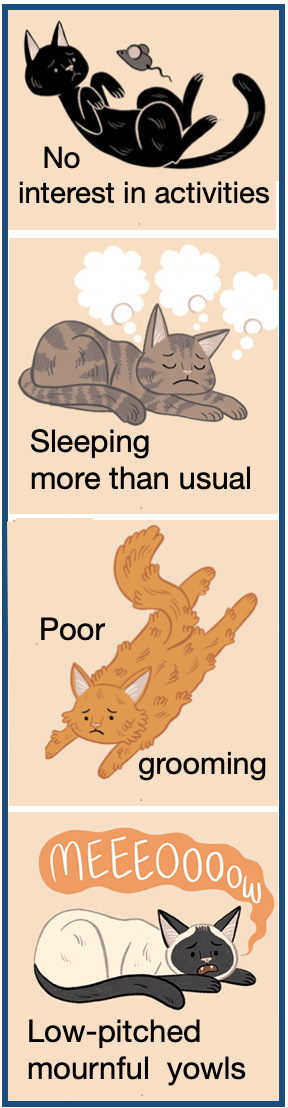
Cats can develop Separation Anxiety Syndrome, with many of the same signs as dogs, a distressing condition that can be a result of excessive attachment. SIGNS of anxiety :
⛔︎ Destroying things, more common in males
⛔︎ Excessive grooming,  more common in females
⛔︎ Excessive vocalization. Some also carry a favorite toy in their mouths while yowling or crying  

⛔︎ Defecating or Urinating outside the litter box.  In one study, 3/4 of those cats did so exclusively on the pet parent’s bed
⛔︎ Hyper-attachment to their caregiver, seeking constant contact when they are together (MORE ….causes & solutions)

HELP : Treatments for animal anxiety disorders
❥ Behavior Modification, Counter-conditioning, Rewards
❥ Create and Maintain a Consistent Routine
❥ Ignore Attention-Seeking Behaviors
❥ Manage the Environment, w/ Enrichment Activities
❥ Pharmaceuticals, EXP: pheromone products,

The best way to promote attachment security in cats is to encourage gentle, appropriate human-animal interaction from an early age, such as physical touch, & a predictable routine.

NOTE : Women are Emotionally Attached to Their Feline Pets.
Brain scans show that when we look at cats, the amygdala lights up, the part that processes emotionally important information. A study showed the most activity in seen in amygdala’s neurons, as a strong-positive response to pictures of cats more than when looking at buildings or people.”

SO — cats, naturally play with our emotions! Although they have individual temperance & attachment styles – like us – they provide amusement, attention & warmth. Once we’ve formed that bond, it feels heavenly, & nothing can take that away.
«
NEXT :

Attachment & ANIMALS – Dogs (#3)

PREVIOUS :  Attachment & Animals, #2

SITE : 4 Attachment Styles, & how they Sabotage Your Work-Life Balance


Bowlby also defined attachment as a “safety regulation system via behavior targeted at specific individuals…. it is not only related to our behavioral-control system for avoiding the danger of predation, but is also closely related to the feedback system of the neuro-endocrinological system” (<—- interactions between hormones & the brain, mainly how hormones affect behavior).

Infants separated from a parent tend to make characteristic distress noises (crying), to bring the parents back & feel safe again. Dogs do that too, such as the 7-week old puppy heard crying loudly in the woods who had wandered an away from its mother. 

Dogs have been our companions for at least the last 30,000 years, considered ‘Man’s Best Friend’ & have been shaped into hundreds of breeds for many purposes, from the lion-hunting Rhodesian Ridgebacks to the Chinese Crested on the lap of an emperor. 

A Swedish study of 51 female Golden retriever owners investigated if an owner’s adult attachment style (AAS) influences how their dog interacts & gets support from them during challenging events.  NOTE :
a. STRESSOR used to test dogs’ reactions, in relation to type of owner :
🎤 Auditory  (AUD)  //  👁️ Visual  (VIS)
💀 Ghost (G) – one person with a white sheet over them
🚶🏽‍♀️Approaching Person (AP) 

b. Dog POSITION relative to owner – when faced with various stressors :
🚹 Stand next to /  Stand behind
🛜 Lip licking // Reaction to a harsh sound
👁️‍🗨️ Look at owner / Look at threat / Look back & forth

1. More secure people find it easy to trust, to get along with others, & don’t mind depending on others or having others depend on them. 

Dogs belonging to more secure owners —-> during the approach of a potentially threatening person (‘ghost’)
— were less likely to stand behind the owner
— were more oriented to the auditory & visual stressors
— & less oriented to the owner
— looked more at the stressor rather than back & forth between the stressor and the owner ….. which may also reflect those dogs did not need to refer to their owners (for help) when socially challenged

— > Interestingly, this seems to be the opposite in human psychology, which suggests that secure children with a secure parent are better able to shift their attention back-&-forth between threat & safe haven (the attachment figure) than insecure children, to get guidance & protection.

2. People scoring high on the anxiety attachment sub-scale tend to believe it’s important that others like them, worry they won’t measure up to others’ standards, & about the risk of being abandoned. 

Dogs’ attention to humans is affected both by familiarity & by the relationship quality. In this test these dogs of more anxious owners :
— had less lip licking (possibly indicating lower stress) during separation from the owner, & released higher levels of cortisol than dogs of more secure owners.
However, behaviorally it was found that the more active-excitable the dog was the lower the cortisol release.
— were oriented longer toward their owner during the approach of a strange looking person
This is somewhat in line with findings in human psychology.  Insecure / ambivalent children, in a stressful situation, will tend to focus mostly on the safe haven (parent) for protection, comfort, & information about the ambiguous or frightening stimuli. 

3. People scoring high on the Avoidant attachment sub-scale tend to have trouble trusting or being dependent on others, or to have others depend on them. They often believe that achievement is more important than relationships, so place little importance on getting along with others. Children of parents with an avoidant AAS focus their attention away from their parent in a stressful situation, but also away from the stressor …..

Dogs of more avoidant owners :
— stood behind or apart from the owner
— less oriented toward the auditory stressor
— but more oriented toward the owner during the visual stressor, & took longer to approach the source
— were less likely to stand close to owner during the approach of ‘ghost’, indicating they did not experience owners as safe haven or secure base (in Port 1)

NEXT : Attachment ^Animal, #4