
 PREVIOUS : Disorganized Style, #1
Disorganized Attachment (DA)
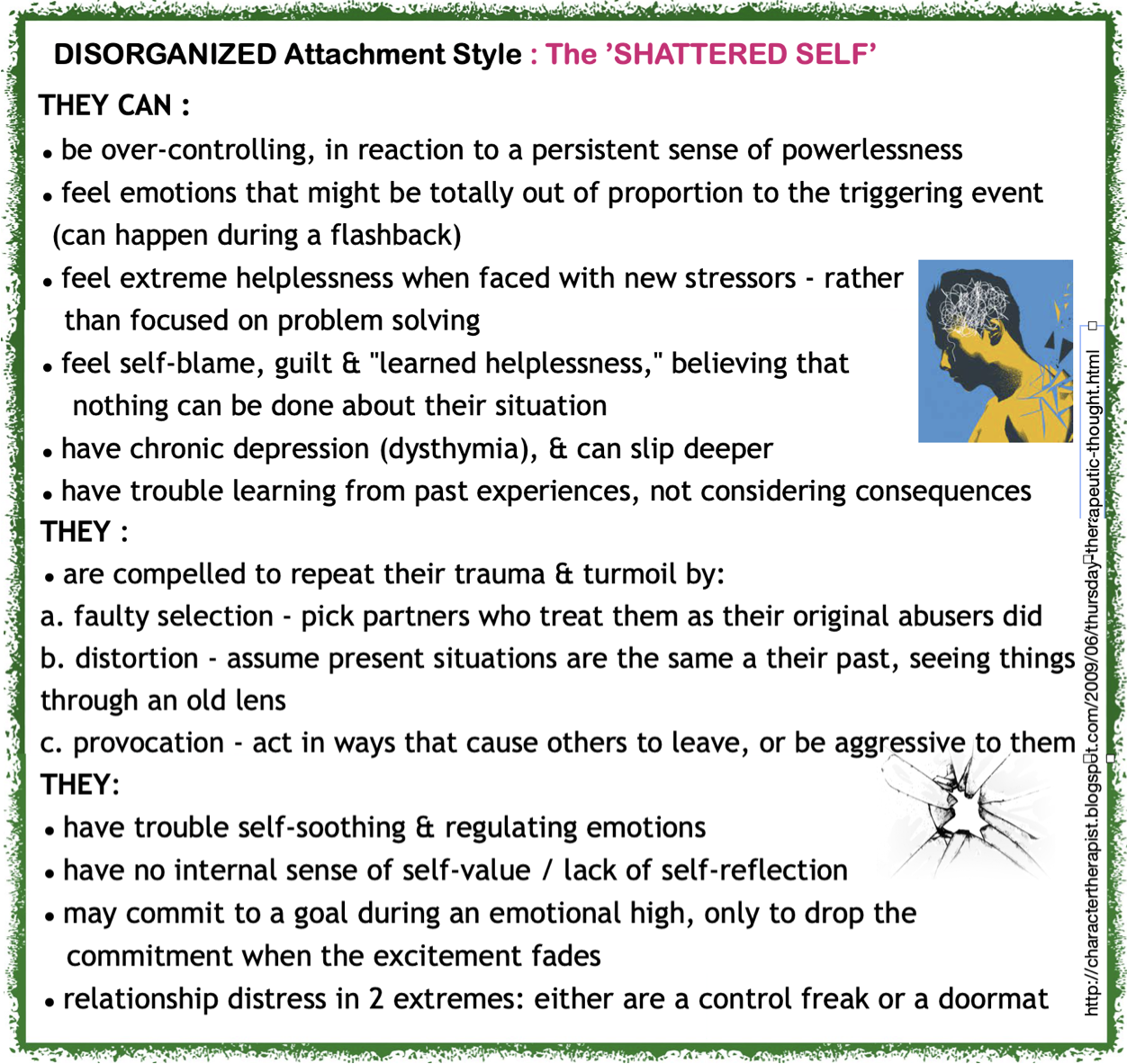
BODY : The pervasive state of fear found in people with DA has been seen in trauma & memory research. As adults, they have trouble consciously recalling & verbalizing traumatic childhood experiences, caused by prolonged stress on the brain’s memory systems, particularly the hippocampus & amygdala.
Adding a meaningful attachment relationship (therapist, friend, lover…..) is needed to develop the capacity to mentalize & so to reflect on & resolve a traumatic, abusive experiences.
NOTE: Mentalizing capacity forms within early attachment relationships as a parent helps the young child develop a representation of its own mind, which in turn will help it to communicate with other minds.
MOTHER : Primary caretakes are a psychological & practical mirror, so when a child looks at its parent & what it keeps seesing makes little or no sense – the child has no way of understanding itself or its own behavior.
Panksepp (2001) emphasizes that the frontal lobes of the brain integrate basic emotional processes with the ability for cognitive reflection (thinking about oneself). But developmental traumas during infancy leave a child unable to regulate their emotions.
In addition to the come-here-go-away pattern, another cause of DA is the mother’s inability / unwillingness to help the child separate & psychological differentiate from herself (S & I) .
This results in the child’s self-alienation (be the ‘good one’ by disowning their wounded part) & identity diffusion (“Who am I? What do I think, feel, want?”), particularly when the father is weak, powerless or absent.
This relational dynamic has been linked to a form of adult psychopathology in which dissociated hatred of & rage toward the controlling mother are acted out in sexually perverse ways.
FATHER : The need for the father to help the child separate from a disturbed dyadic relationship with the mother is a vital part of the child’s relational experience. His point of view as a third ‘object’ may provide the child with a second chance to form a secure psychological self.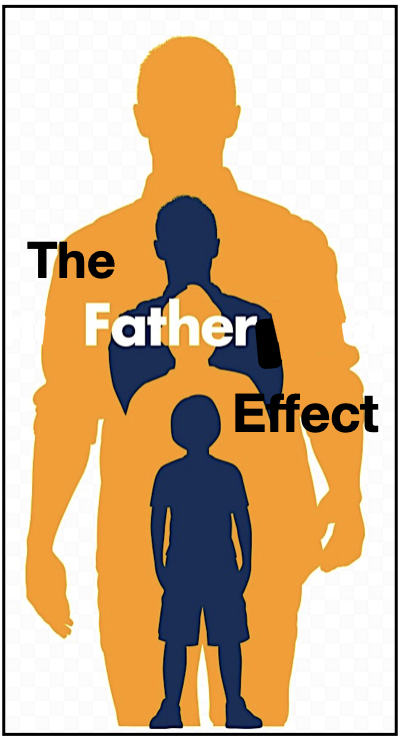
He is the one who can promote the gradual emergence of the child’s capacity for self-regulation & self-restraint, the ability to communicate effectively & share emotional experiences.
Despite the importance of a father to the child’s overall development, all too often they’re actively alcoholic, physically & verbally abusive, emotionally unavailable, &/or totally absent. This lack includes the long hours worked by many men, & the high rate of separation or divorce in modern-day Western society.
When the child’s attachment to both parents is severely disturbed, serious psychopathology is the likely outcome, unless a safe person in its environment is available to buffer or protect it & validate its experiences. The child subjected to persistent parental maltreatment may be diverted from successful personality development, possibly ending in borderline PD or other psychopathology.
↘️ Go to site to see the black dot bounce around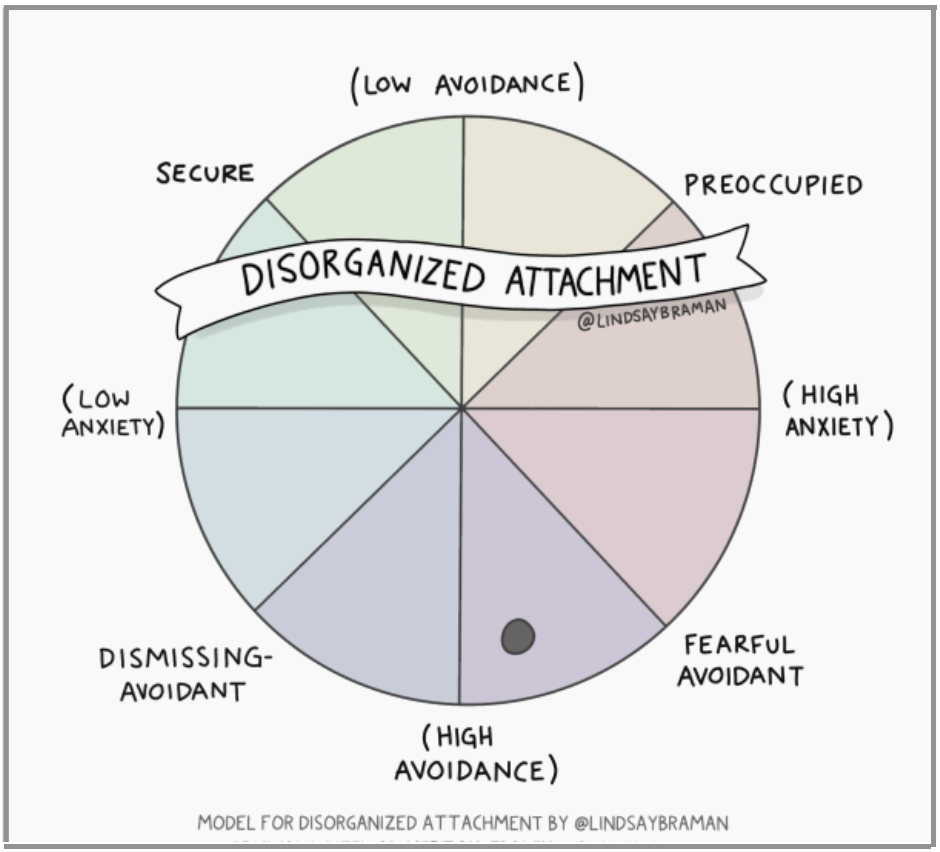
Panksepp (2001) also suggests that all children need the social-physical experience of rough & tumble games, a vigorous form of playful interaction typical of healthy child-father relationships.
Children deprived of this opportunity may experience slower neuronal maturation of the frontal lobes, a developmental delay associated with emotional & behavioral problems, particularly ADD & ADHD
BIOLOGY of Disorganized Attachment (DA)
Infants respond to stress by activating a wide range of behaviors & body responses called the Adrenal Stress Response (ASR).
This not only activates the adrenals, but also the pituitary & hypothalamus glands. Attachment research shows that in emotionally neglected infants & young children with Disorganized-A —> the activity of this pituitary-hypothalamic-adrenocortical (HPA) axis – produced a large increase in the hormone Cortisol , as a reaction to reunion with an absent mother, more so than in other Insecures. (see Part 1)
 Attachment research by Ashman et.al. showed that a mother’s depression during the first 2 years of the child’s life is the best predictor of cortisol elevations at age 7. And a study by Essex et.al of 282 4,5-year-olds showed that maternal depression during her child’s infancy was the strongest predictor of high cortisol levels at the tested age.
In contrast, research by Spangler & Schieche on infant adreno-cortical function – after being separated from a parent – indicated that Securely attached infants did not show elevated cortisol, and that the initial level decreased from 0 to 30 minutes after the end of the test. (
NEXT: Ambivalent Attachent
 HEAL & GROW for ACoAs