
 PREVIOUS: Alcoholic TRAITS #3b
SITE: “Alcoholism & the Brain: An Overview” (extensive)
PHYSICAL characteristics – Alcoholism CAUSES:
• Compulsions: talking for hours & hours – to a captive audience (like one of their children), continually repeating oneself, stalking, unwanted phone calls, esp late at night…
• Loss of control – mental & physical – leading to accidents, fights, falling down, lowered inhibitions (perpetrating rape, incest, assaults, killing..)
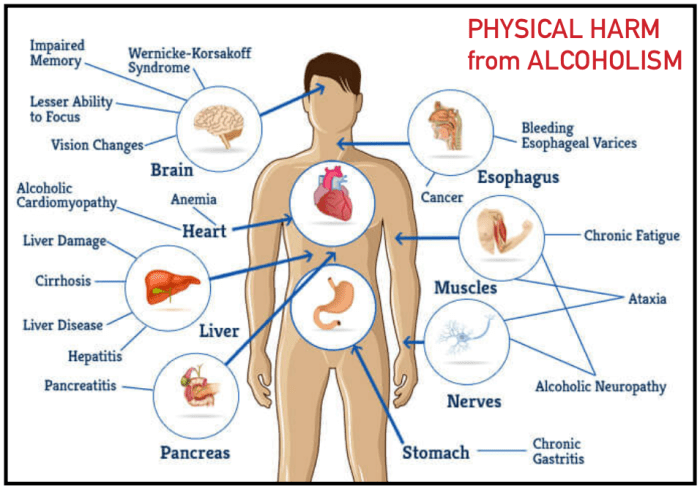
• Many physical problems (see below)
• Patterns of drinking : daily, weekends, periodic, binge, steady…
• Personality changes: chemical changes in the brain, serious blood-sugar level disturbance – like people with low blood-sugar when they’re out of fuel (food): headaches, nausea, very cranky, can’t think…
• Progression – in 3 stages, from mild to psychosis & then death
• Victimization : more vulnerable to crimes, sexual & domestic abuse
🚦☠️ Alcohol & Health
◘ Accidents : burns, fall, fights….
◘ Birth defects : binge drinking early in pregnancy is particularly risky for the developing baby
◘ Blackouts: blocked memory – a few minutes, several hours or more
◘ Brain : inflammation, dementia & other neurological deficiencies
◘ Cancer : alcohol consumption is a risk factor for cancers of the mouth, throat, colon, breast & liver (even 1 drink per day is linked to a 20% 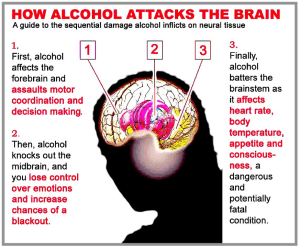 increase
◘ Depression : worsens overall mental health & sparks a vicious cycle
◘ Diabetes : heavy & binge drinking rises the risk
◘ Digestion : alcohol alters the composition of needed bacteria in the GI tract, causing anemia, bleeding, gastritis, ulcers & other lesions, scarring
◘ Heart disease : heavy drinking appears to increase risk – high blood pressure & stoke…
◘ Infections : bacterial, respiratory & viral infections such as HIV, hepatitis (B & C), pneumonia & tuberculosis
◘ Immune System: affects the number of immune cells in a person’s system, alters their functioning, & can often kill existing cells
◘ Kidneys : affects rate of blood flow & disrupt hormones needed to filter out harmful substances from blood
◘ Liver diseases : alcohol poisoning, fatty liver, inflammation, cirrhosis
◘ Obesity : 2nd most calorie-rich nutrient after fat — packing about 7 calories per gram. Heavy drinking can cause increased weight gain
◘ Sex : F – unwanted pregnancies, infertility, menstrual problems, reduced lubrication, harder to have an orgasm….
M – physical insensitivity, erectile dysfunction, premature ejaculation, loss of sexual desire, 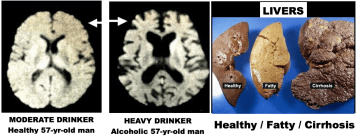 ‘brewer’s droop’ into full-blown impotence
◘ Death : alcohol abuse is the 3rd most common cause of preventable death in the US, including drug ODs (More….)
ONE DRINK: Significant alcohol intake produces changes in the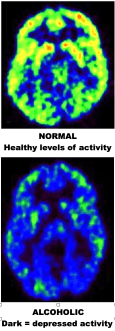 brain’s structure & chemistry, BUT some occur even with minimal use over a short time, to form tolerance & physical dependence
✴︎ 30 seconds after the first sip, alcohol rushes into the brain, slowing down its chemicals & pathways used to send messages. This alters mood, slows reflexes, throws the drinker off balance & they can’t think straight. Alcohol makes it hard to store experiences in long-term memory, so they won’t remember things later …. (More…. )
➡️ MRI scanner forms images using strong magnetic fields & radio waves
🌀 🌀 🌀
Behavioral Addiction is an intense desire to repeat some action that’s pleasurable, believed to improve well-being, or able to alleviating some personal distress – despite knowing its negative consequences
Researcher Jeffrey A. Gray (1981 & 87) proposed 2 brain-based systems which control a person’s interactions with their environment. Emotional situations are identified by the intensity of reaction, AND actions, based on what’s appealing or unpleasant.
⬇️ BIS & BAS brain activity have been connected to a broad range of psycho-pathologies, such as lifetime diagnoses of depression, anxiety, drug & alcohol abuse, ADHD & conduct disorder
❤️ FFFS = Fight, Flight, Freeze System (on chart↘️)
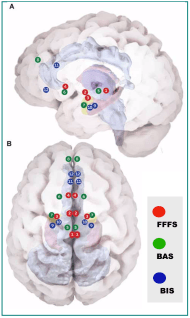 Systems controlling actions:
1. BIS – The Behavioral Inhibition System is responsible for curtailing, stopping, or avoiding ‘dangerous’ behaviors which can lead to disappointment or loss
People with strong BIS activity have a heightened sensitivity to new experiences that are non-rewarding, and to anything they experience as punishment, which they avoid to prevent feeling anxiety, frustration, terror & sadness.
🖤 OPPOSITE: People with low BIS (high BAS) activity have strong urges & desires, & are usually more impulsive & Extroverted
2. BAS – The Behavioral Activation System created a high sensitivity to reward – actions that don’t produce punishment.
It’s the desire to approach, pursue & achieve goals, with emotions such as elation, happiness & hope, especially when a benefit is imminent.
Strong BAS activity produces impulsivity, which may lead to punishment – not a deterrent – so pleasurable behaviors will be repeat, such as the instant-gratification use of addictive substances.
💚 OPPOSITE: People with low BAS (high BIS) activity have weaker urges & desires, & tend to be more careful & Introverted (MORE….. scroll down)
NEXT:
 HEAL & GROW for ACoAs