
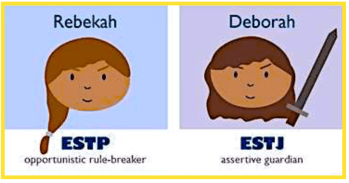
 PREVIOUS: INFP & INFJ Functions
CHARTS below: All SARCASTIC Functions
POSTS modified from VERYWELLmind
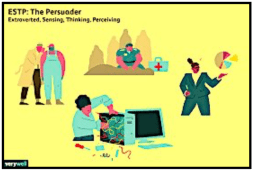
ESTP = The PERSUADER (Review)
Strengths : action-oriented, adaptable, energetic, funny, gregarious, influential, observant, persuasive, resourceful
Weaknesses: competitive, dramatic at times, easily bored, impulsive, insensitive
 DOMINANT = Se
ESTP’s primary response is to be interested in the sights, sounds & experiences immediately around them, with little use for daydreams or flights of fancy. Because they’re so focused on the present world, ESTPs tend to be realists.
As ‘sensors’, they wants to touch, feel, hear, taste & see everything that draws their interest. When learning about something new, it’s not just enough to read about it in a textbook or listen to a lecture – they want to experience it as well.
ESTPs also have a lot of energy, so get bored in drawn-out situations or when presented with too much theoretical information. They’re the quintessential ‘doers’ – getting straight to work, & willing to take risks to get the job done.
AUXILIARY = Ti
As a support to the DOM – when making judgments about the world – here Ti focuses inward, where information is processed in a logical, rational way.
Because this aspect of the ESTP is introverted, others may not immediately notice this quality. But their inner sense of control provides them a great deal of self-discipline. They’re great at working independently, being very goal-focused when they have an objective.
They have excellent observational skills, noticing things that others tend to overlook. As they take in information, their logical mind looks for practical solutions that can be immediately applied to a problem
TERTIARY = Fe
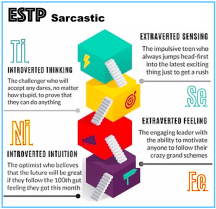 Less prominently, Fe in 3rd place gives ESTPs a great need for inter-personal connections, so they focus on creating social harmony.
While emotions are not their strongest suit, they enjoy being at the center of attention, & are good at forming friendly rapport with others.
Even so, they’re less comfortable sharing opinions & judgments. Rather than rock the boat, they’re more concerned about pleasing others, sometimes overlooking their own needs.
INFERIOR = NI
Usually least preferred, here NI focuses the person on looking at patterns i gathered facts, & to develop a gut feelings about situations. By noticing their impressions of incoming data, they can develop a sense of what to expect will happen next.
Since Intuition is not an ESTP’s strong suit, when undeveloped, they can form strong reactions that are completely wrong. So they may conclude they don’t have good instincts.
But developed, their intuitive impressions of incoming data come more accurate, which can help to form better decisions in the future.
See: INTERNAL WORLD (scroll down)
ESTJ = The DIRECTOR (Review)
Strengths : dependable, hard-working, practical, realistic, self-confident, strong leadership skills, traditional
Weaknesses: argumentative, bossy, inflexible, insensitive, not good at expressing feelings
DOMINANT = Te
ESTJ’s primary response is to rely on objective logic – skilled at making impersonal decisions rather than using their subjective reactions. While good at making fast & decisive choices, they can often rush to judgment before considering all the facts about a situation. Being very practical, they enjoy learning about things th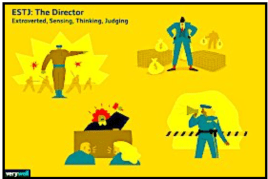 at have immediate, real-world use, not interested in abstract or theoretical info.
They’re mainly concerned with moving forward, & not interested in wasting time or energy nitpicking a solution to death before using it. Positively, this trait makes them good leaders, but it can sometimes make them harsh or abrasive.
AUXILIARY = Si
As a support to the DOM, Si helps ESTJs be good at remembering things with lots of detail. Memories of past events can be quite vivid, which are then used to make connections with current events.
Because Si is internally oriented, they tend to focus less on the new & more on the familiarity. They enjoy having habits & routines they can depend on, which gives them stability & predictability, but can sometimes make them stubborn & rigid.
TERTIARY = Ne
Less prominently, Ne in 3rd place does encourage interest in new ideas or possibilities, & pushes ESTJs to explore their creativity. EXP: When thinking up a project, they combine details they’ve gathered from previous experience to form a really great concept. It can fuel sudden ‘lightbulb’ moments, & unexpectedly have them lapse into factual story-telling mode.
As they process new ideas & info, they’ll look for possible meanings, to help spot connections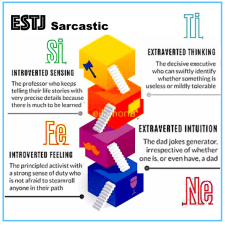 or patterns. This allows them to recognize that there may be more than one interpretation or possible outcome to a situation.
INFERIOR = Fi
Usually least preferred, here Fi can cause ESFJs’ subjective feelings /opinions to override objective interpretation of experiences.
Under-developed, it can lead to having too-fast a reaction to a situation based on Te-DOM, ignoring the consequences – how their actions might affect other people, or whether a decision lines up with their own values.
ESTJs tend to give much thought to their own emotions, often as internal evaluations that lead to gut feelings. As they grow, they get much better at using Fi at the start of their decision-making. Although the most effective option will take priority, they become more aware & careful about not doing things that would hurt others.
See: INTERNAL WORLD (scroll down)
NEXT: ESFP & ESFJ
 HEAL & GROW for ACoAs