

PREVIOUS: What is Guilt (#1)
SITE: “How to ditch the guilt of putting yourself first“
POINT 3. “GENERAL” Types (cont)
In addition to those listed in Part 1 dealing with action / non-actions, there are:
• Adaptive (pro-social) – considered helpful guilt, as it relates to a person’s genuine understanding of wrongdoing & responsibility
• Maladaptive – chronic guilt that leads to mental or emotional distress, & therefore has a negative impact on life.
People with unresolved guilt might feel irritable or always on edge, overly clingy or apologetic. This guilt can show up as physical symptoms: insomnia, digestive issues (stomach pain, nausea….), headaches, mental confusion, muscle tension, tearfulness…..
🌱 Genuine guilt mobilizes. 🔪Self-punishment paralyzes
🌱 Genuine guilt leads to repairing relationships. 🔪Self-punishment makes us withdraw from connecting
🌱 Genuine guilt helps improve damaged relationships with others. 🔪Self-punishment damages relationship with oneself.
POINT 4 – MAIN REASON for ACoA Guilt
GUILT is an emotion that ACoAs feel often & intently. It’s a familiar companion of negative self-talk & of actions we believe to be bad, but which are not always.
G is an inevitable side-effect of self-hate, since our WIC’s default position is that we’re intrinsically bad, so anything that goes wrong for us (that hurts) is OUR FAULT.
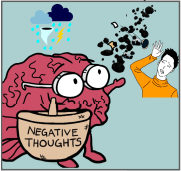 This self-hate assumption is never to be questioned & is very hard to give up, even when we ‘know better’ – because we think it makes us less vulnerable, a little more powerful!
After all, if “it’s my fault – then it’s in my control to stop the pain – up to me to fix the problem, change something about myself or the other person – which will make it all better”!
Perfectionism leads to ACoA guilt. “If I fail at anything, no matter how small, then I’m not perfect & then I’ll never get the love, acceptance & validation from my family, & then by no one else in the whole world.”
MEANING: “I can do something to make things better.” We naturally thought that obeying their rules would work
PROBLEM : Not only were those rules cognitive distortions, they also kept changing, were endlessly contradictory or simply impossible to fulfill. And the adults didn’t follow their own rules! Remember “Do as I say, not as I do” ? ? It was crazy-making!
In childhood – having power over our circumstances was an illusion, since the cause of our pain came from outside of ourselves. Alcoholic, narcissistic family members & others were the source of our suffering, which we had NO control over – no  matter how hard we tried to please. There never was a way to win! We were not a failure.
⬅️ Hogwarts’ Wall of Rules
HOW IT WORKS for ACoAs:
1. Guilt is the emotion – generated by ↩
2. Breaking a law or rule – of ↩
3. Society, government, religion, community, school or family
4. Category of rules we feel guilty for breaking ate Toxic FAMILY Rules
(“If you don’t like it you have to stay! / Only other people’s needs matter / don’t trust anyone, don’t have fun, don’t think for yourself….”)
✶ If the family’s rules had been healthy, we would currently be doing positive, self-esteeming things, most of the time
✶ Because most of the rules were unhealthy, we continue to act on them in ways that hurt ourselves & others, on a regular basis.
Therefore – ACoA guilt is caused by any thought or action which disobeys any direct or indirect rule we internalized as kids.
IMPORTANT to remember:
• most ACoAs don’t realize we’ve absorbed those toxic rules & are automatically obeying them – but we can tell by our habit-patterns. They’re the self-defeating things we automatically do over & over.
• we don’t have to consciously agree with the rules – but the WIC has to believe they applies to itself, no matter how much we may hate it or intellectually know they don’t make sense
True PURPOSE of Guilt :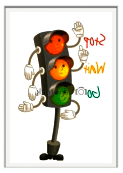
➼ To make a person (or group) go back to obeying the law or rule they broke.
This is the legitimate reason for human guilt – a natural & positive thing. It’s built into our psyche, like the ability to love. People devoid of guilt are sociopaths / psychopaths.
🔻 We are not trying to get rid of all guilt – we need it to tell us how to behave in safe & appropriately ways, for everyone’s benefit.
🔸The issue for most ACoAs is that we feel guilty about things that are not actually bad – like having needs, emotions !
NEXT: What is Guilt (#3)
 HEAL & GROW for ACoAs