
 PREVIOUS : Creativity – 4 Types
💝 If we think of Creativity as only about producing ART, we exclude other types of people from being considered as Creatives, & limit our ability to think creatively about any other arena – such as business, education, medicine, science…. & family dynamics!
If you say, “But I’m not creative!”, ask : “What product am I referring to? What process could I need to use to become creative?”
Maybe you are innately, but are in the wrong environment or not encouraged to express themself.
FROM ‘anotherbrigida’, 2024 : some principles associated with idea-generation & creativity are : collaboration, curiosity, flexibility, originality, persistence, and broken rules (freedom). They are part of the equation but not the foundation. The fusion of these powerful pillars rests on : Think, Respect, Humanize, Create.
IN BUSINESS – to succeed, organizations NEED the ability to foster innovation, develop exceptional talent & leadership, with a high degree of brand recognition. This is affected by its creative people, perspective, practices, and culture.
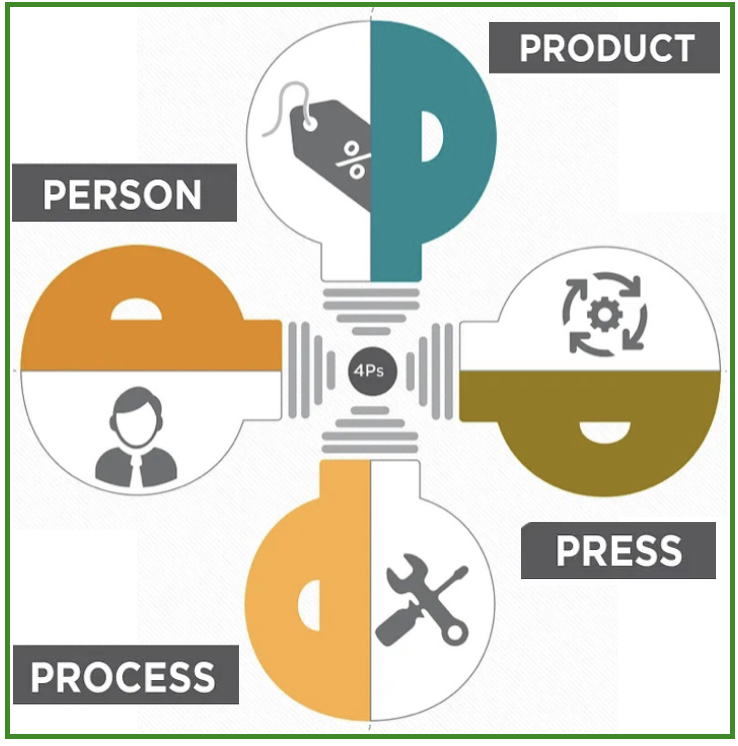 The 4 Ps (from work of Mel Rhodes) ⬆️
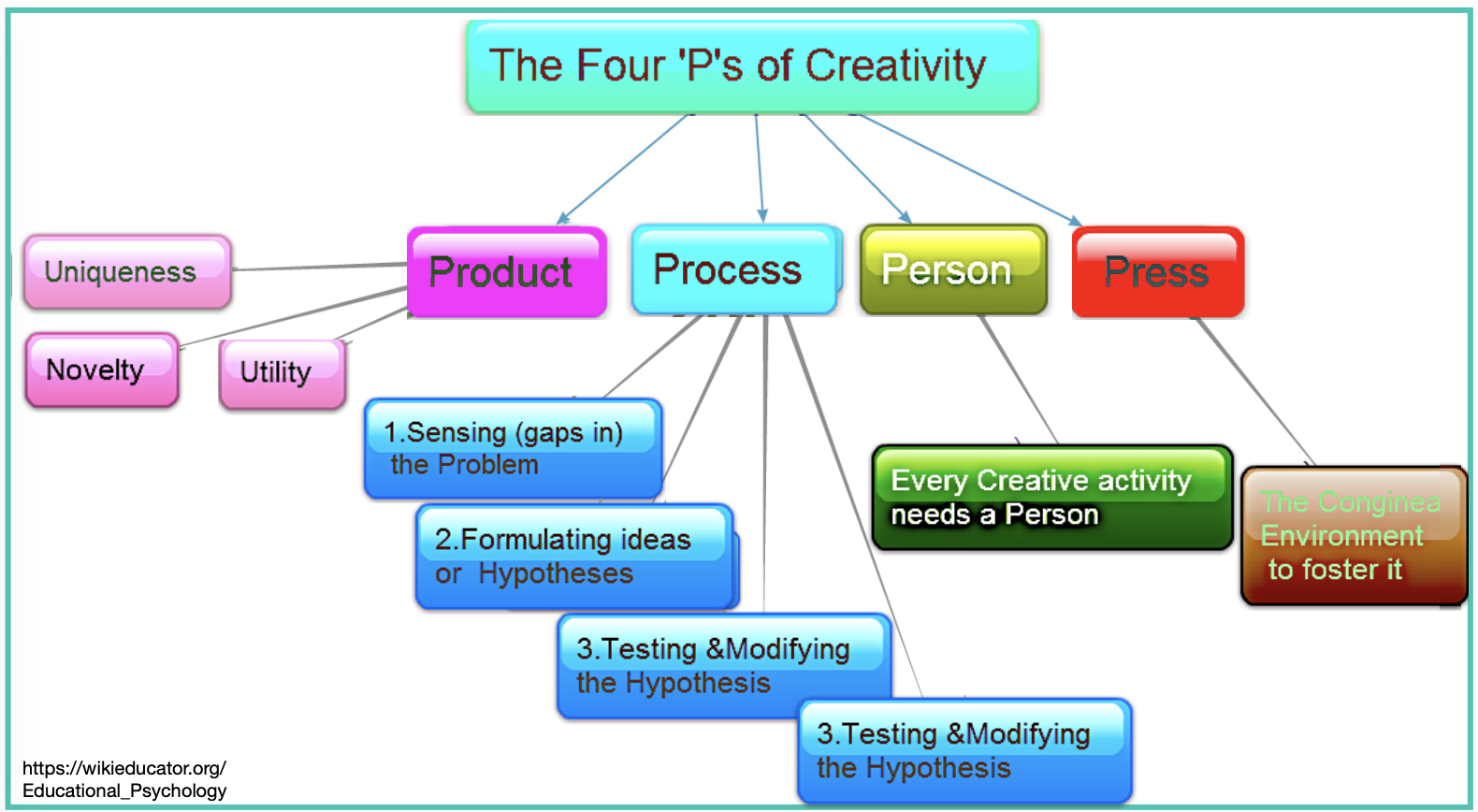
🔹 Person: the characteristics, habits & thoughts what makes someone creative.
🔸 Product – the ‘things’ that are the result of creative activity. What makes one product creative (a song) & another not (grocery list)? What products are the result of creativity?
🔹Process – HOW creative people do what they DO. But Processes can also be Products – new ways of doing old tasks
🔸 Press – the environment around the creative person. If it’s not conducive to creativity, it soon dies. (MORE info…)
COMPONENTS
A report from the “Center for Childhood Creativity” lists 7 critical components of creativity in children :
💮 Physical = Action & movement
💮 Mental = ⇓
• Imagination & originality – combining 2 or more different ideas to create a new one
• Decision-making skill – intersectional thinking, to refine ideas & choose the best possible answer for problem solving
• Flexibility – combining & modifying previous ideas or strategies
 💮 Social / Emotional =
• Communication & Self-expression – exhibiting one’s unique perspective to others with confidence, from a connection to one’s authentic feeling & desires
• Collaboration – exchange of ideas when working together to find a solution for a project or to a problem. Explain & expand ideas
• Motivation – the core of development, being inspired to explore & satisfy one’s curiosity ☛ ☛ acting without expectation or promise of reward.
According to Guilford (1986) Creativity is “divergent thinking“, a way of solving problems by more than one approach, with :
▫︎ Fluency – generate numerous ideas or solutions by the smooth flow of objects or emotion that resonate with unique symbol or norm.
EXP : list possible ways to use a rope or scarf (think Robin Williams)
▫︎ Flexibility – shift between different types of ideas. Flexible thinkers might suggest various categories shift between different types of ideas. EXP : suggest various categories for the same object (practical, social, artistic….).
▫︎ Originality – produce uncommon or unique responses that are not obvious, as in a number of statistically infrequent ideas
▫︎ Elaboration – develop ideas in detail, adding & elaborating. EXP : “What would it be like if no sleep was needed?”
▫︎ Sensitivity – identify overlooked challenges & potential opportunities
▫︎ Redefinition – see familiar items or problems in new ways, which promotes innovative solutions.
«
«
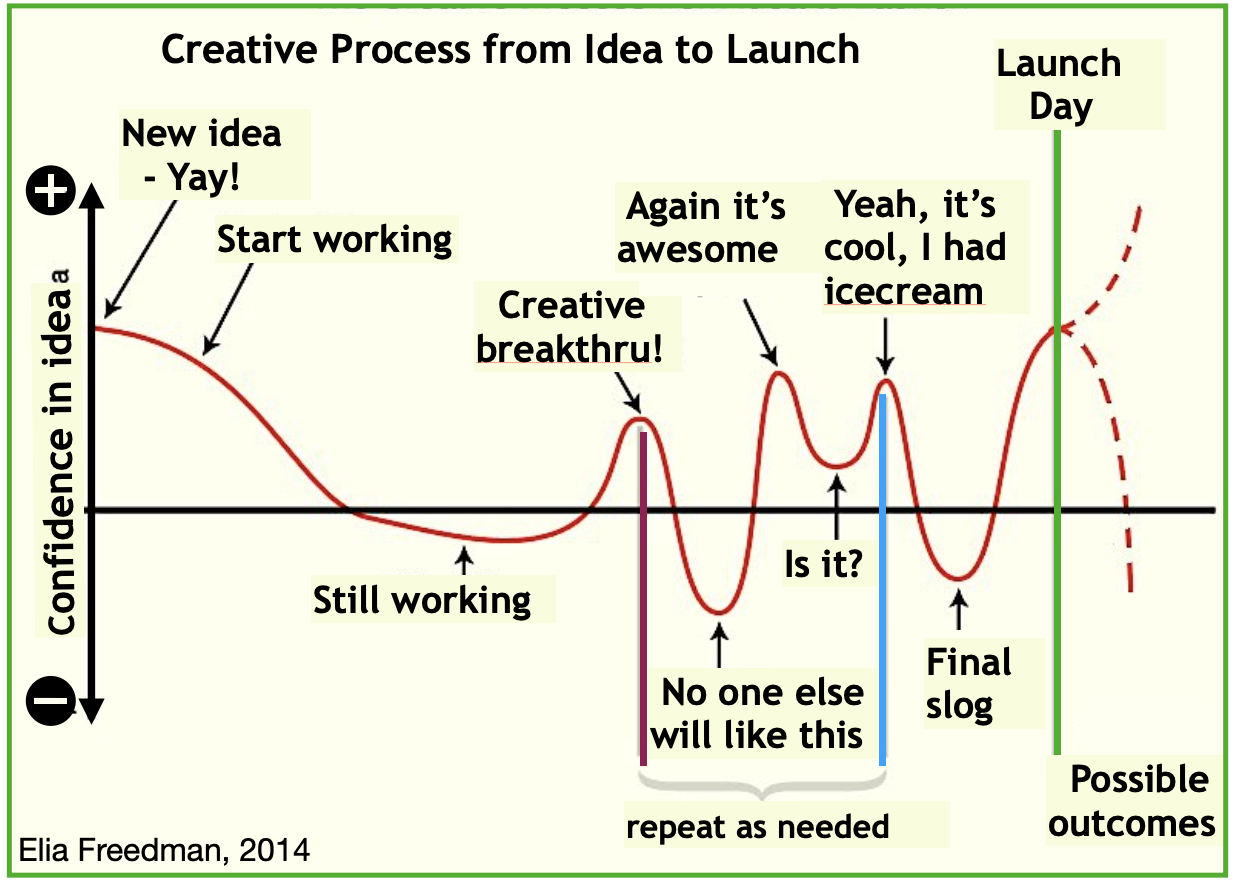
STAGES of Creative Activity (CHART ⬆️ )
1. Idea generation – interest or curiosity about a specific problem to area of study
2. Preparation – develop clarity about what one wants to achieve with a novel idea, & how to accomplish it
3. Incubation – reflective thought, often subconsciously, working in the background
4. Illumination (Insight) – when the idea resurfaces as a realistic creation
5. Verification – double-check that the chosen idea is realistic & useful, by evaluation & experimentation.
BLOCKED
Anyone doing creative work has experienced the ebb & flow that comes with it. But like weather, most turbulent spells eventually pass, & though we can’t will them away, we can work with & through them until sunny skies return. (Explanation for each tool ➡️) 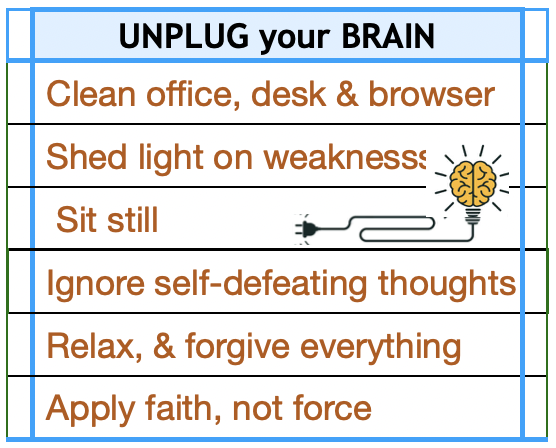
Q : Creative blocks keep us from taking pleasure in our work. SO – what can we do when clouds darken our eyes?
A : While there could be other root causes to creative blocks (illness, abuse, severe loss….), IF possible – a starting place is removing external & internal clutter allowing oneself to be becoming vulnerable, still, gentle & self-forgiving.
ALSO : “14 Tips for Getting out of a Creative Slump”
NEXT : Internal Saboteurs, #1
 HEAL & GROW for ACoAs