
 PREVIOUS :
S-R & Emotional -EQ
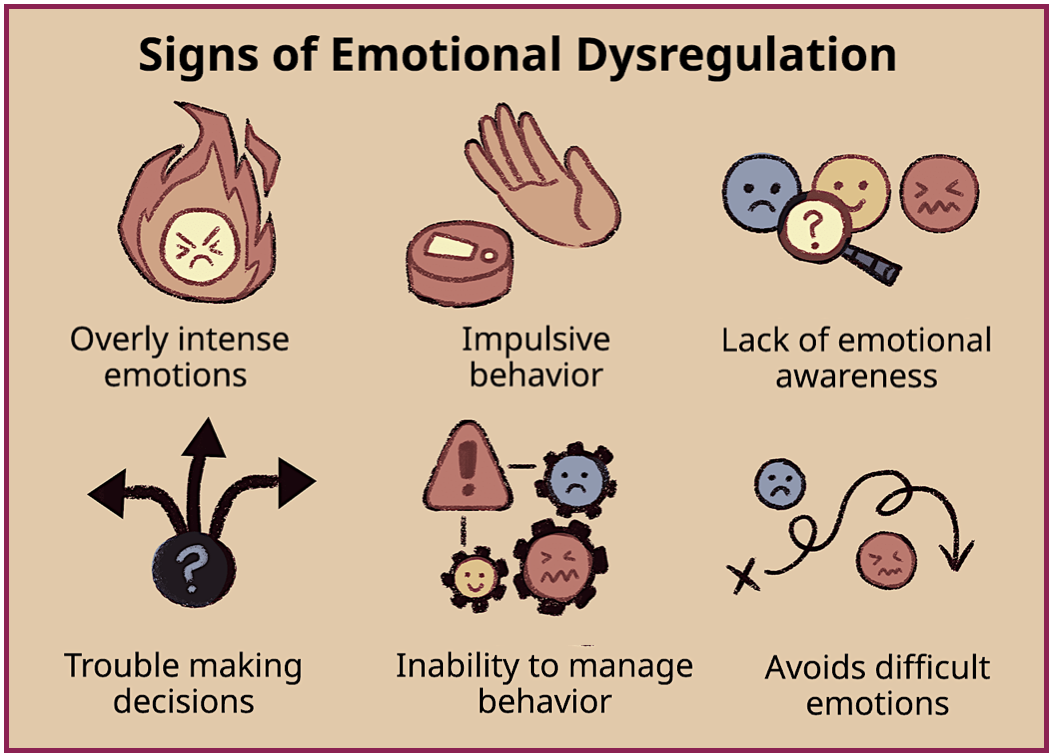
EMOTIONAL DYSregulation (E-D) is the inability to use healthy strategies to diffuse or moderate painful emotions. When in this state, we can act in ways that overwhelm us further, getting stuck in a vicious emotional cycle. It’s on a spectrum between under & over-reactive styles.Either extreme makes it hard to self-soothe & return to a baseline emotional state.
Research indicated that psychological dysfunction (such as affective or borderline personality disorders) may be identified as a lack of emotion-regulation flexibility
Someone with dysregulated emotions may have :
 ♦︎ extreme perfectionism
♦︎ high levels of shame, guilt
♦︎ heightened, unstable painful emotions
♦︎ high sensitivity to emotions in social situations
♦︎ inability to inhibit impulsive behaviors
♦︎ low tolerance for frustration
♦︎ obsessing on an emotional situation
♦︎ reduced awareness & understanding of emotions
♦︎ severe depression, &/or continual anxiety
♦︎ suicidal thoughts or attempts
Common reactions / behaviors :
♞ alcohol & substance abuse. Self-injury
♞ avoiding or withdrawal from difficult situations
♞ conflict in interpersonal relationship
♞ dissociating , numbness, distractibility
♞ emotional eating, sleep dysfunctions
♞ over-use of social media, neglecting other responsibilities
♞ impulsive, reckless . high risk sexual activity
♞ rage, &/or violent outbursts
LOW Emotional Intelligence (EQ)
♦︎ Limited Recognition: trouble accurately identifying emotions
♦︎ Emotional Ignorance : unable to handle emotional triggers
♦︎ Impulsive Reactions : have knee-jerk emotions & “acting-out’ behaviors
♦︎ Ineffective Coping : often use unhealthy strategies
♦︎ Reduced Empathy: makes interpersonal conflicts more likely & harder to resolve
♦︎ Trouble Verbalizing : Missing, inaccurate or distorted ways of expressing emotions often lead to miscommunication / misunderstanding, & conflicts, causing personal or work losses.
CHILDHOOD CAUSES
 √ Environment. Whether is the family or the physical environment, a bad environment can negatively impact a person’s ability to process & respond to emotions.
√ Traumatic brain injury. A mental dysfunction caused by an outside force, usually a violent blow to the head.
√ Temperament – is determined by genetic inheritance, usually stable across time & situations. Differences in siblings show up very early in life. Some infants are calm & even-tempered, others tend to have more intense & longer stress-(over)reactions
√ Trauma – Experiencing or witnessing abuse, especially in childhood, causes catastrophic emotions which a child or adult cannot process, understand &/or integrate. This leads to severe emotional dysregulation. The overwhelming intensity of painful feelings can lead to developing long-term inflexible strategies
Child neglect. A form of parental abuse that deprives a child’s basic needs, including inadequate or missing —-> supervision, health care, clothing, or housing, as well as other physical, emotional, social, educational, & safety needs.
Chronic low levels of invalidation. This occurs when a person’s thoughts and feelings are rejected, ignored, or judged.
√ Attachment styles = Early connection-experiences shape emotion regulation abilities. Infants need caregivers to help modulate their emotions through Attuned Bonding. Without this, children fail to develop self-soothing capacities & instead will rely on external regulation, expressed as co-dependence, people-pleasing & passive-aggressive interactions. (See posts on Insecure attachment styles )
E-D Symptoms in Related DISORDERS
Poor emotion regulation in childhood may increase the development of other mental health disorders. Also, having a neuro-developmental condition may include symptoms of poorer emotional regulation.
♛ Attention-deficit hyperactivity disorder (ADHD)
Such people likely have strong reactions to small setbacks, feel emotions more intensely than others, have difficulty calming down, with a low tolerance for frustration or annoyance.
♛ Autism spectrum disorders (ASD)
These people often have greater or more intense baseline levels of “negative” emotions or irritability, poorer problem-solving skills, can become easily overstimulated, & find it harder to detect other people’s emotions.
♛ Borderline personality disorder (BPD)
Symptoms are heightened & changeable negative moods, weak ur missing appropriate regulation strategies, & a surplus of unhealthy / self-defeating strategies.
♛ Complex post-traumatic stress disorder (CPTSD)
Often diagnosed in adults or children with repeated trauma experiences (abuse, neglect, & violence).
E-D symptoms involve great trouble self-calming when distressed, & chronic emotional numbing.
♛ Disruptive mood dysregulation disorder (DMDD)
This childhood condition can involve extreme moods & intense temper outbursts. It includes intense reactions to painful emotions with anger, irritability .
«
«
‼️ For HEALING – RECOVERY ideas = see long lists in future posts —- >“Adults” & “Growth”
NEXT :
 HEAL & GROW for ACoAs