

PREVIOUS : S-R -Emotion Domain
SITEs : ▶︎ 6 Key Skills to Regulate Emotions = Self-awareness, Mindful awareness, Cognitive reappraisal, Adaptability, Self-compassion, & Emotional support
▶︎ S-R Affirmation CARDS for WOMEN with ADHD & ANXIETY
▶︎ 3 Science-Based Emotion Regulation Strategies = Reappraisal, Self-soothing, Attentional control.Emotional Regulation (E-R) includes both pleasant & unpleasant emotions, & actively using the tools 🛠️ makes it possible for us to be in charge of them. It involves :
• Initiating actions triggered by emotions —-> Inhibiting those actions when necessary —-> & Modulating those responses. IMP : Emotion regulation (E-R) is not aimed at eliminating our emotions, but rather being flexible, so we can manage many different experience with grace & humor ! Rigid or numb reactions are unhealthy, but flexibility makes adjustments to new information & experiences easier.
Emotional flexibility develops from learning a variety of mental & behavioral strategies (see “SITEs” ↑ & Chart ↓). They are to be used according to the demand of a current situation, & practiced through each person’s unique characteristics.
Under stress our brain’s natural reaction is to activate the amygdala, which regulates fight-or-flight responses. Using E-R tools lets us buy time to consider options, before automatically reacting in self-defeating ways. Functioning as a modifier, E-R helps us filter events in daily life, ☀︎choosing to deal with the most important issue presented so it doesn’t become a burden or dangerous.
“R.U.L.E.R.“= E-R used to cope with everyday situations & feelings
♚ Recognize emotions in myself & others
♚ Understand the triggers & causes of my emotions
 ♚ Label words that best describe feelings so I can communicate them accurately
♚ Express – learn how to act appropriately & skillfully in social situations
♚ Regulate – develop strategies to manage & moderate feelings. This will allow me to make wiser responses to emotional situations, & help reach my goals more easily.
E-R Skills are essential for personal ‘ease’, success & smooth-running relationships. Categories they apply to :
• Behavioral = sensory-motor strategies
• Language = words or other symbols
• Meta-cognitive = ability to reflect on & talk about mental tools, including skills that support personal organization & regulation
a. Self-regulation = achieved independently without the support of others. Goals :
• Be available for learning, & to interact with others
• Regulate self during new & changing situations
• Recover from extreme dysregulation by oneself
• Use action strategies to regulate arousal level during familiar activities
• Use language strategies to regulate arousal (a trigger) during familiar activities
b. Mutual regulation = exercised in supportive social interactions. Goals :
• Able to Express a range of emotions
• Respond to assistance offered by family, partners, friends
• Request assistance from valued ‘others’ to regulate state
• Respond well to feedback & guidance regarding behavior
• Recover from extreme dysregulation with support from valued ‘others’
⬇️ Gross identified identified 5 types of responses in the emotional regulation process : a. Situation selection, b. Situation modification, c. Attention deployment, d. Cognitive change & e. Response modulation 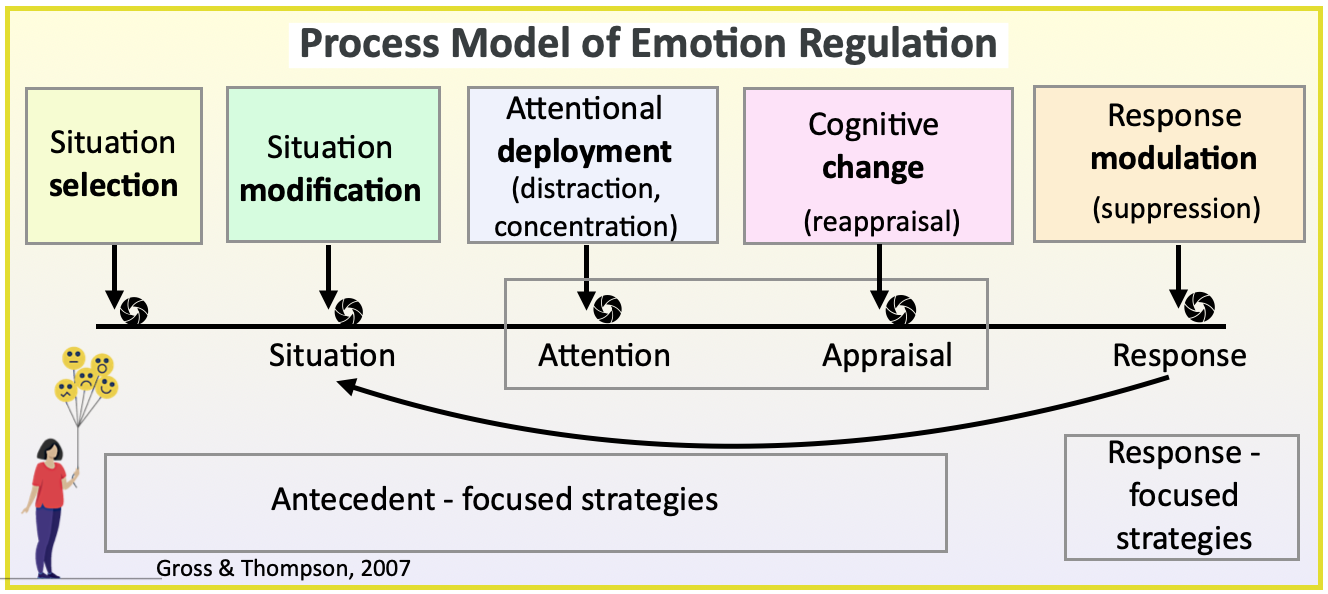
»
Combining strategies
Gross stresses that emotions do not need to be regulated or modified all the time – only when they interfere with desired activity or goals. Gross and John, 2003
1. Cognitive re-appraisal (Antecedent) = correcting & modifying our interpretation of a situation that has triggered an emotion, and what effect that has on us
EXP : Chosing to stay calm when having to continue an important conversation with a ‘difficult’ person – because we are clear that their attitude is not about us!
AND / OR
2. Expressive suppression (Response) = comes after the emotion is triggered, & does not influence the emotion itself, but rather its outcomes & consequences. That means being in charge of actions so they don’t lead us in the ‘wrong ‘ direction.
🔸 The first 4 strategies are used before the emotion registers, & are most effective because they affect which emotion shows up.
🔹 The 5th is used after the emotion has been activated (triggered), since it can change or modify how we reacted to it (behavior).
 To be balanced, Emotional self-regulation allows us to handle our emotions appropriately – in most situations, most of the time – especially the “difficult” ones. Using our tools helps to keep us motivated toward desired goals, stick to personal standards, strengthen willpower, & keep our actions-to-emotions ratio in balance.
EXP : Even if really angry at someone, you can talk to them using direct & self-confident language – “When you don’t stick to our agreements, I feel powerless, frustrated & angry.”
NEXT : S-R – Emotional Intelligence
 HEAL & GROW for ACoAs