
 PREVIOUS : S-R Inhibition (#1)
SITEs : Proactive & Reactive inhibitory brain areas
• Being “Reactive & Proactive at WORK”
<—- Fig. A & B
Different arrow thicknesses represent different strengths of activated influences – priming & reinforcement. The large, blue arrow starts from the frontal lobe & goes to the parietal-occipital ones, showing how the brain enables us to quickly focus attention.
To make sense of the world, we take in energy from the environment, which the brain converts to neural sensations. Then it interprets these sensory signals as perception.
This information allows for mental control by 2 inhibitory modes : Reactive – to prevent problems & Proactive – to achieve goals, depending on when an action is being curtailed.
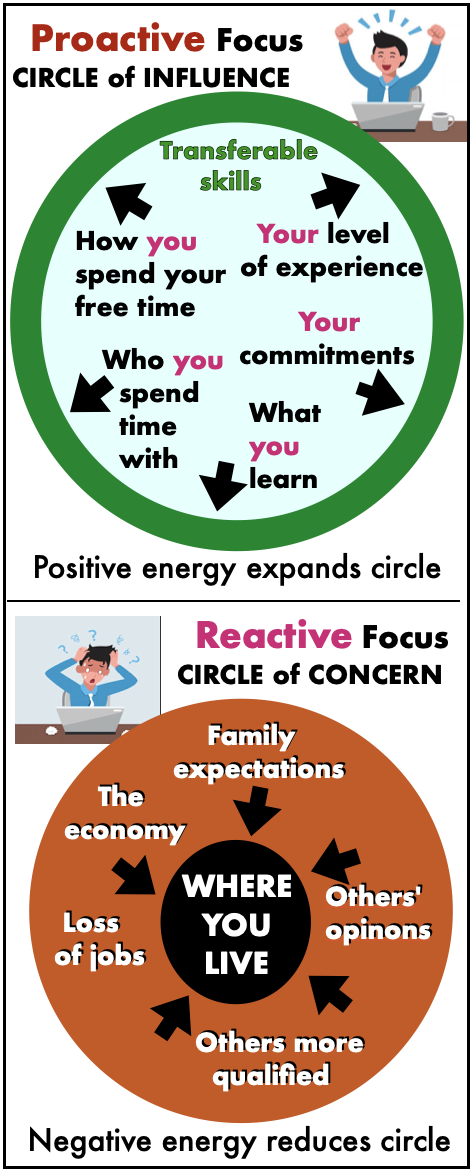
♦︎ Reactive prevention is the ‘bottom-up‘ mode : whenever the environment influences our thinking & emotions. There’s no learning, & perceptions are based on whatever new input comes in from the current external situation.
EXP : Someone trying to avoid losses will play it safe or do what they ‘ought’ to do.
Being Reactive implies you don’t have the initiative, letting events set the agenda. You’re tossed around by the tides of life, each new wave catching you by surprise. Huffing & puffing, you scramble to react just to stay afloat.
★“Proactive Thinking” (the reverse) is the ‘top-down’ mode. It’s when our thinking influences how we feel about ourself & the world, which helps to anticipate the near future – based on experience & the right info – preparing us ahead of time to respond according to what’s needed.
EXP: Focus is on potential benefits when working toward a favorite goal.
Proactivity is ‘grace under fire’ – so when you’re in choppy waters you can manage well. It takes energy to rise above current difficulties, to see the big picture & make needed changes. It’s not just anticipating the waves – it’s being in tune with them, not desperately trying to escape. You ebb & flow with events, drawing on them as a source of energy. (“BEING Proactive” excellent)
 ⛔️ Sometimes we don’t have that energy to cope – then in reactivity. Remember : that is a ‘normal human’ response to stress-overload, NOT a personal failure. So there’s no point in berating ourself for slowing sown.
THEN the best proactive thing you can do is to take a break. Use “Time Out” to review what & how you’re doing something, & plan how to get back on track – with a smile!
Proactive inhibition is regulated by the Prefrontal Cortex, (thinking & logic, higher-order emotional awareness, & speaking). As the brain picks up new experiences (stimuli), stored info from memory is ‘sent down’ to the physical senses. Together they make sense of the input, in a broad overview, without needing to identify every detail.
Top-down & bottom-up processes take different routes to influence emotional learning. Both are activated in the prefrontal cortex, but
— left side when using T-D is via increased language processing, while the
— right side when using B-U may relate to shifting ones attention between events.
 Clinical disorders
Research also indicate that both T-D & B-U styles may play a role in emotional disorders, & that optimal treatment plans differ, depending on which of the 2 processes mainly generated the dysfunction
Bottom-up abnormalities might be modified or changed most effectively using behavioral reinforcement methods that reshape response reactions over time.
Top-down abnormalities may best be addressed using cognitive restructuring methods that change how a person consciously evaluates PPT (people, places, things). IMAGE ⬆️ Cognitive-behavioral therapy (CBT) is one of the suggested modalities.
 ED with NISSI
At the neuro-cognitive level, the compulsion to self-harm when emotionally distressed – is most closely linked to the impairment of a person’s response-inhibition ability.
Emotion dysregulation is a core feature of different self-injurious behaviors. 55% of people who engage in NSSI ➡️ report some disordered eating habits (ED), which are considered “direct” & “indirect” forms of self-injury – respectively.
Inhibitory control has 3 stages : (1) interference over emotional impulses (2) action restraint or suppression (early response), (3) action cancellation or termination (late response). At the neuro-cognitive level, the compulsion to self-harm when emotionally distressed – is most closely linked to the impairment of a person’s response-inhibition ability. (MORE…..)
NEXT : S-R Inhibition (#3)
 HEAL & GROW for ACoAs