
PREVIOUS : Attachment Body DEFINITIONS
SITE : “Multifaceted Nature of Alexithymia – A Neuroscientific Perspective”
Alexithymia
A broad term for a condition whereby a person struggles to distinguish between emotions & bodily sensations.
A relatively new concept, it was coined by the psychoanalytic psychiatrist Peter Sifneos in 1972, who borrowed the term from his native language – “without words for emotion.”
Alexithymia occurs on a spectrum, & is considered a personality trait, not a medical diagnosis.
Estimated : 1 in 10 people (from a study in the Netherlands). But the rate is higher among neuro-divergent people (ADHD, Autism…) and those with mental health conditions (depression, anxiety….), chronic pain & other health issues.
 🔻Primary (trait alexithymia) is innate, considered a part of a person’s baseline personality, present from birth, & consistent across time & situations. It has genetic components, & possibly exacerbated by an environmental upset causing emotion dysregulation in early youth, likely as a result of traumatic experiences.
It may be considered mainly a problem with interoception.
 🔺Secondary (state alexithymia) is temporary &/or situational. It often results from life circumstances or a recent medical diagnosis.
EXP: As with PTSD & SUD, the effect may be present for a much shorter time, & could potentially be resolved after treatment or if the stressor no longer exists.
Nurture: A person’s early environment can harm their ability to perceive & register emotions from —> Lack of mother’s positive attention, the negative emotional tone of the home, inadequate emotional labeling, extremes of emotional expression….. (Source)
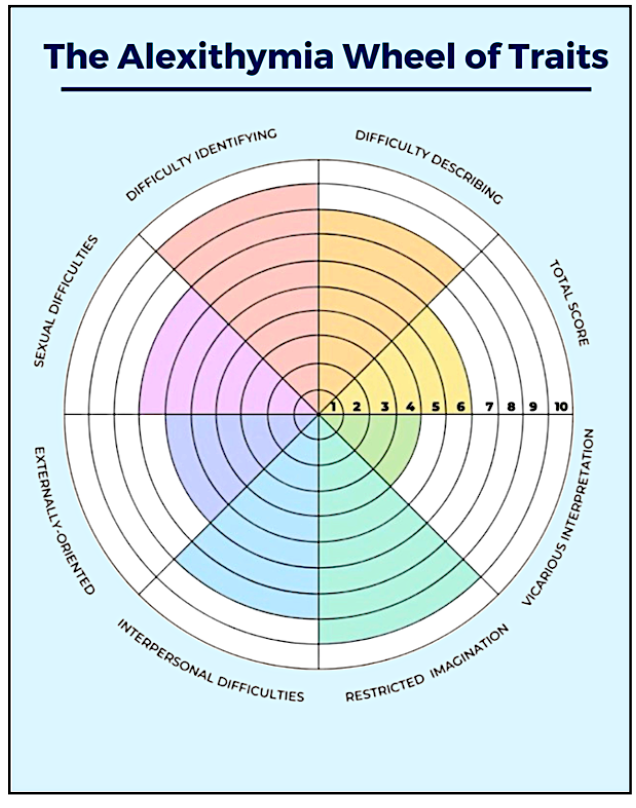
CORE features : note that a person may have high alexithymia traits in one area, but low traits in other areas.
1. Difficulty Identifying Feelings
These people experience confusion about their internal experiences, struggling to distinguish between emotions & bodily sensations
EXP : hunger vs anxiety, hunger cues vs exhaustion, anxiety vs sadness…..
The ability to identify emotions plays a key role in our ability to regulate them. Trouble with this has been linked with depression, non-suicidal self-harm, & suicidal behavior
 2.Difficulty Describing Feelings
They have trouble finding words /labels for emotions so can’t express them to others. Descriptors may be vague, general & diffuse.
They may also have trouble recognizing facial cues in others. while being hyper-sensitive to physical sensations
3. Externally oriented thinking
All their mental energy is focused on the external world. All situations are considered independent of oneself or one’s own experiences, without ever noticing their internal processes. This kind of thinking reduces the ability to feel positive emotions, which can contribute to depression & other mood issues.
4. Interpersonal Relationship Difficulties
They have trouble with empathy – not picking up others’ point of view, feelings & intentions – limiting their ability to form & deepen relationships.
One study found the cause to be alexithymia rather than autism. Autistic people who did not also have A. did not have the same struggles with empathy as people with both conditions (<—- 50-60%). .
5. Restricted Imaginative Processes
Many people with alexithymia – but not all – have a diminished fantasy life, with limited imaginative capacities.
Because they’re oriented to the concrete world of facts & pragmatics** they have little interest in the arts & other creative efforts. They’re unlikely to spend time daydreaming.
** Pragmatics is the study of indirectly verbalized communication, where the speaker implies something & a listener needs to infer the meaning.
6. Sexual Difficulties & Disinterest:
While not primary, many A. people have reduced sexual satisfaction, sexual shyness / nervousness. & greater detachment from potential sexual partners. 2 CAUSES
— A. is associated with more ‘negative’ emotion, which can dampen sexual responses
— They have a more detached, avoidant attachment style, lending to sexual avoidance, & even to identifying themself as asexual (source). This may be a reason for a higher rate of asexuality within the Autistic population. (MORE….re. A & A)
7. Vicarious Interpretation of Feeling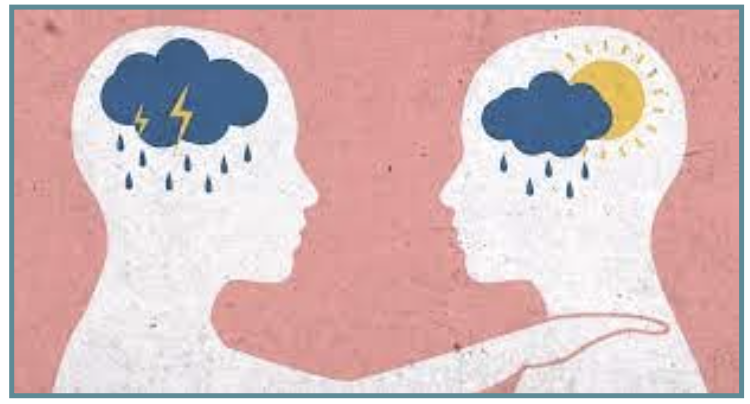
DEF: The undesirable emotion is experienced in another person, & the observer projects what they interpret as the appropriate response onto themselves.
Called “affective empathy”, As. can experience other people’s feelings on their behalf – but not their own!. EXP : have a strong emotion when learning someone’s had a great loss, mirroring what the mourner felt.
IDENTIFYING A — 2 online measures widely used :
:Alexithymia Online Test and the Toronto Alexithymia Scale, which mirror the traits mentioned above & will show your range.
NOTE: #4, 5, 6 & 7 —- are not part of the formal definition, but often correlate with it.
NEXT : Attachment & the BODY, #1
 HEAL & GROW for ACoAs