
 PREVIOUS :
Attachment & FOOD #4a

Reminder : ALL major eating disorders are related to one of the INSECURE Attachment styles. (See also : “Co-occuring problems“)`
1. EXP = ORTHOREXIA Nervosa (ON)
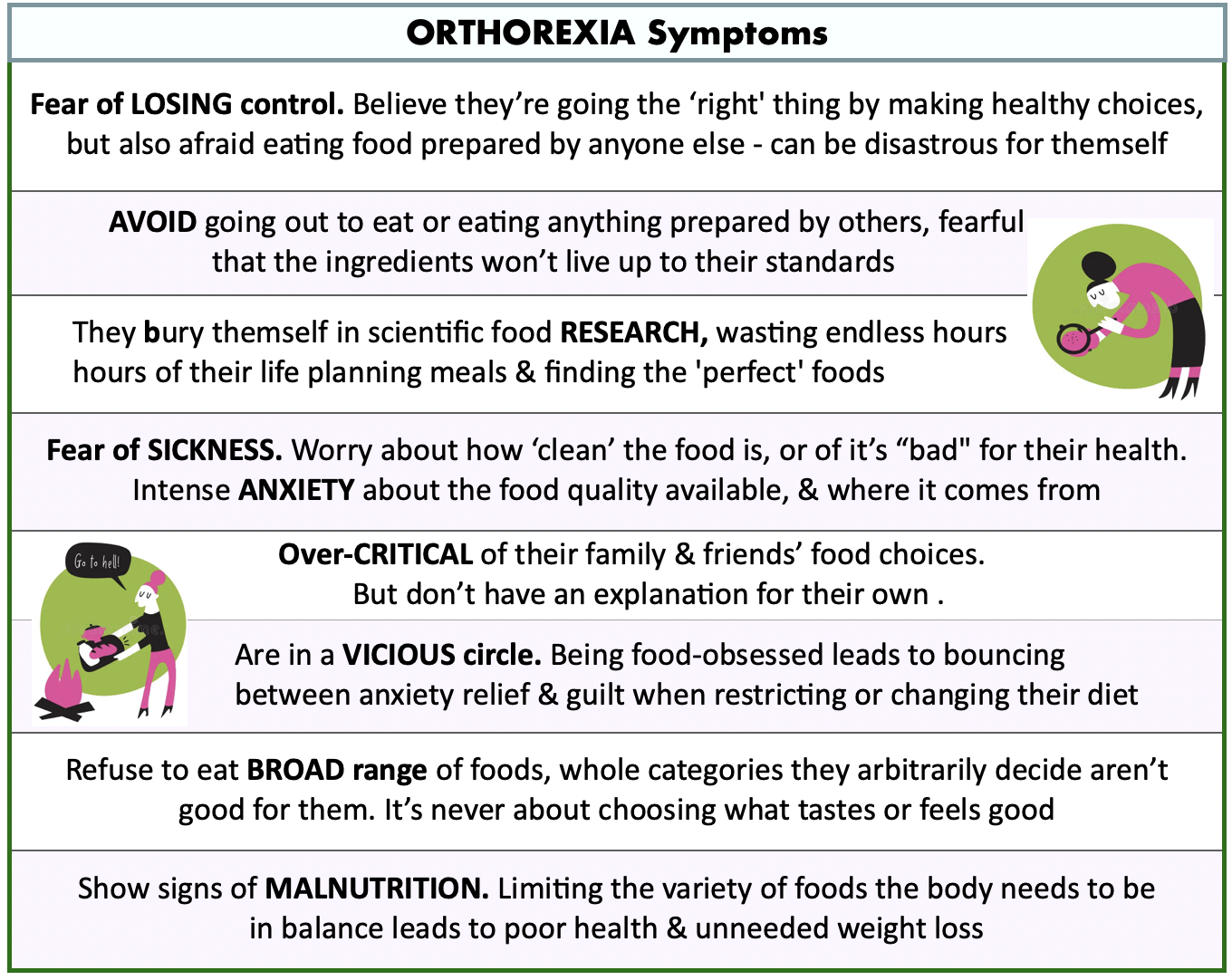
A “fixation on righteous eating”, the unhealthy focus on trying to eat healthily. This person will lose weight although not trying to. Breaking the rules they set for themself creates fear of disease along with anxiety & shame for their choices, so the rules get harsher over time. The person may also do unnecessary cleanses.

Insecure attachment styles are connect to EDs, especially with high levels of Anxious attachment, along with depression & low-self-esteem People with stronger Ortho-tendencies were often unsuccessful at emotion regulation, a common feature of eating & emotional disorders.
They have serious misconceptions about nutrition, such as assuming the benefits of excluding entire food groups. This will lead to severe nutrient deficiencies, eventually causing life-threatening problems such as anemia, osteoporosis, hormone imbalances, & an abnormally slow heart rate. (More….)
«
«
IRONY : If sustained, this pattern actually does the opposite – it damages the person’s overall health & well-being,
♨︎ Similarities between orthorexia and anorexia (both avoidant attachment) & bulimia (anxiety attachment) include eliminating food to have control – over deep abandonment anxiety.
2. EXP = BED (Binging)
These people usually do not lose large amounts of weight – a typical sign, although they’re been publicly dieting for much of their lives. (More….) BED is more common in adulthood than other EDs, & especially in men – who are about half of all sufferers, rather than in other disorders. Treatment can be harder to get for adults because the medical community still has biases against their age & type of disorder.
How it’s MAINTAINED
🔹Impulsivity (I) is premature decision-making without forethought, & no consideration for the consequences of one’s actions. There’s a failure to stop oneself from acting, & the inability to postpone rewards, wanting immediate reinforcement.
People with BED (binge eating) have high Impulsivity scores, & initially this behavior leads to feeling pleasure & satisfaction.
 🔸Compulsivity (C) is repeated & persistent actions not related to a goal or reward, but continues in spite of negative consequences.
Persistent repetition of binging – despite obvious self-harm – is a sign of addiction.
With any chronic substance abuse, there’s a ventral-to-dorsal shift (I to C), as the person’s drive moves from pleasure-seeking to needing relief from the painful symptoms of withdrawal & obsession to get more of the ‘drug / food’. This shift help maintained the disorder. (MORE…. ⬆️ & ⬇️)
Coordinating INFO : Polyvagal theory, Attachment & ED
In treatment, a person’s nutrition status & ability to regulate their nervous system are intertwined. Whenever the Sympathetic system rules (#b), the person is stuck in survival mode. (CHART )
🇨🇭 A body & brain struggling with nourishment is a body in distress & a brain that doesn’t have the capacity to engage in higher-level healing. 
Nervous System Activation
(Ladder + resources)
a. Ventral vagal social engagement: The state that allows us to connect with & relate to others. We feel safe & secure, easily being present for ourself. We can empathize with others, as well as accurately interpret facial expressions & body language.
b. Sympathetic activation: causes the fight-flight response – motivating us to quickly get away from a threat – by increasing our heart rate, breathing rate….. We may feel anxious, chaotic, overwhelmed, even frenzied.
c. Dorsal vagal shutdown: The nervous system tells us we’re in a life-threatening situation (actual or not) & signals the body to stop. This is the freeze response – a state of collapse with feelings of being stuck, despondent, lethargic, unmotivated, & hopelessness.
Stressors & trauma can cause us to move from #a 🔺 to #b🔻. However, the body can’t sustain anxiety for too long, so, for self-preservation, it will go into shutdown, #c.
3. EXP = OVEREATING (OE)
Note – Overeating is not BED (binge eating disorder). Rather, it’s biological & very common. When stressed, our body makes more of the hormone cortisol. – a fight-or-flight response that tells us it’s time to find food, making us crave foods high in sugar, fat or salt.
Some symptoms of OE : acid reflux, bloating, gas, heartburn, nausea. Other factors that contribute to OE are how fast you eat, what, when & and what you’re doing while eating.
BRAIN
☄️Food causes dopamine neurons to release this chemical into the NA. (area re. something important, that’s striking), which plays an important role in assessing reward
☄️In the ‘addicted brain” which causes over-eating, the PFC and CG have a reduced ability to regulate compulsive drives
☄️Compulsive behavior is then driven by the relationship between NA & Memory areas of the brain
«
«
NEXT : FOOD – #2
 HEAL & GROW for ACoAs