
 PREVIOUS : Spirituality (#2)
CONNECTEDNESS : Psychologists & religious leaders trace many personal problems to a lack of adequate parent-child attachment, pointing to broken connectedness & historical dislocation as sources of psychopathology.
Problems in relating to others can & will occur. Disconnections are part of any relationship that is not mutually empowering or mutually empathic. But Humans were not designed to be Disconnected. Yet our scientifically-oriented culture has deliberately cut us off from staying attached to our Creator God, & therefore from our innermost needs, & from each other. Society is ill with fear, confusion & rage inside, while on the outside we still hold on to the fiction that “we are in control’
Christian psychologist Larry Crabb‘s book about Connecting (audio) suggested that it could be formed by empowering the good in each other – that which is of / in line with God’s beneficial rules for living. Crabb realized that it is a more effective counseling approach than many traditional psychotherapeutic styles.
Jean Baker Miller (Wellesley) names some bad things about Disconnection:
 ☀︎ Disempowerment, causing diminished
☀︎ Diminished sense of self-worth
☀︎ Isolation & relationship avoidance
☀︎ Mental Confusion
Some good things about having Connections :
♥︎ Increases sense of worth – by being seen & heard by others with empathy
♥︎ Desire for more suitable connections, & the joy that adds to our life
♥︎ Increased knowledge & clarity about our own & other’s thoughts & feelings
♥︎ Empowered to act for ourself – on our own – with increased energy & productivity
ATTENDING ‘Church’ & Family Relationships
From : MAPING AMERICA : A survey made in 2003, consisting of parents of 102,353 children & teens in all 50 states and D.C. Data was taken from the National Survey of Children’s Health.
PPR-= Positive Parental Relationship (scale)
The survey noted that the stresses of marital conflict or separation + the strains of maintaining a household + rearing children as a single parent —> often interfered with interacting with children in a calm, positive, yet firm way.
On the other hand, when parents & children were involved in a religious community, other families in that environment provided emotional support & practical assistance to the stressed ones, making it easier for parents to raise their children well. Being a members of a religious community also helped reinforce the moral & spiritual lessons that parents wanted their children to absorb.
 a. Family Structure: Children who lived with both biological parents or two adoptive parents scored higher on the PPR scale than children who lived in a different grouping, such as with their father alone, with grandparents or foster parents.
➤ In between were those who lived with one biological parent, a stepparent or with a single mother
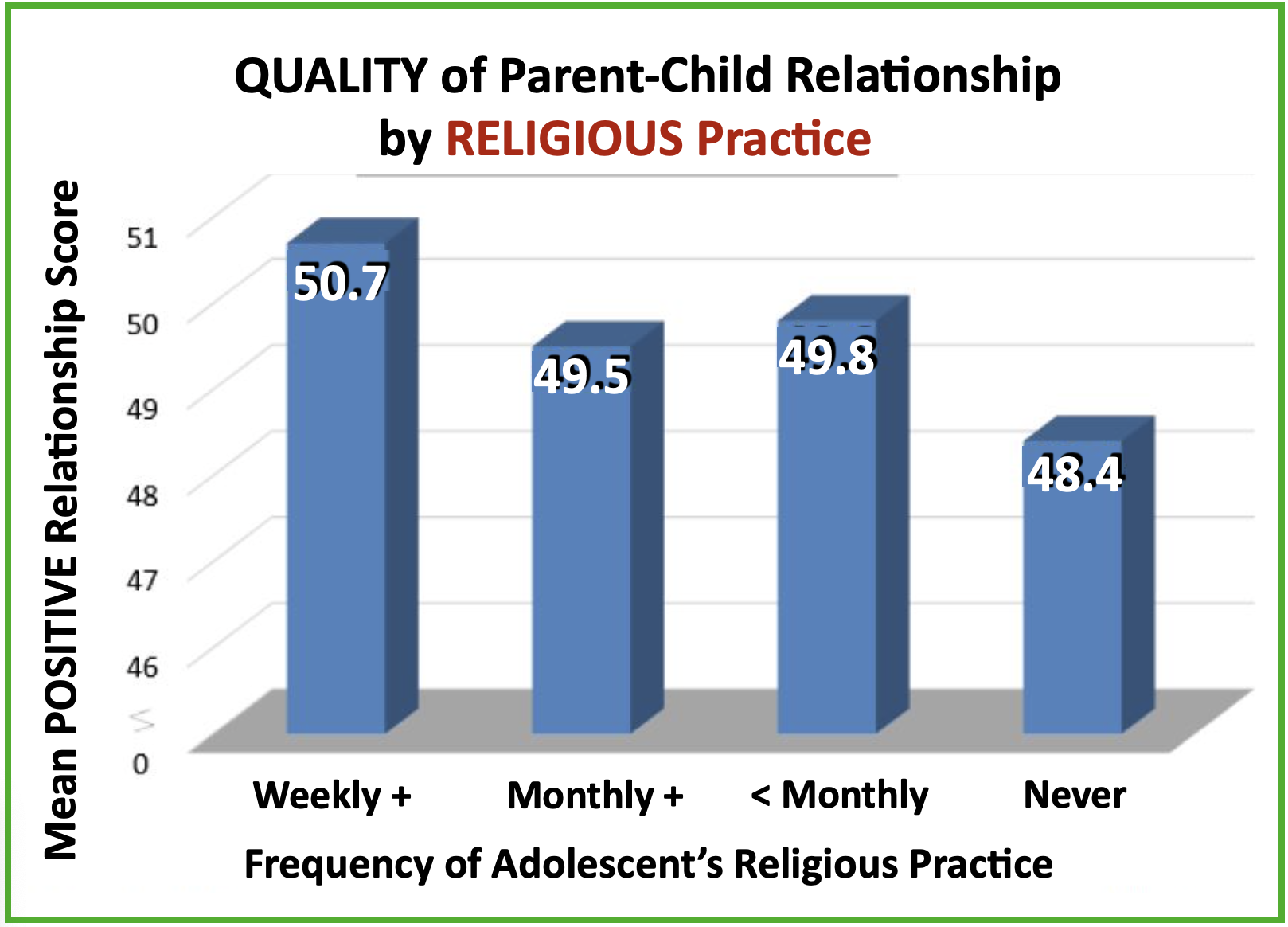 b. Religious Practice: Children who attended religious services at least weekly scored higher on the PPR scale than those who never attended
➤ In between were children who worshipped 1-3x a month, & those who attended less than once a month
 c. Combined – Family Structure & Religious Practice : Children who worshipped frequently & lived with both biological parents or with two adoptive parents had a higher score than those who worshipped less than monthly & lived in single-parent or a reconstituted family
➤ In between were those who lived in intact families but worshipped less than monthly, & those who lived in non-intact families who worshipped at least monthly
OTHER Studies corroborated these findings.
º Single parents “are more likely to yell” at their children, while conservative Protestant parents were less likely to do so
º Fathers in intact families devoted more time to their children & most of their social time consisted of religious activities
CONCLUSION : Combining Religious attendance, Spiritual interest & Intact families are the building blocks of healthy parent-child relationships.
♦️ 2023 UPDATE : Christian Identity & religious affiliation has markedly changes in the last 30 years. While the positive influence of religious participation on the family is still valid ⬆️ , the practice has greatly diminished. The PEW Research Center looked at these changes, (2022), asking “What is your present religion, if any?”.
Theories about why the dis-affiliation has sped up since the ’90s :
— as societal conditions improve & scientific advances allow people to live longer with fewer worries about meeting basic needs, they have less need for religion to cope with insecurity
— the US’s association of Christianity with conservative politics has driven many liberals away from the faith
— declining trust in religious institutions, clergy scandals, rising rates of religious intermarriage, smaller families….
⬇️ Stats are for 1973 to 2017. (MORE….)
«
«
NEXT : SPIRITUALITY (#4)
 HEAL & GROW for ACoAs